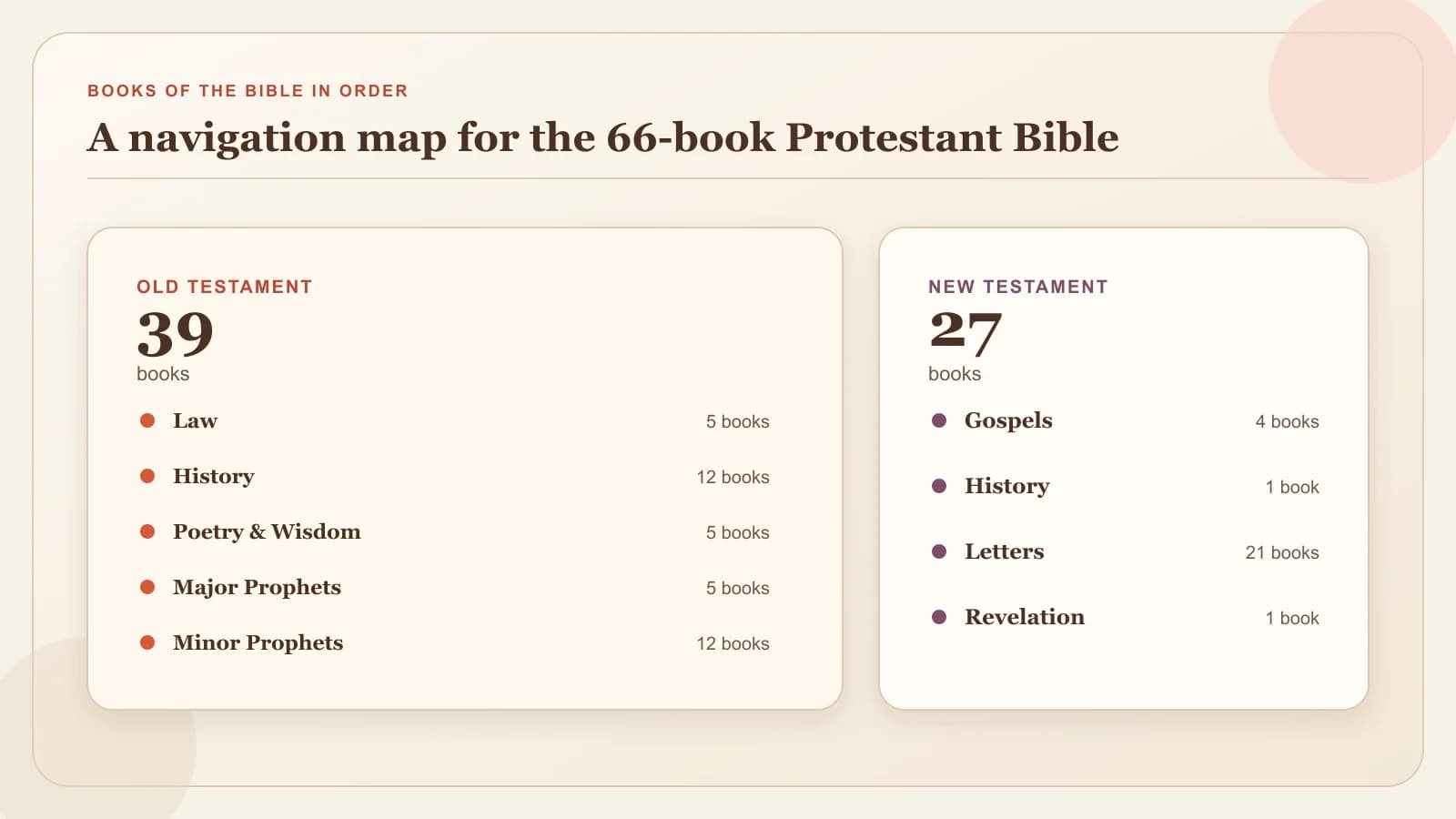
The books of the Bible in order follow a familiar 66-book Protestant sequence: 39 in the Old Testament and 27 in the New Testament. This page lists them in the traditional printed order, grouped into the sections you will see in most study Bibles, so you can find any book quickly and understand where it sits in the whole.
One scope note before the list. Catholic, Orthodox, and Jewish traditions arrange their Scriptures differently, with different Old Testament collections or groupings. This page is a Protestant-order navigation guide. It does not argue for one canon over another, and the group headings below are signposts for finding your way around.
What books are in the Bible, and why the count can differ
When English-speaking readers talk about "the books of the Bible," they usually mean the 66-book collection printed in Protestant Bibles. That collection splits into two testaments: the Old Testament, written before the life of Jesus, and the New Testament, written after.
The count can differ from Bible to Bible for a straightforward reason: Christian traditions did not all settle on identical Old Testament contents. Catholic and Orthodox Bibles include additional Old Testament books or different groupings, while the Jewish Scriptures organize many of the same writings under a different structure. The 27-book New Testament is shared across the Christian traditions compared in the sources at the end of this page.
If your goal is simply to locate a book someone mentioned, the two lists below give you the standard Protestant order with familiar section names.
The Old Testament books in order
The 39 Old Testament books are commonly grouped into five sections. These groupings help you navigate; they describe the kind of writing in each part.
Law
The first five books, sometimes called the Torah or the Pentateuch:
Genesis
Exodus
Leviticus
Numbers
Deuteronomy
Old Testament history
Books that narrate the story of Israel from entering the land through exile and return:
Joshua
Judges
Ruth
1 Samuel
2 Samuel
1 Kings
2 Kings
1 Chronicles
2 Chronicles
Ezra
Nehemiah
Esther
Poetry and Wisdom
Books written largely as poetry, songs, and wisdom sayings:
Job
Psalms
Proverbs
Ecclesiastes
Song of Songs
Major Prophets
The longer prophetic books:
Isaiah
Jeremiah
Lamentations
Ezekiel
Daniel
Minor Prophets
Twelve shorter prophetic books, called "minor" because of their length:
Hosea
Joel
Amos
Obadiah
Jonah
Micah
Nahum
Habakkuk
Zephaniah
Haggai
Zechariah
Malachi
The New Testament books in order
The 27 New Testament books are commonly grouped into four sections. These navigation aids describe the shape of the writings. Questions of authorship or dating call for a different kind of study.
Gospels
Four accounts of the life, death, and resurrection of Jesus:
Matthew
Mark
Luke
John
Acts and the early church
The account of the early church:
Acts
Letters
Letters written to churches and individuals, often divided into the Pauline letters and the general letters:
Romans
1 Corinthians
2 Corinthians
Galatians
Ephesians
Philippians
Colossians
1 Thessalonians
2 Thessalonians
1 Timothy
2 Timothy
Titus
Philemon
Hebrews
James
1 Peter
2 Peter
1 John
2 John
3 John
Jude
Revelation
The closing apocalyptic book:
Revelation
Use the order as a map, not a reading sequence
Canonical order is a conventional arrangement, roughly grouped by type of writing. It helps you find a book; your first reading route can follow a different pace. The legal material early in Exodus and Leviticus can feel dense for a first reader, while a Gospel offers a more manageable place to begin.
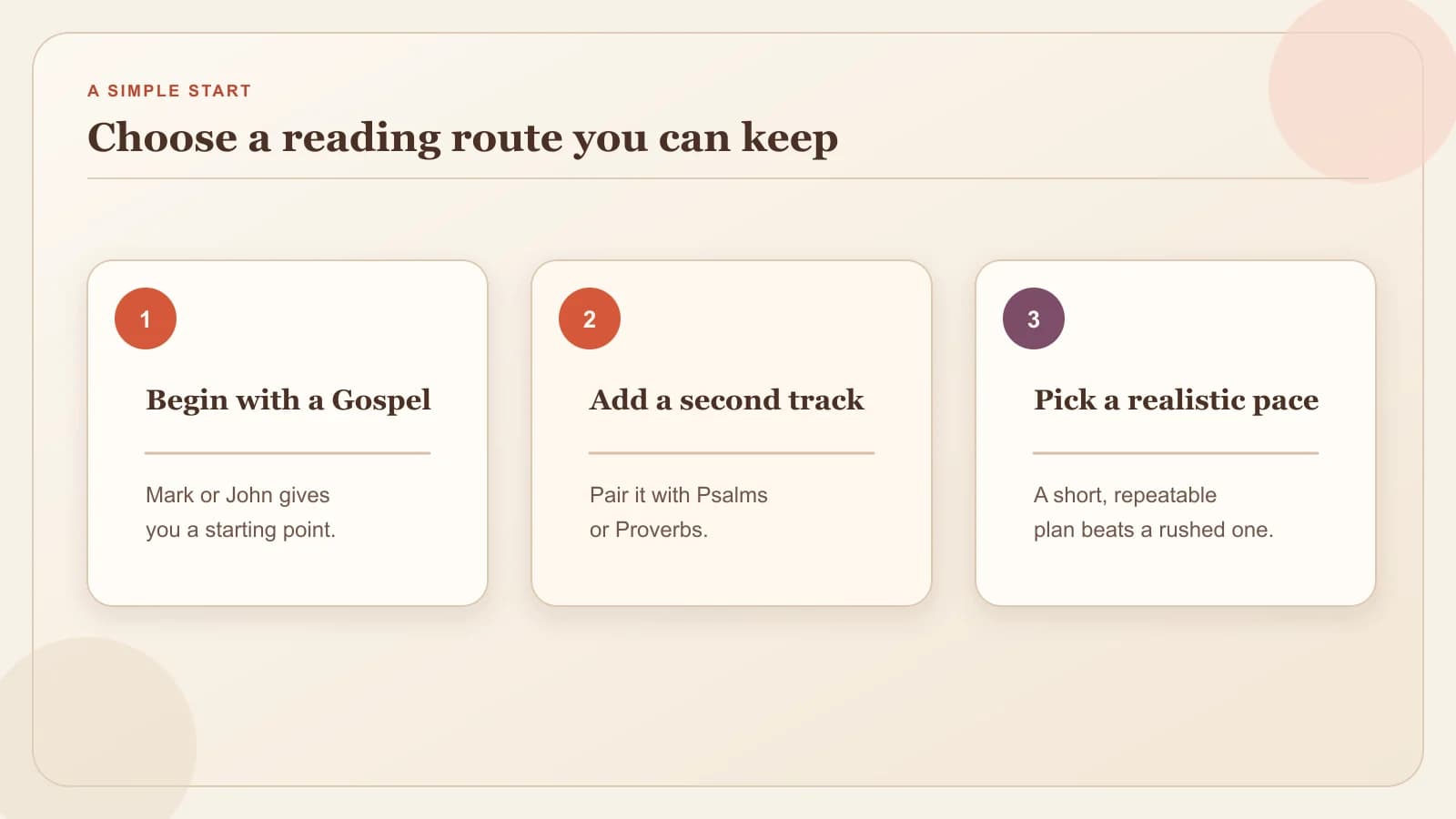
A more manageable approach is to pick a starting book that fits where you are. Many readers begin with one of the Gospels — Mark is short and moves quickly — and then add a wisdom book like Psalms or Proverbs alongside it. Our guide on how to read the Bible walks through how to choose a starting book and build a sustainable habit, and Bible study for beginners lays out a four-week rhythm once you have located the books you want.
The order still earns its place. Knowing that Job sits in Poetry and Wisdom, or that Philemon is a short letter near the end of the New Testament, is what lets you find a passage during a sermon or a study group without fumbling. Learn the sections first; the individual books will follow.
Build a reading path in Bible Note
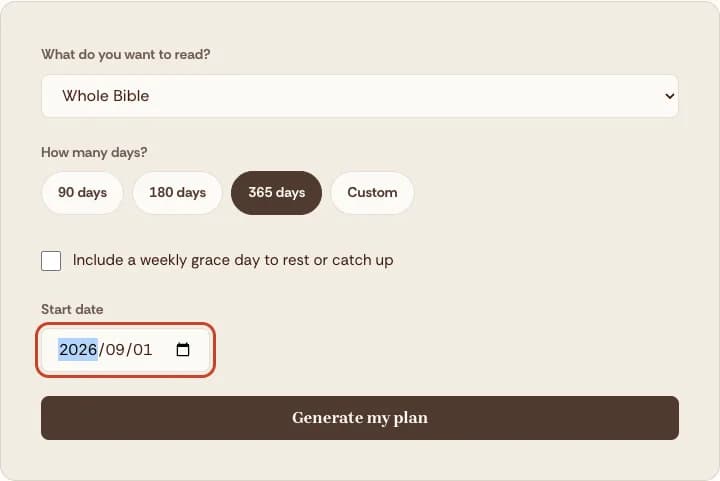
Once you know the layout, the next step is turning one section of it into a plan you can actually finish. The Bible Reading Plan Generator in Bible Note is built for exactly that. You choose a range — the whole Bible, the Old Testament, the New Testament, the Gospels, the wisdom books, an approximate chronological option, or a single book — and then pick a pace of 90, 180, 365, or a custom number of days. The tool splits your choice into verse-balanced daily readings, and you can print the plan, copy it, or track your progress as you read.
The chronological option deserves one honest caveat: it follows an approximate ordering, since the dating of some books is genuinely uncertain. It is a helpful alternate route through the same 66 books, and its dates remain approximate.
Frequently asked questions
Why do some Bibles have more than 66 books?
Christian traditions use different Old Testament collections. Catholic and Orthodox Bibles include additional books or arrange them differently, while the commonly printed Protestant Bible has 39 Old Testament books. The 27-book New Testament is shared across these traditions. When in doubt, follow the table of contents in your own Bible.
Is the list of books in chronological order?
No. Canonical order groups books mainly by type of writing, such as Law, History, Poetry, Prophets, Gospels, and Letters. It is a conventional map for navigation, and reading in this order does not follow the order in which events happened or books were written.
Which book should I start with?
There is no required starting point. Many readers begin with a Gospel such as Mark or John to ground themselves in the life of Jesus, then add Psalms or Proverbs for daily wisdom reading. A short, paced plan makes whichever book you choose easier to finish.
Does the order of books change between translations?
Common English Protestant editions use this familiar 66-book sequence. Translation differences concern the wording of the text itself. The larger canon question is separate: Catholic and Orthodox Bibles may include additional Old Testament books or show a different grouping.
Sources
Editorial status
Written and edited by Hans Keller for Bible Note. Sources, Scripture context, dates, and practical limitations are checked before publication.

About the author
Hans Keller
Editorial & Content Lead
Bible Study & Sermon Learning Content Editor
Hans helps Christians turn sermons and Scripture study into clear notes, thoughtful questions, and faithful next steps.
His work helps listeners and group leaders carry a sermon or study beyond the meeting: back to the passage, into clearer questions, and toward one practical response for the week.
Read with Scripture open
Use this guide alongside the full biblical passage and the practices of your local church. Interpretive details can differ across Christian traditions.
See more Bible Note on Google
Add Bible Note as a preferred source to help find our Bible study guides more easily in Google Search.