
A Bible Chat That Grounds Every Answer in Scripture
Bible Note is a Bible chat app built around what you are actually reading and hearing — ask about the passage in front of you or the sermon you recorded, and get an answer with the Scripture it stands on, the context behind it, and an honest note on what is interpretation.
What you can ask
This AI Bible chat is built for the questions that actually come up when you read Scripture or revisit a sermon — not abstract theology trivia. Three kinds of questions fit best.
Understanding a verse
Follow up on a passage until it actually makes sense.
- “What did Paul mean by "thorn in the flesh"?”
- “Why does Psalm 23 say "valley of the shadow of death" instead of just death?”
- “Does James contradict Paul about faith and works?”
Context and background
Get the historical and literary setting a verse was written into.
- “Who was Onesimus, and why did Paul write Philemon?”
- “Who first received the book of Revelation, and what were they going through?”
- “What did a shepherd actually do all day in ancient Israel?”
Guidance for your situation
Ask for Scripture that speaks into what you are facing this week.
- “What does the Bible say when anxiety about work keeps me up at night?”
- “How do I forgive someone who keeps hurting me?”
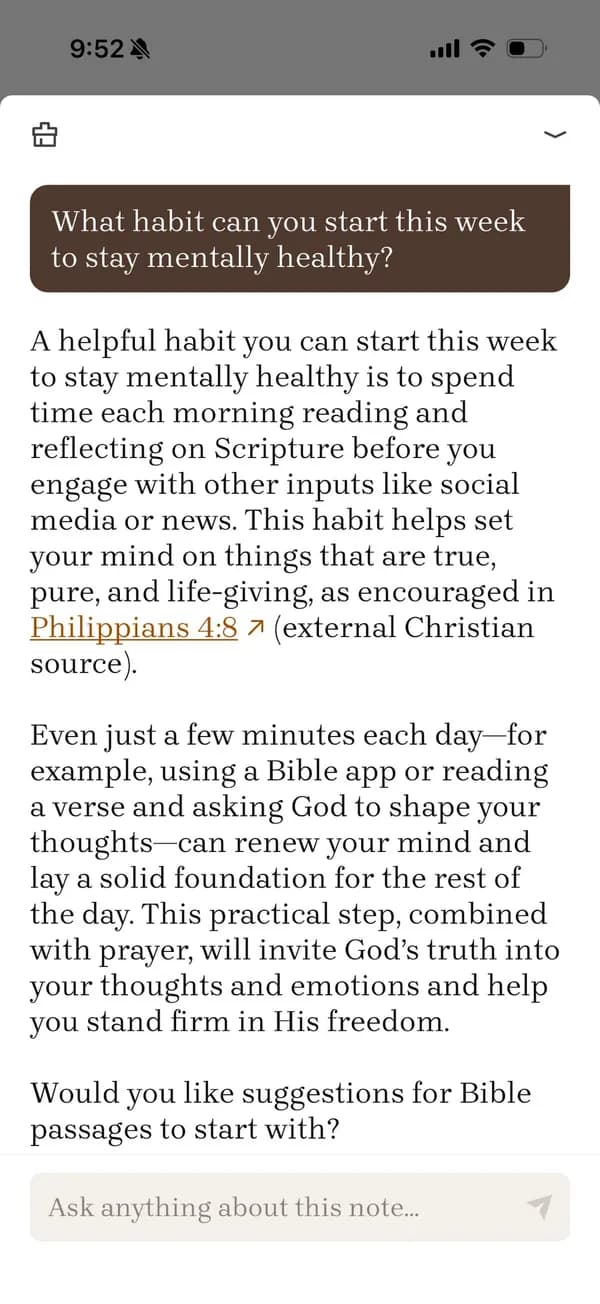
- “Based on Sunday’s sermon, what habit can I start this week to stay mentally healthy?”
How it works
No prompt engineering, no copying verses into a separate chatbot. The conversation starts where your reading already is.
Read a passage, or open a note
Start in the Bible reader with a passage like John 3, or open a sermon note you recorded. That text becomes the context for everything you ask next.
Ask your question right there
Tap Ask on a selected verse, or type straight into the chat under your note. Bible Note already knows which passage or sermon you mean — no need to paste it in.
Get a cited answer, then save it
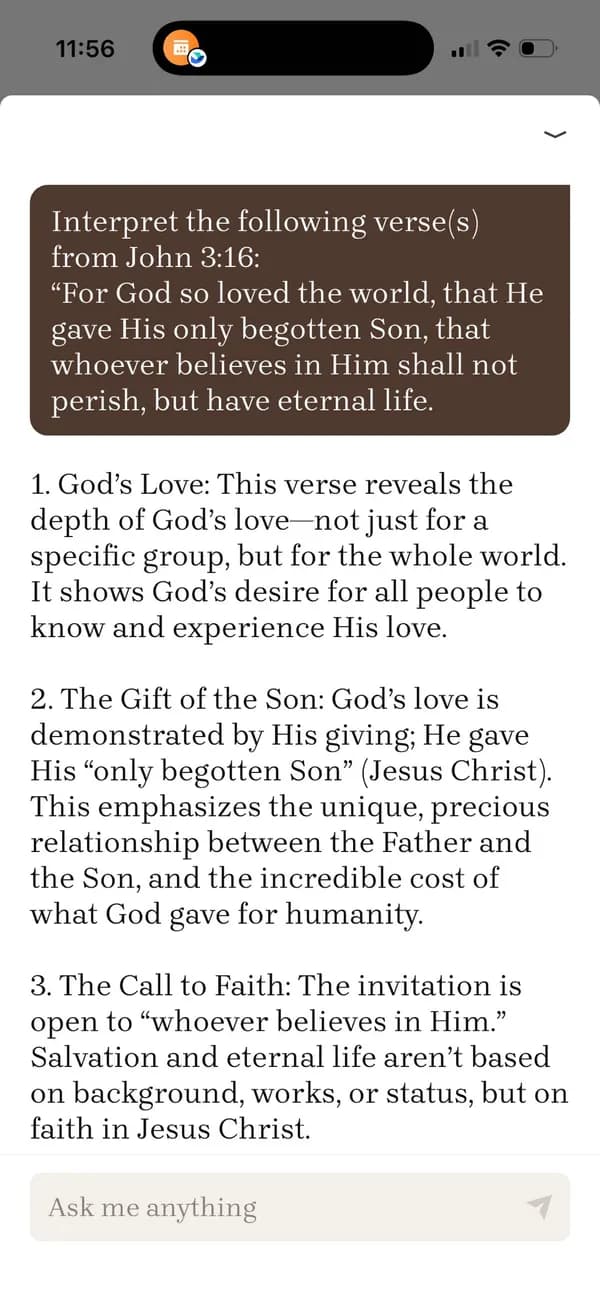
Every answer shows its Scripture references with the translation, marks interpretation as interpretation, and can be saved into a Note so it is still there on Friday.
What a real answer looks like
Here is one complete exchange. Notice the parts: Scripture quoted with its translation, context you can check, interpretation marked as interpretation, and the AI’s own reasoning flagged as inference.
And lest I should be exalted above measure through the abundance of the revelations, there was given to me a thorn in the flesh, the messenger of Satan to buffet me, lest I should be exalted above measure.
Paul writes this near the end of 2 Corinthians, defending his ministry. He has just described being caught up into paradise (12:1–6), and says the thorn was given precisely so that experience would not make him conceited.
Paul never names the thorn. Interpreters have suggested a physical affliction (see his "bodily illness" in Galatians 4:13–15), ongoing persecution ("a messenger of Satan"), or another form of suffering. Scripture deliberately leaves it unnamed — any confident identification goes beyond the text.
God’s answer to Paul was not removal but grace: "My grace is sufficient for you, for power is perfected in weakness" (2 Corinthians 12:9). Whatever the thorn is for you, the passage invites you to bring it to God honestly and expect His strength inside the weakness, not only after it.
Based on the phrase "messenger of Satan" and Paul’s long list of persecutions in 2 Corinthians 11:23–27, I lean toward reading the thorn as opposition to his ministry. This is my inference, not a fact of the text — weigh it against the passages cited above.
Grounded, not generic
A generic Bible AI chat answers from nowhere in particular. Bible Note answers from your passage, your notes, and the text of Scripture — and tells you the difference.
| Dimension | Generic AI chat | Bible Note |
|---|---|---|
| Scripture citations | May quote verses loosely, or not at all | Every answer cites references with the translation |
| Knows what you are reading | You paste text in and hope it keeps up | Starts from your open passage or sermon note |
| Fact vs. interpretation | One confident voice for everything | Labels Scripture, interpretation, and AI inference separately |
| Keep the answer | Lost when the chat scrolls away | Save to a Note and revisit with the original context |
| Where to go next | Ends at the answer | Suggests related passages and further reading |
Honest about its limits
Bible Note’s AI can be wrong. It can misread context, overstate an interpretation, or flatten a debate Christians have held for centuries. That is exactly why every answer carries its citations — so you can open the passage itself and check.
When you use an app to ask Bible questions, you deserve to know what kind of statement you are reading. Bible Note labels what is Scripture, what is interpretation, and what is AI inference, so verification is built in rather than bolted on.
And for the weighty things — doctrine that shapes your life, decisions that affect others, grief that needs a person — take it to Scripture itself and to your pastor or a trusted believer. A Bible chat app is a study companion, not a shepherd.
Where a Bible chat actually helps
Four moments where asking in context beats searching alone.
Stuck in personal reading
A verse stops you mid-chapter. Instead of leaving the app to search, ask right where you are reading and keep going with the context intact.
Small-group discussion backup
A question comes up in the group that nobody can place. Ask for the background and the key passages, and bring the discussion back to the text.
Following up on a sermon
The preacher made a point you want to test or trace. Open your sermon note and ask about it — the chat already knows what was said.
New to the Bible
Without a background in church, every chapter raises five questions. Asking as you read turns confusion into a guided first pass through Scripture.
Frequently asked questions
Is the Bible chat free to use?
You can start using Bible Note’s Bible chat for free. Some advanced features — like heavier usage and the full set of note tools — require a subscription.
Do answers include Scripture references?
Yes. Every answer shows the references it relies on, with the translation labeled, and you can tap through to read the passage yourself. If an answer ever lacks a citation, treat it as unverified.
How is a Bible chat app different from asking ChatGPT?
Three ways: Bible Note starts from the passage you are reading or the sermon note you took, so you never paste context in; it cites Scripture with the translation on every answer; and it labels what is Scripture, what is interpretation, and what is AI inference. You can also save any answer into a Note instead of losing it in a chat history.
Can I ask questions based on my sermon notes?
Yes. Open any sermon note you recorded or imported, and ask the Bible chat about it directly — follow up on a point the preacher made, trace a reference that was mentioned, or turn the message into a habit for the week.
Which Bible translations does it use?
Bible Note lets you read and ask across major English Bible translations, and every citation in an answer shows which translation it comes from, so you always know the source of the wording you are reading.
What if the AI gets something wrong?
It can — that is why every answer ships with citations you can check against the passage itself, and why interpretation and AI inference are labeled separately from Scripture. For weighty questions, verify in the text and talk with your pastor or a trusted believer.