
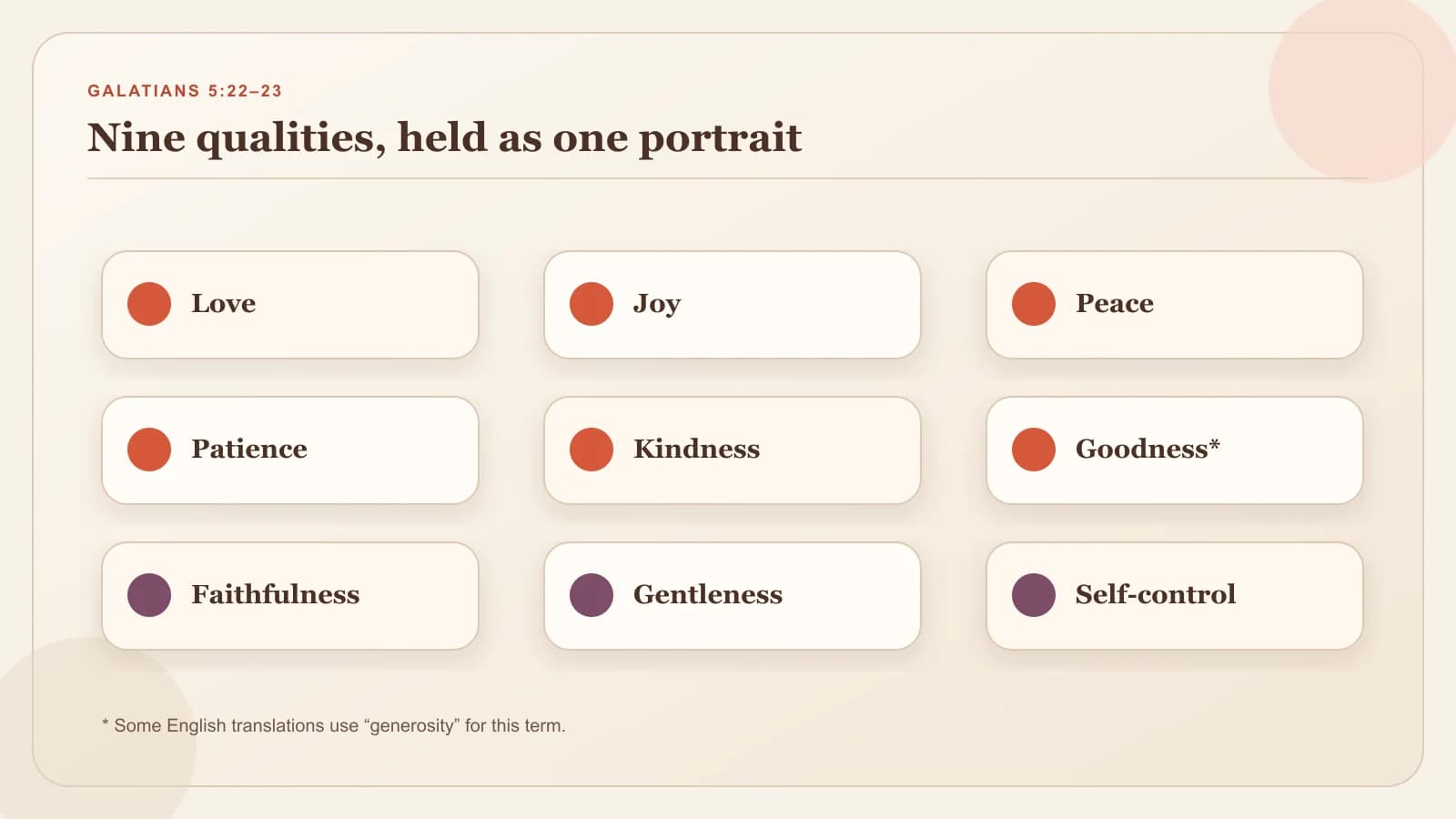
The fruits of the Spirit are the nine qualities Paul names in Galatians 5:22–23: love, joy, peace, patience, kindness, generosity or goodness, faithfulness, gentleness, and self-control. The exact English words vary a little from translation to translation, so read the list in your own Bible and hold any single wording loosely.
Paul places this list inside a larger invitation to live by the Spirit and to serve one another through love. Read in that setting, the nine qualities describe a direction of life that rewards slow attention. This guide gives you the list, shows you the passage around it, and offers one small weekly practice for staying close to the text.
What are the fruits of the Spirit?
The phrase comes from Paul's letter to the Galatians, chapter 5. After writing about freedom and serving one another through love, Paul contrasts two ways of living: one driven by selfish desire, one led by the Spirit. The fruit list in verses 22–23 names what that Spirit-led life grows toward.
Two details are worth noticing. Paul speaks of "fruit" in the singular, as though the nine qualities belong to one shared harvest. And he sets the list inside an exhortation to a community learning to love well, so it functions as a portrait to walk toward.
The nine fruits of the Spirit
The groupings below follow the order of the passage. Each cluster offers a brief study observation as a starting point for your own reading; your translation may word individual terms differently.
Love, joy, and peace
The list opens with love, the quality Paul has just named as the shape of freedom: serve one another through love. Joy follows as deep gladness in God. Peace points to wholeness and settled relationship, with God and with neighbor. Together these three read like the inner atmosphere of a life led by the Spirit.
Patience, kindness, and goodness
The middle three qualities describe how a person treats others over time. Patience is forbearance with people who test you. Kindness is active goodwill that looks for ways to do someone good. The sixth quality appears as "generosity" in some translations and "goodness" in others; either rendering points toward a character that gives freely. These three are easy to admire and slow to grow, which fits Paul's image: fruit ripens over a season.
Faithfulness, gentleness, and self-control
The list closes with three qualities of steadiness. Faithfulness is trustworthiness that keeps promises and stays. Gentleness is strength kept tender, especially toward people who have failed. Self-control names mastery over the impulses the earlier part of the chapter warns against. Read the three as a portrait of durability: a life that can be counted on, handled safely, and steered from within.
Read Galatians 5 in its context
Pulled out of Galatians 5, the nine qualities can harden into a generic virtue checklist; read inside the chapter, they keep their original weight.
The immediate unit runs from verse 13 to verse 26. Paul begins with freedom and its purpose: you were called to freedom, and that freedom expresses itself by serving one another through love. He then describes life by the Spirit in contrast to life driven by selfish desire, and the fruit list arrives as the positive half of that contrast. The unit closes with an appeal to live by the Spirit and keep in step with the Spirit.
A simple way to honor this context is to read all of Galatians 5:13–26 in one sitting before studying any single quality, and to watch how the list sits between the command to love and the appeal to keep in step. For a fuller method, the guide on how to read the Bible in context walks through the discipline step by step. This article stays inside the passage's own claims; larger questions about sanctification belong to your wider study and your community's teachers.
A nine-week practice for patient attention
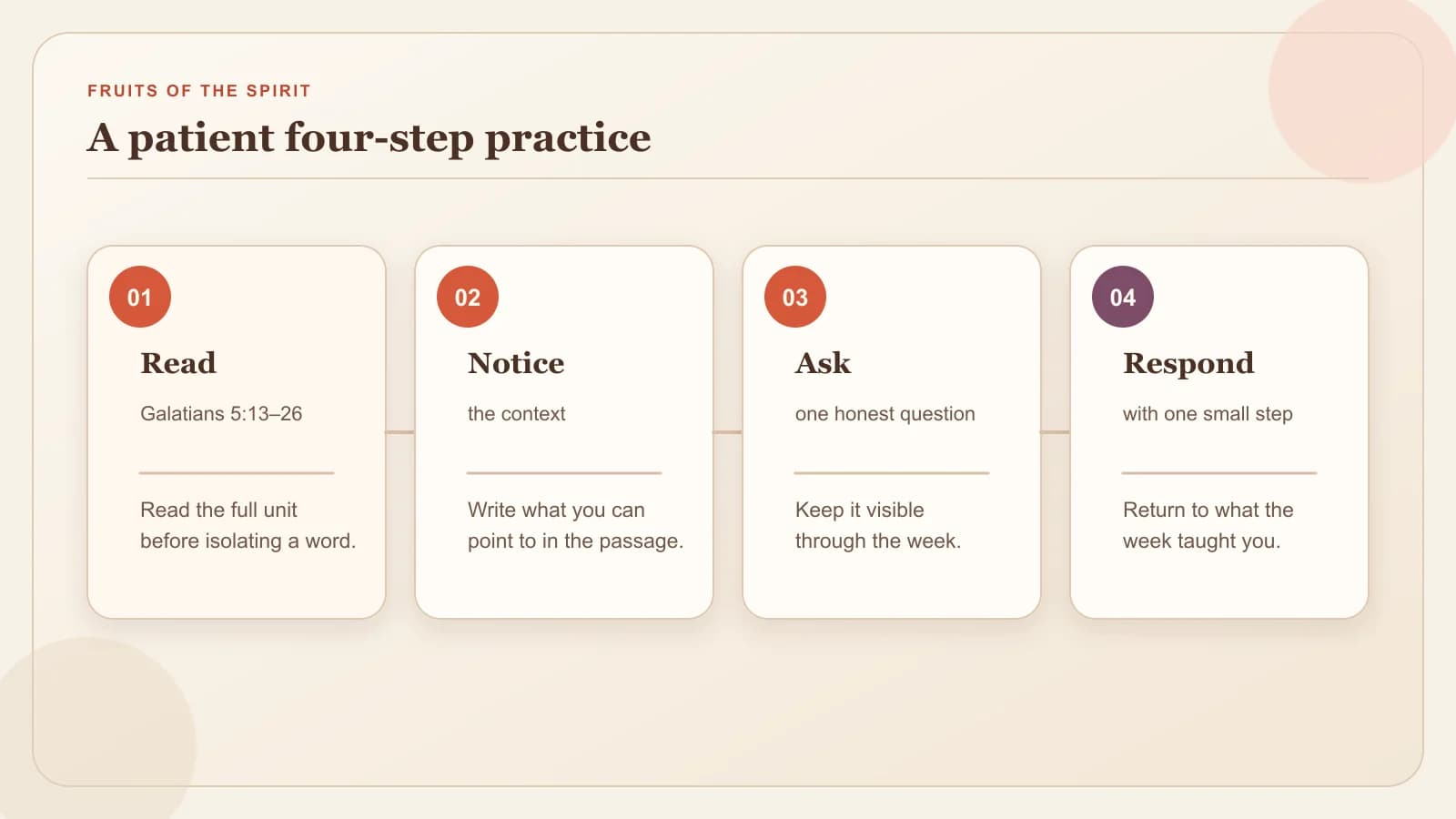
One way to receive this list without flattening it is to give it time. A nine-week rhythm gives one week to each quality, repeating the same four steps. The fruit is the variable; the method stays still.
Read the passage. Begin each week by reading Galatians 5:13–26 aloud or slowly, and copy the week's quality into a notebook along with the exact wording your translation uses.
Notice the context. Write down where the word sits in the sentence and what surrounds it. Observation stays at the level of what you can point to in the text.
Write one honest question. Let the week's quality raise one question you genuinely cannot answer yet. Keep the question visible all week.
Return to one response. At the end of the week, write one small, concrete response the study suggests — a conversation, a habit, a prayer — and record what happened when you tried it.
Nine weeks is long enough for the list to become familiar and short enough to finish, and the notebook ends holding nine pages of observations, questions, and responses you can return to. When you want a wider rhythm, the overview of Bible study methods can help you choose a framework.
Use Bible Note to keep questions close to the passage
The weekly practice produces a question a week, and questions need a home. Bible Note Bible Study Chat fits that need directly: it can start from the passage you currently have open or from a sermon note, so a question about gentleness in Galatians 5 can be asked the same evening it surfaces.
Answers show cited references with translation labels and distinguish Scripture, interpretation, and AI inference, so you can see which kind of statement you are reading. When an answer proves useful, you can save it to a Note beside the week's observations and return to it later.

Bible Note is a study companion, and its AI can be wrong. Read the cited verses in your own Bible, let the passage itself have the final word, and bring weighty questions to trusted believers or a pastor.
Frequently asked questions
Are there nine or twelve fruits of the Spirit?
Galatians 5:22–23 names nine qualities, and that is the list this article covers. If you see a longer list elsewhere, check the source it names; that discussion goes beyond the wording of Galatians 5:22–23.
Why do Bible translations use slightly different words?
Translation teams make different judgment calls when rendering Greek terms into English. One team may choose "generosity" where another chooses "goodness" for the same word. Reading the passage in your own translation and noting where another differs is a sound habit.
How can I study one fruit this week?
Pick one quality, read Galatians 5:13–26 once, and copy the sentence that contains your word. Write one honest question about it, carry that question through the week, and close with one small response you can actually attempt. Repeat the same shape with the next quality when you are ready.
Does this list measure my faith?
Paul offers the list as a portrait of life by the Spirit, an invitation to walk in that direction. Reading it as a pass-fail test adds a use the passage itself does not announce. Let the list guide attention and prayer, and bring deep struggles about assurance to trusted believers or a pastor.
Sources
Editorial status
Written and edited by Hans Keller for Bible Note. Sources, Scripture context, dates, and practical limitations are checked before publication.

About the author
Hans Keller
Editorial & Content Lead
Bible Study & Sermon Learning Content Editor
Hans helps Christians turn sermons and Scripture study into clear notes, thoughtful questions, and faithful next steps.
His work helps listeners and group leaders carry a sermon or study beyond the meeting: back to the passage, into clearer questions, and toward one practical response for the week.
Read with Scripture open
Use this guide alongside the full biblical passage and the practices of your local church. Interpretive details can differ across Christian traditions.
See more Bible Note on Google
Add Bible Note as a preferred source to help find our Bible study guides more easily in Google Search.