


Ten minutes into a small-group meeting, the leader looks down at a page crowded with questions. The group is still talking about the first paragraph of the passage. That is not necessarily a failed plan. It may be the first sign that people are reading carefully instead of racing through a worksheet.
The best small group Bible study questions move in a simple order: observation, interpretation, and application. They help the group notice what the passage says, understand its main idea in context, and choose a faithful response. Prepare more questions than you expect to use, then select six to ten that fit the passage, the people, and the time available. A good meeting does not finish every question. It gives the group a clearer view of the text and one response worth carrying into the week.
Use a three-part framework for every passage
Start with the passage itself. InterVarsity describes inductive Bible study through three movements: observation, interpretation, and application. Observation gathers what is actually present. Interpretation connects those details to context and purpose. Application asks how the discovered meaning should shape belief, action, relationships, or prayer.
The sequence gives a group a shared path without turning the meeting into a lecture. Treat it as a guardrail rather than a script. A careful observation may raise an interpretation question immediately, and an application question may send everyone back to reread a verse. The leader's task is simply to keep those movements connected so that personal responses remain accountable to the passage.

Decide the meeting aim before choosing questions
Before writing the question list, complete one sentence: “By the end of the discussion, the group should understand _ and consider _.” The first blank names the passage's central idea. The second names a possible response. If the sentence remains fuzzy, spend ten more minutes with the passage before opening a question bank or commentary.
That small pause prevents two common problems. It keeps an interesting but secondary detail from taking over the meeting, and it keeps the leader's favorite topic from being attached to a passage that is not addressing it. Cru's small-group preparation guide makes a similar recommendation: decide what participants should understand and how they might respond before selecting the questions.
Start with observation questions everyone can enter
Observation questions put everyone's attention in the same place: the words on the page. They give a first-time participant a way into the conversation without requiring specialist vocabulary or church history. They also slow down experienced readers who may already have an interpretation in mind.
Choose four or five from this list, then keep only the ones that expose important details:
Who speaks, acts, receives, resists, or changes in the passage?
What happens immediately before and after this section?
Which words, ideas, commands, promises, or contrasts repeat?
What cause-and-effect relationships can you find?
What surprises you about the order of events?
What does the writer emphasize through an example, question, or comparison?
What do we learn about the audience's situation?
Where does the tone appear to shift?
Which detail would be easy to miss on a quick reading?
How would you summarize the passage in one neutral sentence?
Wording matters. “Why were the disciples so faithless?” has already reached a verdict. “What do the disciples say and do in this scene?” lets the group gather evidence first. A later question can explore fear, trust, motive, or misunderstanding with the details still visible.
Use follow-ups instead of answering your own question
When someone notices a detail, leave a little room before explaining it. A short follow-up is often enough:
Where do you see that in the passage?
What else supports that observation?
Does anyone notice a related contrast?
How would you phrase that in your own words?
These prompts keep the Bible open and make the discussion collaborative. They also communicate something important: a contribution matters because it helps the group read carefully, not because it happens to match the leader's notes.
Move into interpretation without forcing one response
Interpretation asks what the observed details mean within the passage's literary and historical setting. A study Bible, a book overview, or another responsible reference may help here. Bring enough context to make careful discussion possible. There is no need to unload every fact you found during preparation; the group is studying a passage, not sitting an exam on your browser history.
Useful interpretation questions include:
What problem, question, or situation is the writer addressing?
How does the surrounding paragraph clarify this verse?
What does this command, image, or promise contribute to the main idea?
Why might the original audience have needed to hear this?
What does the passage reveal about God, people, faith, or community?
How do the beginning and ending of the passage relate?
Which explanation accounts for the most details in the text?
What misunderstanding does the writer appear to correct?
What tension remains after our first reading?
How would you explain the main idea to someone who missed the meeting?
Some passages have genuine interpretive disagreements. A loaded question will not make the disagreement disappear. Name the scope instead: “Christians have understood this phrase in more than one way. What evidence in the immediate context supports each reading?” If the issue requires expertise the group does not have, write it down for later research. A careful unanswered question is better than a quick answer that outruns the text.
Replace disguised teaching points with discoverable questions
A disguised teaching point sounds like this: “Don't you think this shows that we should always be more generous?” The sentence ends with a question mark, but it is still asking for agreement. Cru distinguishes closed or limiting questions from open questions and notes that open questions create more room for participants to think and respond.
Try this sequence instead:
What action or attitude does the passage commend?
What reason does the writer give for it?
What would that principle look like in the situation the original audience faced?
Where might we encounter a comparable decision?
The leader can still clarify context or correct a claim that materially contradicts the text. Openness does not mean every interpretation is equally well supported. It means participants have room to reason from shared evidence before the leader offers a summary.
Ask application questions that stay anchored to meaning
Application should not begin with “What does this verse mean to you?” as though meaning were created by each reader. Start with the meaning the group has identified in context, then ask what kind of response follows from it.
Use questions such as:
Which belief or assumption does this passage challenge?
What response does the writer call for?
Where is this response difficult in ordinary life?
What is one specific action that fits the passage's main idea?
Is there a relationship that needs a different posture or conversation?
What would obedience look like this week, not only someday?
What support or accountability would make that next step more concrete?
How might the group pray in response to what we have seen?
What would be an application that sounds spiritual but misses the passage?
What question should we carry into the week?
One precise next step is usually more useful than five vague intentions. “Be more loving” is difficult to revisit. “Before Friday, listen without interrupting during one conversation I normally rush” is concrete enough to remember and discuss again without turning the group into a performance review.
Build a question ladder that invites participation
A healthy discussion needs more than one entry point. If every question requires theological vocabulary, new readers may stay quiet. If every question asks for an obvious fact, experienced readers may stop listening. A simple question ladder begins with a visible detail, connects it to the passage's meaning, and then invites a response.

For example:
Notice: What changes between the first and final scene?
Connect: How does that change support the writer's main point?
Respond: Where does that same truth confront or encourage us?
Make room without putting people on the spot
Participation is not the same as disclosure. “Where might someone experience this tension?” can open a discussion before the more personal “Where do you experience it?” A member may pass, answer generally, or speak privately after the meeting. That freedom is part of a safe discussion, not an obstacle to a deep one.
Leaders can also widen participation through simple practices:
pause long enough for people to think;
invite a second voice before giving your summary;
ask dominant speakers to help make room for others;
let pairs discuss a question before returning to the whole group;
thank someone for an honest uncertainty without rushing to remove it;
redirect gossip or confidential details before they become group content.
Cru's guidance on group discussion treats listening as part of leading, not a break between questions. Rephrasing what you heard and checking whether you understood can be more useful than asking the next prepared question.
Plan a flexible 60-minute discussion
A meeting plan protects time for reading, discussion, and response. It should give the leader a sense of direction without forcing the group to finish every prepared question.
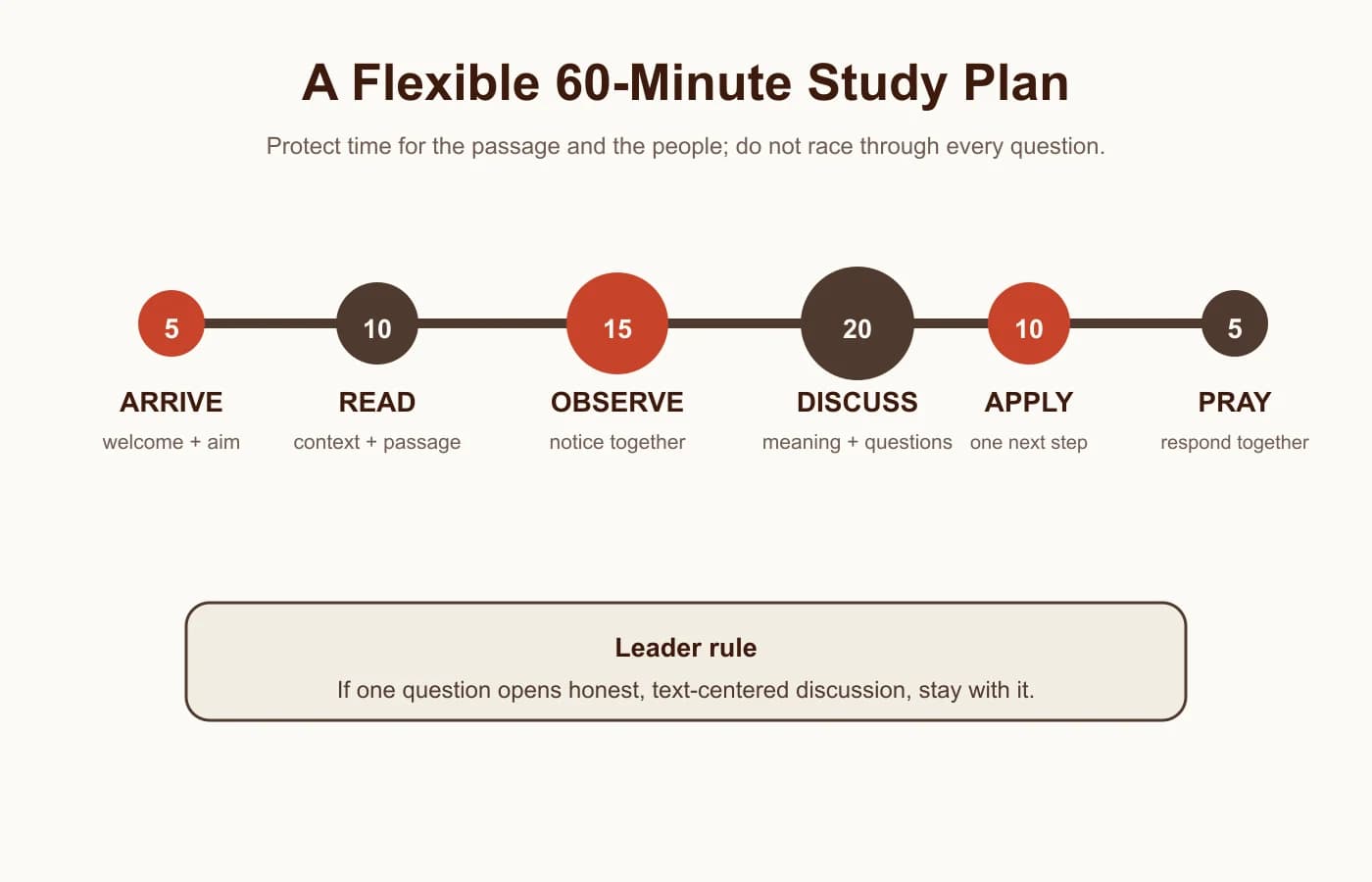
Try this starting rhythm:
5 minutes — arrive: welcome people and state the aim.
10 minutes — read: give essential context and read the passage, perhaps twice.
15 minutes — observe: ask two or three questions that surface important details.
20 minutes — interpret: explore the main idea and one meaningful tension.
10 minutes — apply: choose one response and pray from the passage.
Real conversation will not follow the clock exactly. If an observation question produces honest, text-centered discussion, stay with it. If the group is stuck, rephrase the question, point to a smaller section, or let everyone reread silently. A few quiet seconds are not an emergency.
If you are preparing from a sermon, the free sermon notes template includes a Small Group format that can help you collect the passage, key idea, questions, and next steps before the meeting. For a lighter opening activity, one round of the Bible trivia quiz can get people looking up Scripture references together without replacing the study itself.
Avoid six common question-writing mistakes
Too many questions
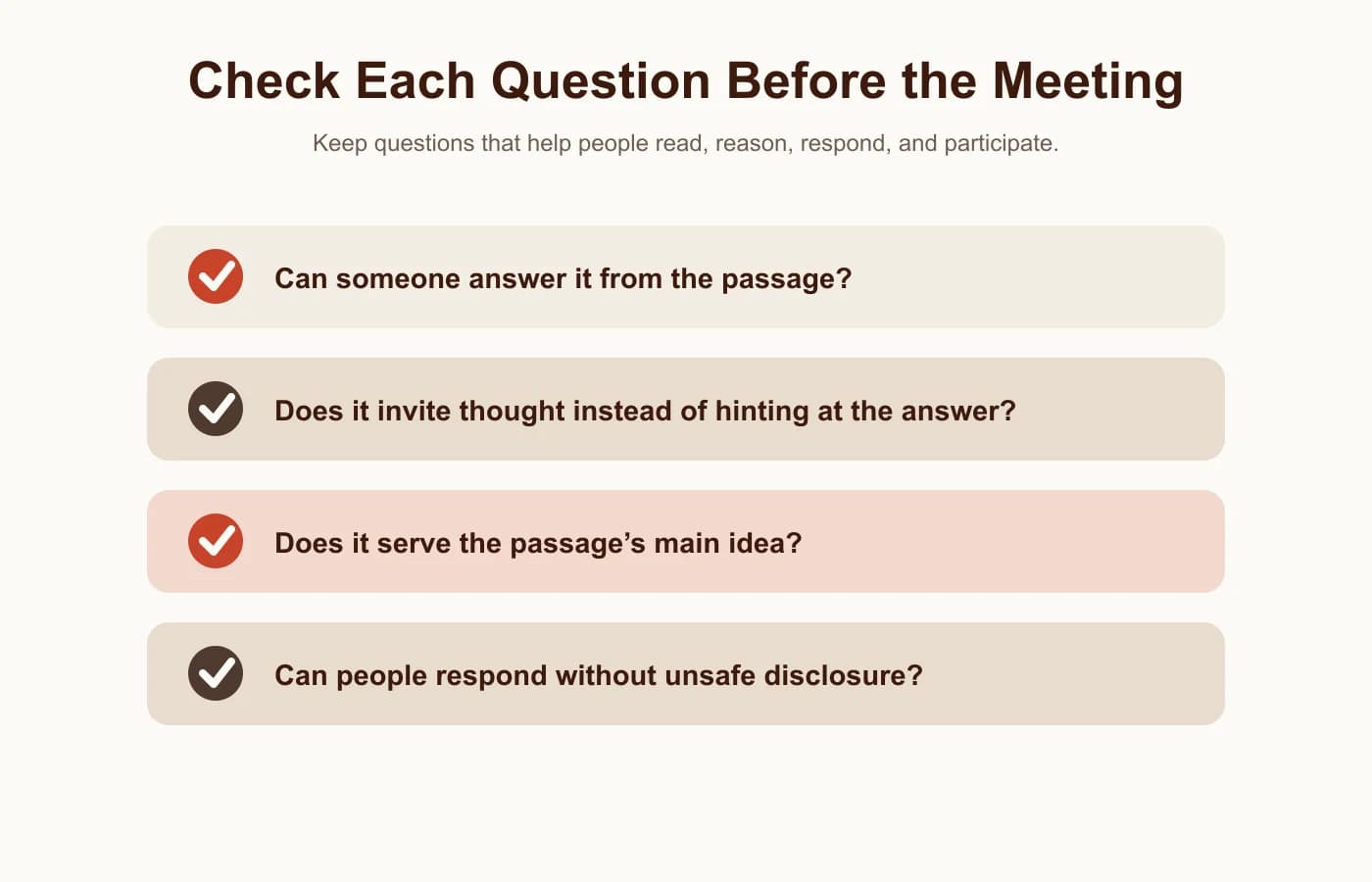
A long list can make the leader hurry and the group feel examined. Mark each question as essential, useful, or optional. Ask the essential questions first and let the rest wait without apology.
Questions that contain the answer
If the expected answer is hidden in the wording, rewrite the prompt. Replace “Why is prayer obviously the most important response?” with “What responses appear in the passage, and what priority does the writer give them?”
Application before context
Personal experience can dominate before the group understands the text. Begin with observation, establish the main idea, and then ask for response.
Abstract questions without evidence
“What is faith?” may become a collection of definitions. “How does this paragraph describe faith?” gives the group a shared source.
Questions that require unsafe disclosure
Do not pressure people to reveal trauma, conflict, finances, health, or private prayer details. Offer a voluntary path and protect confidentiality.
Correcting every imperfect sentence
Not every imprecise phrase needs an immediate mini-sermon. Ask, “What in the passage leads you there?” Correct what materially distorts the text, and let smaller wording problems improve as the group keeps reading.
Keep the questions and takeaways together
After the meeting, keep four things: the passage, the question that opened the best discussion, the group's main insight, and one next step. That small record is usually more useful than a transcript of every comment. It also gives the next meeting a natural opening: “What did we carry from last week?”
A notebook can hold that record perfectly well. Bible Note is useful when you want Scripture-focused notes, questions, and follow-up in one place where they are easier to revisit. It does not decide what a passage means for the group, and generated suggestions still need to be checked against Scripture and responsible context.
Frequently asked questions
How many questions should a small group Bible study use?
Six to ten well-chosen questions are a useful starting range for a one-hour meeting. Prepare backups, but prioritize the questions that reveal the passage's main idea and lead to one clear response.
What are the three basic types of Bible study questions?
Observation asks what the text says, interpretation asks what it means in context, and application asks how that meaning should shape belief or action.
Should a Bible study leader answer every question?
No. A leader should provide needed context, correct serious errors, and summarize key discoveries, while giving participants time to read, think, and respond.
How do I get quiet members to participate?
Begin with answerable observation questions, allow silence, use pairs before whole-group discussion, and invite rather than pressure. Give everyone permission to pass on personal questions.
What should I do when the discussion goes off topic?
Acknowledge the connection, then return to the passage with a focused prompt such as, “Which part of the text helps us answer that?” Record important side questions for later.
Can I use the same questions for every Bible passage?
The observation, interpretation, and application framework can repeat, but the actual questions should follow the genre, context, structure, and central concern of each passage.
For the next meeting, begin with one modest step: read the passage once without writing questions. Then write the single observation question that would help everyone slow down and notice what is actually there. Build the rest from that.
Sources
Leading Inductive Bible Study — InterVarsity's overview of observation, interpretation, and application.
How to Ask Really Good Questions — Cru's distinction between closed, limiting, and open questions.
How to Guide a Meaningful Group Discussion — Cru's practical guidance on exploration questions and listening.
Preparing the Small Group Lesson — Cru's preparation sequence and question-selection guidance.
Editorial status
Written and edited by Hans Keller for Bible Note. Sources, Scripture context, dates, and practical limitations are checked before publication.

About the author
Hans Keller
Editorial & Content Lead
Bible Study & Sermon Learning Content Editor
Hans helps Christians turn sermons and Scripture study into clear notes, thoughtful questions, and faithful next steps.
His work helps listeners and group leaders carry a sermon or study beyond the meeting: back to the passage, into clearer questions, and toward one practical response for the week.
Read with Scripture open
Use this guide alongside the full biblical passage and the practices of your local church. Interpretive details can differ across Christian traditions.
See more Bible Note on Google
Add Bible Note as a preferred source to help find our Bible study guides more easily in Google Search.