
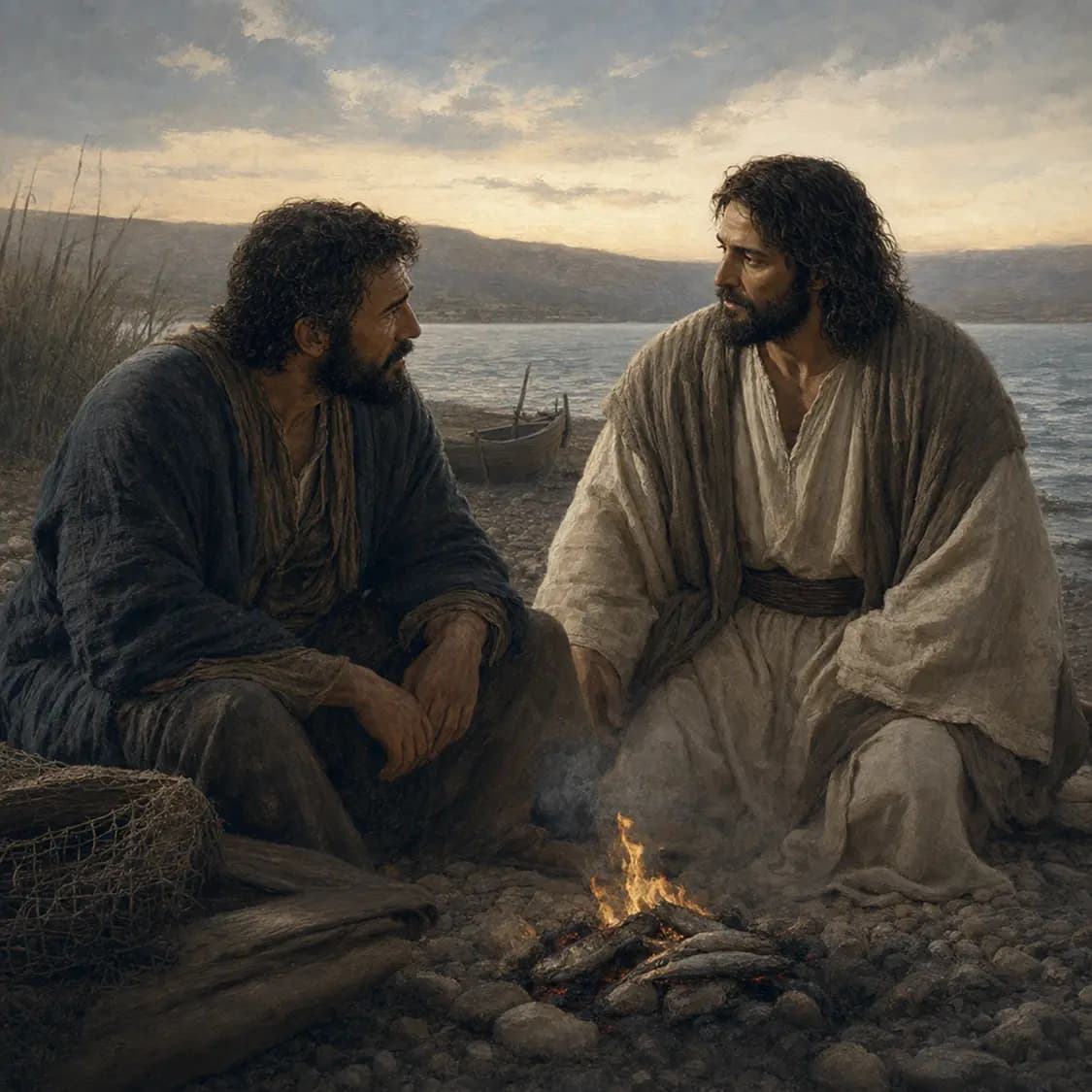
Read the story
Context
Jesus had risen from the dead and had already appeared to his disciples. They knew he was alive, but some unfinished matters remained. Simon Peter carried a particularly painful history: on the night Jesus was arrested, Peter had denied knowing him three times.
The scene now shifts to the Sea of Tiberias, also known as the Sea of Galilee. There, after an unsuccessful night of familiar work, Peter would meet the risen Jesus again—and hear what Jesus still asked of him.
Story
Simon Peter was with Thomas, Nathanael, the sons of Zebedee, and two other disciples. Peter announced that he was going fishing, and the others joined him. They went out in a boat and worked through the night, but they caught nothing.
As morning came, Jesus stood on the shore. The disciples could see someone there, but they did not recognize him. He called out and asked whether they had caught any fish.
“No,” they answered.
He told them to cast the net on the right side of the boat. They did, and suddenly the net held so many fish that they could not pull it into the boat.
The disciple whom Jesus loved recognized what had happened. He said to Peter, “It is the Lord!”
As soon as Peter heard that, he put on his outer garment and plunged into the water. The other disciples followed in the boat, dragging the heavy net behind them, since they were not far from land.
When they came ashore, they found a charcoal fire with fish cooking over it, and bread beside it. Jesus told them to bring some of the fish they had just caught. Peter went aboard and hauled the net onto the shore. It held 153 large fish, yet even with so many, the net had not torn.
Jesus invited them to breakfast. None of the disciples dared to ask who he was; they knew it was the Lord. Jesus took the bread and gave it to them, and he did the same with the fish. This was the third time he had appeared to his gathered disciples after rising from the dead.
After breakfast, Jesus turned to Peter and asked, “Simon, do you love me more than these?”
Peter answered, “Yes, Lord. You know that I love you.”
Jesus told him, “Feed my lambs.”
A second time, Jesus asked, “Simon, do you love me?”
Again Peter said, “Yes, Lord. You know that I love you.”
Jesus answered, “Care for my sheep.”
Then Jesus asked him a third time, “Simon, do you love me?”
Peter was grieved that Jesus had asked him this for the third time. He replied, “Lord, you know everything. You know that I love you.”
Jesus told him once more, “Feed my sheep.”
Jesus then spoke about the cost Peter would face. When Peter was younger, he had dressed himself and gone wherever he wanted. But when he grew old, he would stretch out his hands, and someone else would dress him and lead him where he did not want to go. These words pointed to the kind of death by which Peter would glorify God.
Then Jesus said to him:
“Follow me.”
What We Learned
- The risen Jesus meets his disciples in their emptiness and provides what their long night of effort could not produce.
- Peter’s failure did not have the last word. Jesus addressed him personally and entrusted him with responsibility instead of casting him aside.
- Peter’s love for Jesus was to take visible form through caring for Jesus’ people—feeding his lambs and tending his sheep.
- Following Jesus may be costly. Peter was called to remain faithful even on a path that would lead to suffering and death.
Story background
Jesus Restores Peter is read in John 21:1-19. At the Sea of Tiberias, seven disciples fish all night without success. The account also draws attention to restoration and love expressed in care. Its named people, setting, and sequence matter, while details not stated in the passage should remain open rather than being supplied from later retellings. Read the scene in its surrounding movement: notice what prompts the action, how the central figures respond, and what the final words leave with the hearer. This background keeps the story close to its explicit claims while making room for careful reflection on restoration, love expressed in care, and the other themes named here. The passage can be revisited slowly, with its questions and tensions intact.
People in the story
- Jesus — Provides the catch, shares breakfast, entrusts Peter with care for his people, and calls him to follow
- Simon Peter — Fishes with the disciples, recognizes Jesus' identity through another disciple, and answers Jesus' three questions
- The disciple whom Jesus loved — Recognizes the man on the shore as the Lord
- Thomas, Nathanael, the sons of Zebedee, and two unnamed disciples — Fish with Peter and share the shore meal
Themes to notice
Restoration
The passage brings restoration into focus through its named people, actions, and ending.
Love expressed in care
The passage brings love expressed in care into focus through its named people, actions, and ending.
Calling
The passage brings calling into focus through its named people, actions, and ending.
Costly discipleship
The passage brings costly discipleship into focus through its named people, actions, and ending.
Questions for reflection
- What stands out to you about restoration in this passage?
- How do the people in the story respond to love expressed in care?
- Which detail would you want to read again in its wider context?
- What question does this account leave you carrying?
Related stories
Carry the story with you
Save your reflections on jesus restores peter and revisit them as you continue through Scripture.