


Maybe you have tried to read straight through the Bible and stalled somewhere in the long legal sections, or the familiar passages have gone blurry and the larger storyline is hard to trace. A friend mentions Joseph or Deborah, and you realize you could not easily say where their stories sit or how they connect.
This 30 day Bible story reading plan offers a steadier way in. For the next thirty days, read one complete Bible story each day, in order, moving from creation and covenant through deliverance, judges, kings, and wisdom. Each day below gives you the passage, a link to the story in Bible Note's published collection, one sentence of orientation, and one question to carry with you. The time needed varies with the passage, your reading pace, and whether you also use the linked story or audio.
How this 30-day Bible story plan works
Each entry names the passage in your own Bible, links to the matching story in the Modern Bible Stories collection for the full published text and audio, and closes with one reflection question. You need a Bible, a few quiet minutes, and somewhere to write a sentence.
A few habits make the month work better:
Read the passage first. Open your Bible to the listed reference before the retelling. The story pages help you follow the narrative; the passage itself stays primary.
Keep one appointment. Attach the reading to something fixed, such as breakfast or the commute, so the habit survives busy weeks.
Write one sentence. Answer the day's question in a single sentence. Thirty short answers become a record you can reread.
Miss a day without quitting. If a day slips, resume with the next story in sequence. The plan has no penalty box.
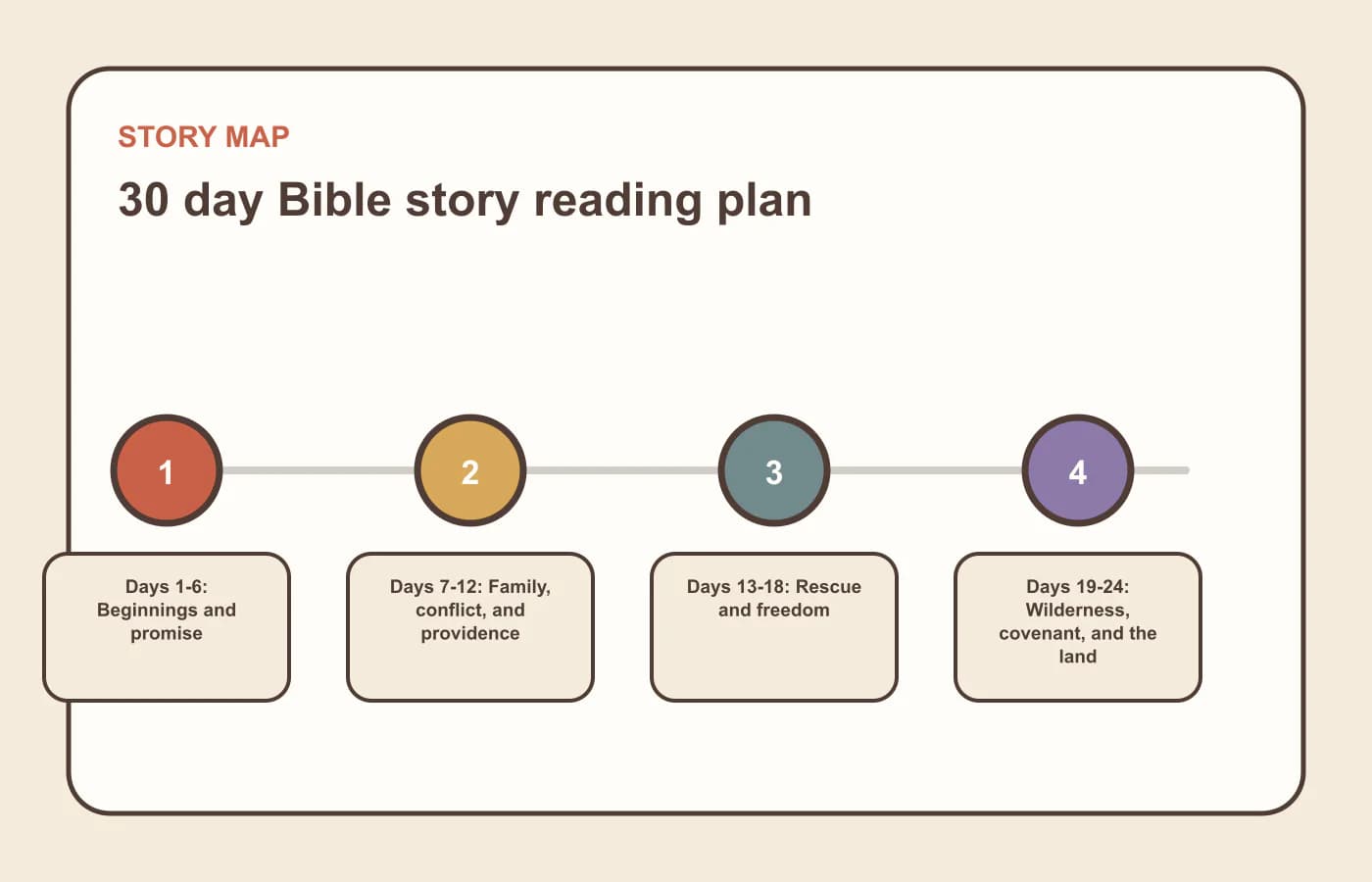
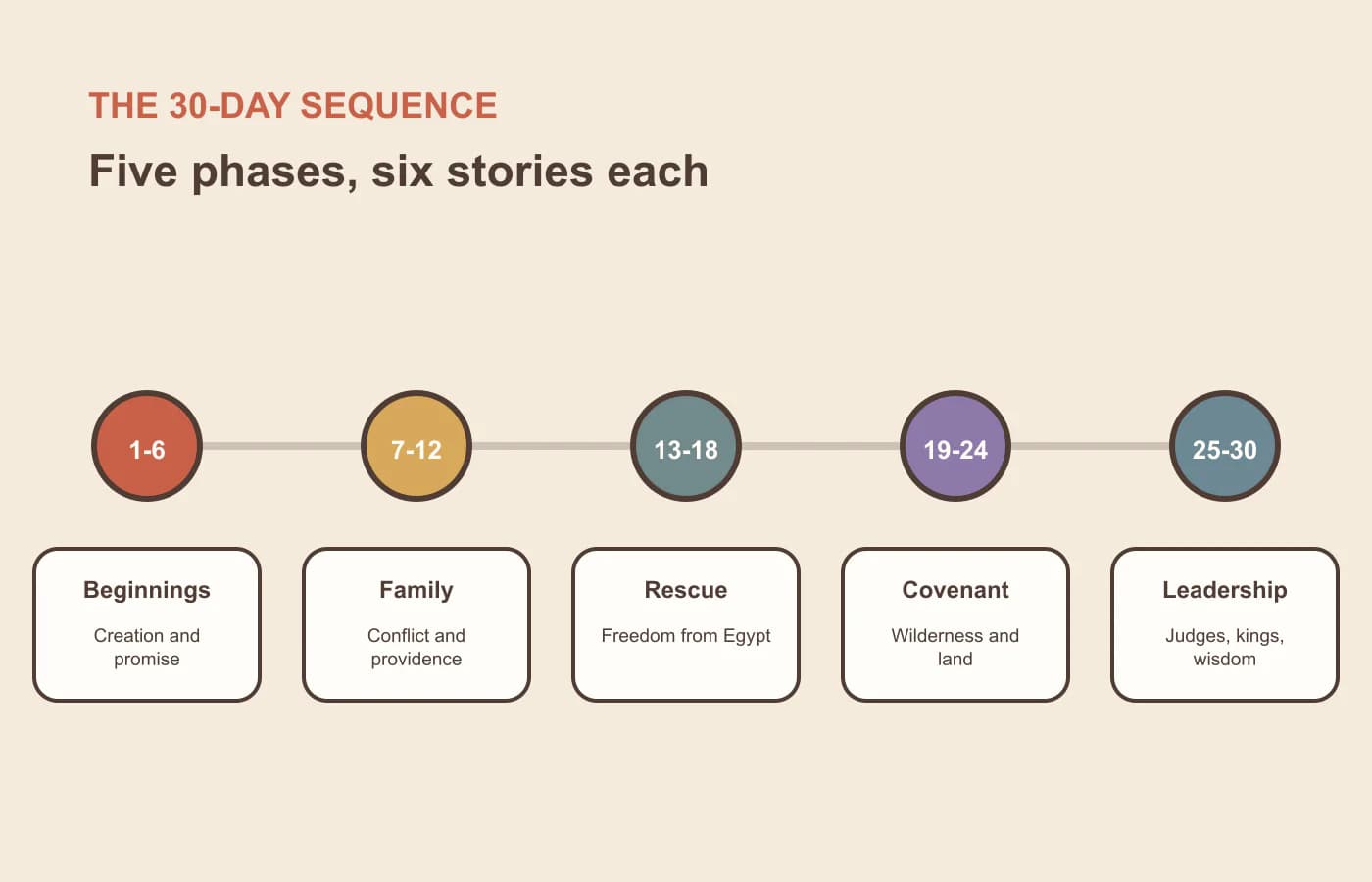
The thirty stories come in five groups of six, each with its own thread. Watching one thread at a time keeps the month coherent.
Days 1-6: Beginnings and promise
The opening week covers the widest ground: the world itself, the first human choice, a flood, and the start of one family's unlikely promise. As you read, notice where promise and human failure appear together in the passages.
Day 1: The Creation of the World
Read Genesis 1:1-2:3, then the creation story. God speaks an ordered, good world into being, makes humanity in his image, and rests on the seventh day. Question: What does the repeated verdict of "good" say about how God regards what he made?
Day 2: Adam and Eve's Choice
Read Genesis 2:4-3:24, then Adam and Eve's story. Placed in a garden with trust, work, and one limit, the first pair reaches for what was withheld. Question: Where do you see trust and responsibility held together?
Day 3: Noah, the Flood, and the Rainbow Covenant
Read Genesis 6:5-9:17, then Noah's story. Judgment falls on a violent world, yet God preserves a family and binds himself to a covenant sign. Question: How does the rainbow change the way the story ends?
Day 4: God Calls Abram and Makes a Covenant
Read Genesis 12:1-15:21, then the story of Abram's call. An aging man leaves home carrying a promise, and God formalizes it in a covenant. Question: What does Abram's obedience look like before the promise is visible?
Day 5: Abraham and Sarah's Promised Son
Read Genesis 17:1-21:7, then the story of Isaac's birth. After decades of waiting, the promised child finally arrives. Question: What does the long delay add to the way you read God's promise?
Day 6: Abraham Offers Isaac
Read Genesis 22:1-19, then the story of the test on the mountain. God asks for the unthinkable and provides a substitute at the last moment. Question: How does that provision reshape the way you read the test?
Days 7-12: Family, conflict, and providence
The second week stays inside one family across four generations, then steps back to Job. Deception, favoritism, and betrayal all appear, and God's purposes move forward through them.
Day 7: Jacob's Deception and Dream at Bethel
Read Genesis 27:1-28:22, then Jacob's story. Jacob secures a blessing through deceit, flees, and meets God in a dream on the road. Question: What does God's appearance to a fleeing deceiver show about who takes the initiative?
Day 8: Jacob Wrestles with God and Reconciles with Esau
Read Genesis 32:1-33:20, then the story of the wrestling and reunion. Before facing the brother he wronged, Jacob wrestles until daybreak and limps away renamed. Question: How do the wrestling and the reunion belong to the same story?
Day 9: Joseph Is Sold by His Brothers
Read Genesis 37:1-36, then the story of Joseph and the pit. A father's favoritism and a teenager's dreams end in a cistern and a slave caravan. Question: Which family patterns from earlier Genesis stories repeat here?
Day 10: Joseph Rises from Prison to Power in Egypt
Read Genesis 39:1-41:57, then Joseph's rise in Egypt. Through slavery, false accusation, and a forgotten prison term, Joseph keeps honoring God until Pharaoh listens. Question: What stays consistent in Joseph's conduct across promotion and injustice?
Day 11: Joseph Reunites with His Brothers
Read Genesis 42:1-46:34, then the reunion story. Famine drives the brothers to Egypt, where the brother they sold now holds power and chooses forgiveness. Question: How does Joseph describe God's role in what his brothers did?
Day 12: Job Seeks God in Suffering
Read Job 1:1-2:13 and Job 38:1-42:17, then Job's story. A blameless man loses nearly everything, endures the accusations of friends, and hears God answer from the whirlwind. Question: What do you notice about the answer God actually gives?
Days 13-18: Rescue and freedom
The third week follows Israel out of Egypt, from a hidden baby to bread on the desert ground. Notice how slowly rescue unfolds, and how often the rescued struggle to believe it.
Day 13: Baby Moses Is Rescued
Read Exodus 1:8-2:25, then the story of Moses' rescue. Under a royal death decree, a hidden infant floats to safety and grows up between two worlds. Question: Who shows quiet courage here, and at what risk?
Day 14: The Burning Bush
Read Exodus 3:1-4:17, then the burning bush story. God meets a fugitive shepherd in a flame that keeps burning and sends him back to Egypt. Question: How does God answer each of Moses' objections?
Day 15: Moses Confronts Pharaoh
Read Exodus 5:1-10:29, then the confrontation with Pharaoh. Plague after plague presses a stubborn king to release a people he refuses to lose. Question: What pattern do you notice in Pharaoh's responses as the pressure grows?
Day 16: The First Passover
Read Exodus 11:1-12:42, then the first Passover story. A final night of judgment and deliverance becomes a meal Israel is commanded to keep eating. Question: Why does God tie this rescue to a repeated meal?
Day 17: Crossing the Red Sea
Read Exodus 13:17-15:21, then the Red Sea crossing. Trapped between water and an army, Israel walks through the sea and sings on the far shore. Question: What does the song in chapter 15 add to the narrative?
Day 18: God Provides Food and Water in the Wilderness
Read Exodus 15:22-17:7, then the story of manna and water. Complaints rise in the desert, and bread arrives with the morning dew, one day at a time. Question: What can daily provision teach that a single rescue cannot?
Days 19-24: Wilderness, covenant, and the land
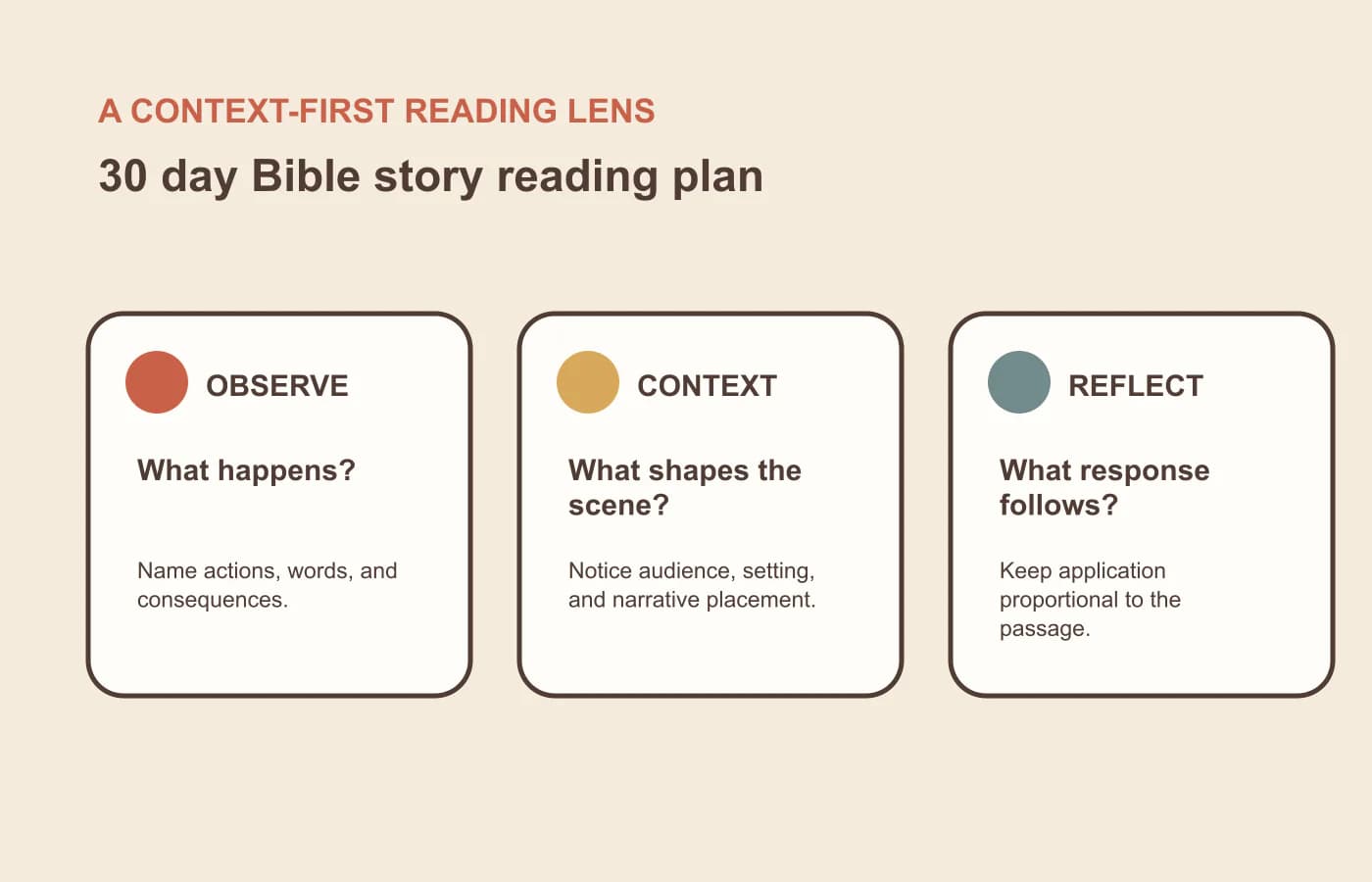
The fourth week holds sharp contrasts: covenant given and broken, spies who trust and spies who spread fear, a farewell, and a city's fall. Keep three lenses separate as you read: what the text says happened, what it meant for Israel then, and what you take from it now.
Day 19: The Ten Commandments at Mount Sinai
Read Exodus 19:1-24:18, then the Sinai story. At a trembling mountain, God speaks the words that will shape Israel's life with him and with one another. Question: How does the covenant setting change the way you hear the commands?
Day 20: The Golden Calf and the Renewed Covenant
Read Exodus 32:1-34:35, then the golden calf story. Impatience at the mountain's base becomes idolatry, intercession, and a covenant made again. Question: What does Moses' intercession reveal about his role?
Day 21: The Twelve Spies and Israel's Fear
Read Numbers 13:1-14:45, then the story of the twelve spies. Twelve men walk through the same land; ten spread fear, two urge trust, and a generation turns back. Question: What separates Caleb and Joshua's report from the other ten?
Day 22: Moses Says Farewell and Commissions Joshua
Read Deuteronomy 31:1-34:12, then Moses' farewell. Moses blesses the tribes, hands leadership to Joshua, and dies within sight of a land he will not enter. Question: How does an unfinished journey shape his goodbye?
Day 23: Rahab Helps the Spies
Read Joshua 2:1-24, then Rahab's story. In Jericho, a woman hides Israel's scouts on her roof and asks for mercy, confessing what she has heard about their God. Question: What does Rahab already know, and what does she do with it?
Day 24: The Fall of Jericho
Read Joshua 5:13-6:27, then the fall of Jericho. Israel marches in silence for days, the walls collapse, and Rahab's household is spared as promised. Question: Where do obedience and mercy intersect in this account?
Days 25-30: Judges, kings, and wisdom
The final week covers leaders: a judge under a palm tree, a reluctant farmer, a loyal widow, a praying mother, a shepherd facing a giant, and a king who asks for the right thing. The plan ends with Solomon's wisdom in 1 Kings 3.
Day 25: Deborah Leads Israel
Read Judges 4:1-5:31, then Deborah's story. A prophetess and judge summons a hesitant commander, and deliverance arrives through an unexpected hand. Question: Who receives the credit in Deborah's song, and why?
Day 26: Gideon and the Three Hundred
Read Judges 6:1-7:25, then Gideon's story. A man threshing wheat in hiding watches God shrink his army to three hundred before the battle. Question: Why might God reduce Gideon's strength first?
Day 27: Ruth and Boaz
Read Ruth 1:1-4:22, then Ruth's story. A Moabite widow's loyalty carries her to Bethlehem, where kindness and a kinsman's redemption restore her family line. Question: How do ordinary decisions move this story toward redemption?
Day 28: Hannah's Prayer and God's Call to Samuel
Read 1 Samuel 1:1-3:21, then Hannah and Samuel's story. A grieving woman's prayer opens the way for a new leader in Israel, and a boy learns to answer when God speaks. Question: How do Hannah's surrender and Samuel's listening echo each other?
Day 29: David and Goliath
Read 1 Samuel 17:1-58, then David and Goliath's story. An untested shepherd faces a champion with five stones and a settled conviction about who fights for Israel. Question: How does David describe the battle differently from the soldiers around him?
Day 30: Solomon Asks for Wisdom
Read 1 Kings 3:3-28, then Solomon's story. Offered anything he wants, Israel's new king asks for discernment, and a famous ruling shows that gift at work. Question: What does Solomon's request reveal about how he understands his role?
What to notice after each story
Thirty stories can blur together if every day ends with a generic moral. A better close is one honest observation. Four questions keep that observation grounded, and they work for any story in the plan:
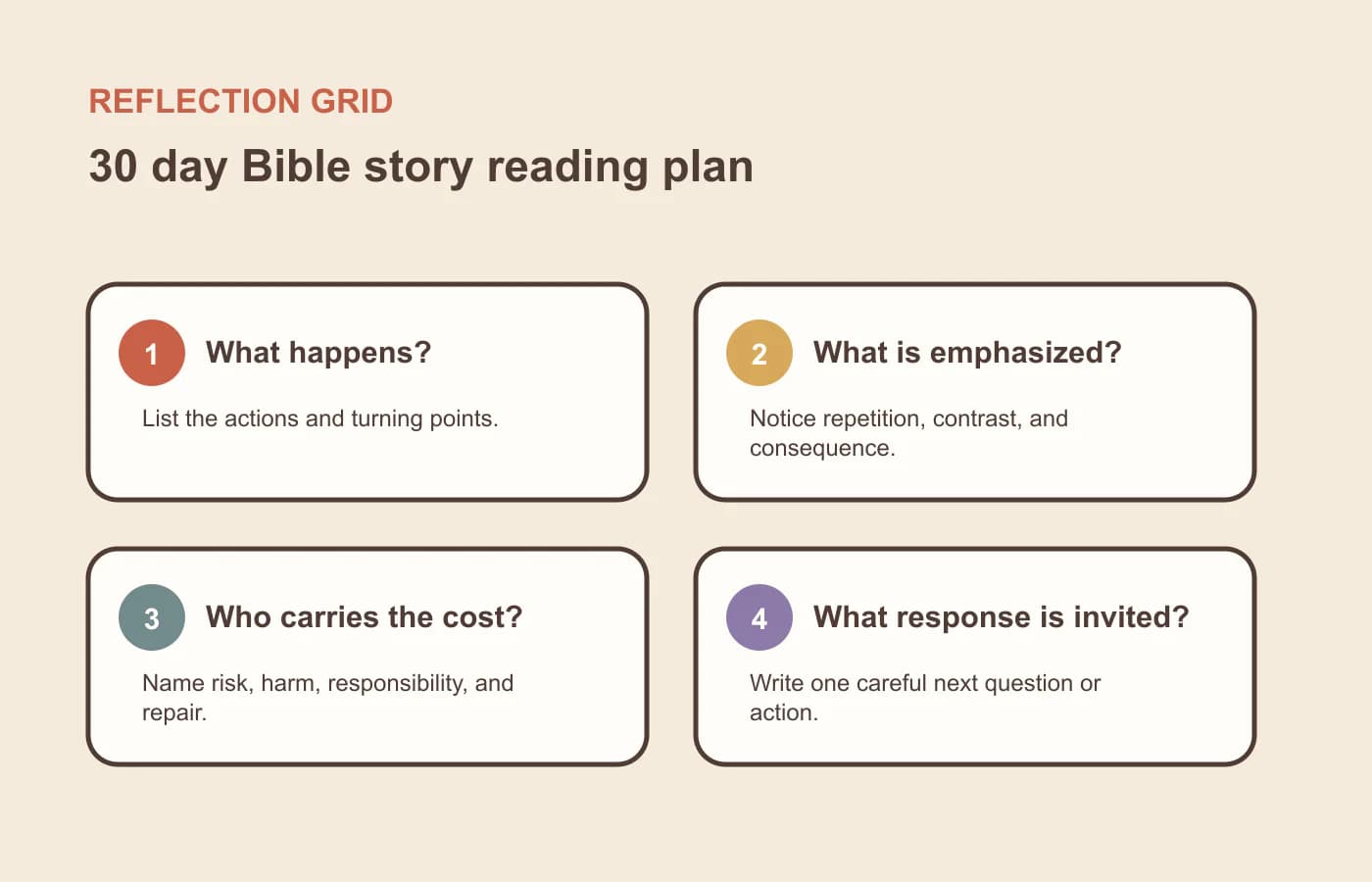
What happened? Name the setting, the people, and the turn of events before drawing any lesson.
What did it mean then? Ask what this moment meant for Israel, or for this family, inside the larger promise.
Where does God act? Look for where the story credits God, whether in dramatic rescue or quiet provision.
What stays with me? Choose one sentence to carry into the day, written while it is still specific.
These questions follow the same order as a careful approach to reading the Bible in context: the passage first, its original setting second, and your response last. To keep the habit durable, a simple method for taking notes while you read the Bible helps you separate observations and questions from conclusions.
When to build a custom Bible reading plan
A fixed thirty-story plan suits a reader who wants the Old Testament narrative spine in one focused month. You may want something different: a week instead of a month, ninety days, a specific start date, or a scope that includes the New Testament.
For that, Bible Note's custom Bible reading plan generator lets you choose the scope, set a duration from 7 to 1,000 days, and pick a start date, then print, copy, or keep a checklist locally on your device. The thirty stories above stay where they are; return to them whenever the schedule fits.
Frequently asked questions
Do I have to start on the first of a month?
No. Start on any day and keep the sequence. The plan's value is in the order of the stories, so begin today and let the calendar follow you.
How much time does each day take?
It depends on the passage, your reading pace, and whether you also read the linked story or use its audio. Leave enough time for one written sentence rather than trying to meet a fixed number of minutes.
Does this plan cover the whole Bible?
No, and it is not meant to. It follows the narrative spine from Genesis 1 through 1 Kings 3, ending with Solomon. For the New Testament or a full-Bible schedule, use the custom generator to set a wider scope.
What should I do if I miss a day?
Simply continue with the next story in sequence. There is nothing to make up; a plan you resume on day nine still finishes all thirty stories.
Sources
Selected Bible passages for this plan, WEB — the passage references behind each day, checked against the World English Bible. This article quotes no translation directly.
Bible Note Modern Bible Stories — the published collection behind each day's linked story, with full text and audio.
Editorial status
Written and edited by Hans Keller for Bible Note. Sources, Scripture context, dates, and practical limitations are checked before publication.

About the author
Hans Keller
Editorial & Content Lead
Bible Study & Sermon Learning Content Editor
Hans helps Christians turn sermons and Scripture study into clear notes, thoughtful questions, and faithful next steps.
His work helps listeners and group leaders carry a sermon or study beyond the meeting: back to the passage, into clearer questions, and toward one practical response for the week.
Read with Scripture open
Use this guide alongside the full biblical passage and the practices of your local church. Interpretive details can differ across Christian traditions.
See more Bible Note on Google
Add Bible Note as a preferred source to help find our Bible study guides more easily in Google Search.