

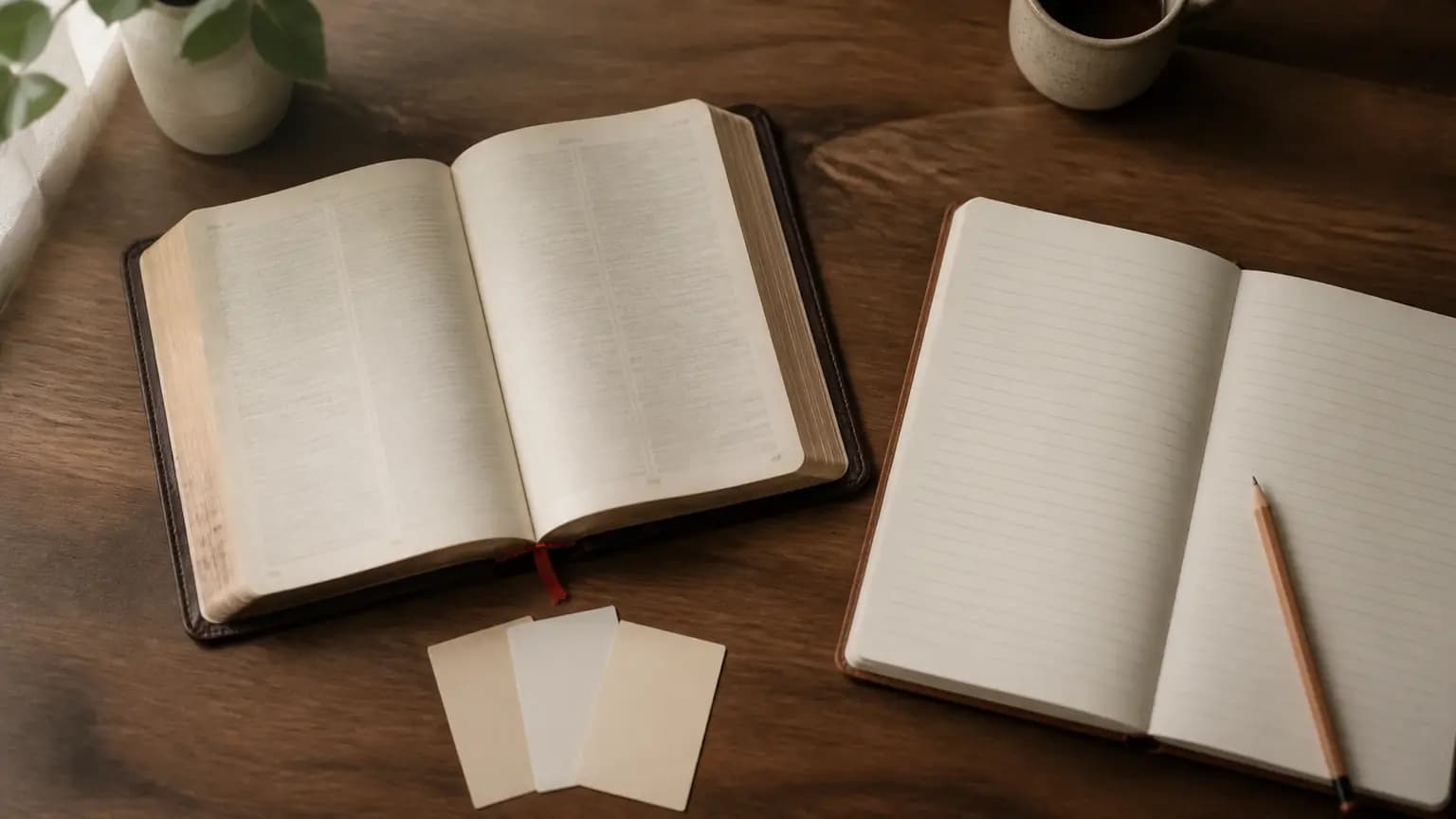
An open Bible can make a blank page feel more demanding than it needs to be. Here is how to take notes on the Bible with a simple four-part note: begin with one short passage, record what you see, save the context you need, write the questions that arise, and name one response you can revisit.
That method works in a wide-margin Bible, a notebook, or a digital note. Keep the passage reference, observations, questions, and response together so the next reading has a clear place to begin.
Start with a small passage and a simple note page
Begin with a paragraph or another complete unit of thought. Read it once without writing, then read it again with a pencil or note page ready. A shorter passage gives new note-takers room to notice details while keeping the session manageable.
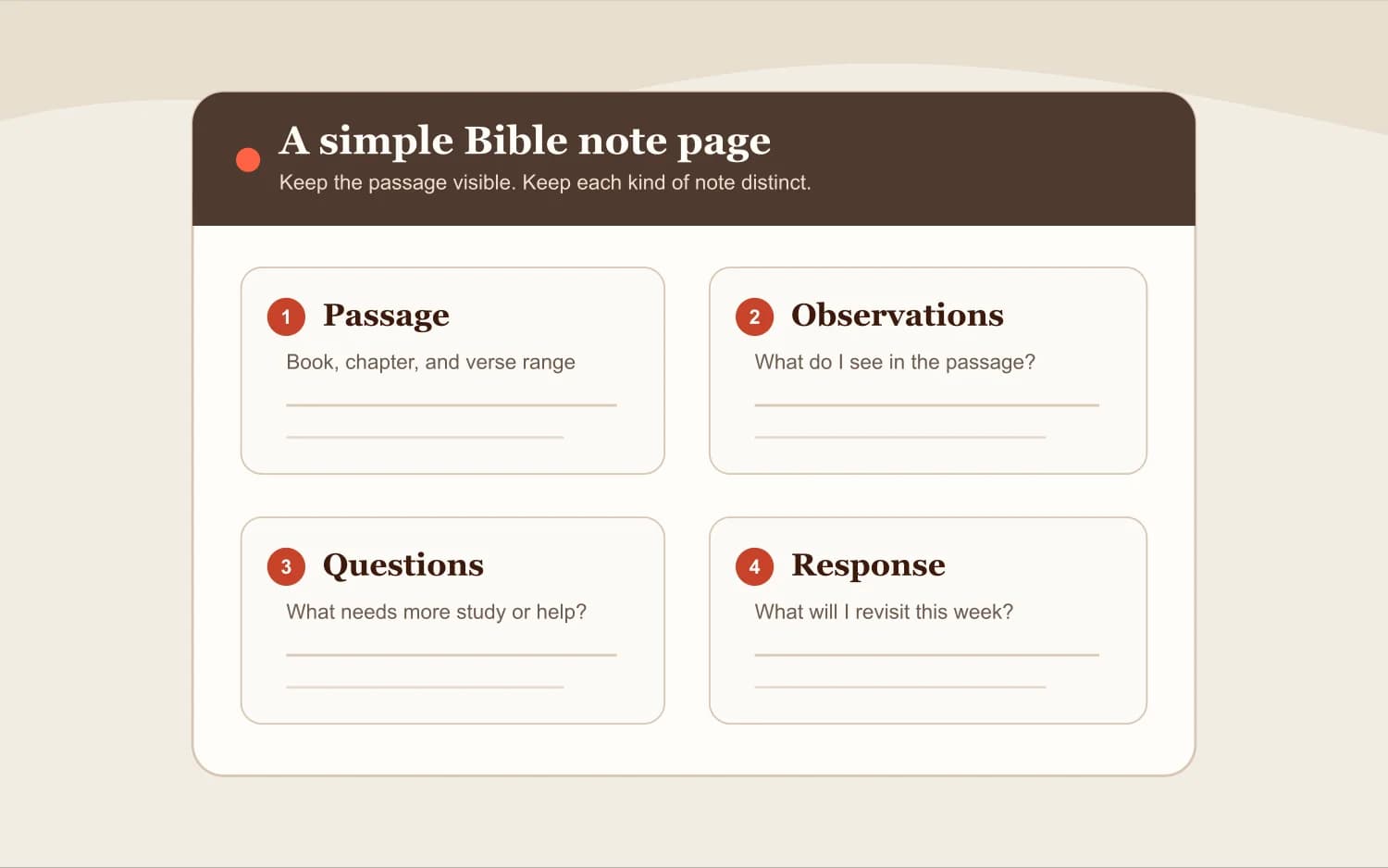
Write the book, chapter, and verse range at the top of the page. Then use four fields: passage, observations, questions, and response. Those headings give each thought a useful home as the note grows.
Read the short passage once without writing, then read it again slowly.
Record the passage reference and the observations another reader could see.
Add context and questions before you settle on an explanation.
Write one response you can revisit during the week.
Keep the passage, questions, and review in Bible Note
Once you have the four-part shape, Bible Note can keep the practice in one place. Start a note with the book, chapter, and verse range, then add your observations and questions in your own words. When the note begins with a sermon you are authorized to process, Bible Note can also connect the recording, recognized Scripture references, and structured review material.
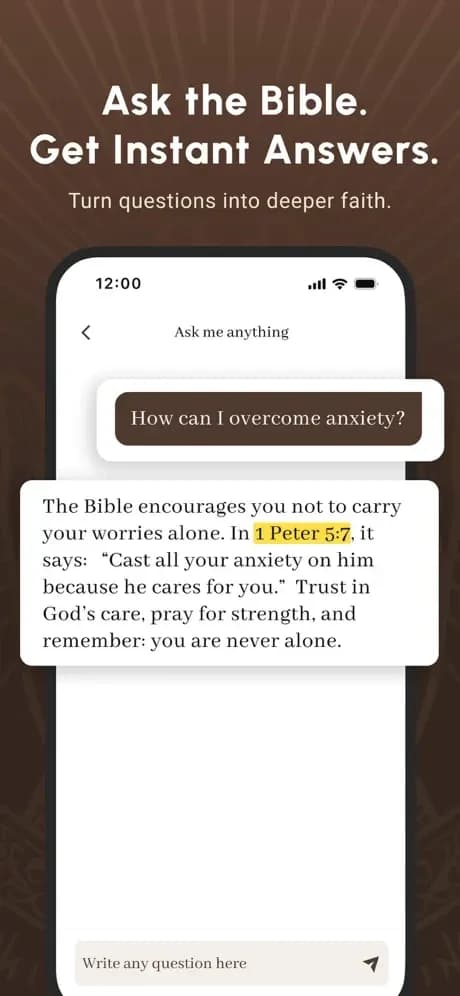
For a question that appears while you read, Bible Note Bible Study Chat begins from the open passage or saved note. Its answers show Scripture references with the translation and can be saved back to the note for later review. Read the cited passage for yourself and bring weighty questions to trusted teachers and your church community.
Give each part of the note its own job
An observation says what is present in the text. A context note names something around the text that may matter. A question admits that you need to investigate further. A response records one way you intend to carry the passage into ordinary life or prayer.
Those categories may overlap as you study, and that is normal. Keeping them visible helps you recognize the difference between “the writer repeats this word” and “I think this repeated word means this.” The first sentence records a detail. The second records a conclusion worth checking against the passage and its context.
Step 1: Save what the passage says in Bible Note
Open the passage in Bible Note or keep your Bible beside the note. Look for details that another attentive reader could point to in the same passage. This first pass gathers the words, relationships, movement, and emphasis that will support the rest of your study.
What to save first
Use a few of these prompts as you save observations:
Who speaks, acts, receives, resists, or changes?
Which words, images, commands, promises, questions, or contrasts repeat?
What happens first, next, and last?
Where do you see a cause-and-effect connection?
What is surprising, difficult, or easy to miss on a quick reading?
What does the passage emphasize through an example, comparison, or change in tone?
Use plain wording. An observation can read, “The passage repeats waiting,” or “The speaker contrasts fear and trust.” Add an interpretation after you have gathered the nearby context. A page full of visible details gives you a sturdy place to begin when you return.
If you prefer marks in the margin, keep them simple: a circle for repeated words, an arrow for a connection, and a question mark for something to revisit. Add the fuller observation to your Bible Note when you want it beside the passage and ready for later review.
Step 2: Add context while the passage is open
A note becomes much clearer when the surrounding paragraph stays in view. Before you write an explanation, read what comes immediately before and after the passage. Then ask how the section fits the book's larger argument, story, poem, letter, or teaching.
Use the paragraph, not an isolated line
Begin with what is close at hand:
Who appears to be speaking or writing?
Who is being addressed?
What problem, situation, or question is this section responding to?
What comes before it, and what changes after it?
Is the passage narrative, poetry, wisdom, prophecy, letter, or another kind of writing?
Write only the context you can support. “This paragraph follows a warning” gives your note a reliable marker for later study. When a background question matters to the passage, save it in the same Bible Note and consult a responsible study resource or a trusted teacher later.
Step 3: Turn observations into study questions
Questions mark the places where more reading will help. They often bridge a detail you have noticed and a clearer understanding of why it matters. Give them their own space in the note so they remain visible for the next study session.
Write questions the text and context can answer
Good study questions send you back to the passage. Try stems such as:
Why does this word, image, or action appear here?
How does the surrounding paragraph clarify this statement?
What problem is the writer addressing?
Which earlier observation does this question depend on?
What would need to be true for this interpretation to fit the whole section?
Some questions will remain open for a while. Mark them for a study Bible, a book overview, a pastor, or a conversation with mature Christians you trust. If the question grows from a saved passage or sermon note, Bible Study Chat can show linked references and label interpretation as interpretation. Use those citations as a starting place, then weigh the passage carefully.
Step 4: Save one response and build a review loop
After you have read the passage and its context, add one response you can carry into the week: a belief to reconsider, a practice to begin, a relationship to approach differently, a prayer to keep, or a question to return to.
Make the response concrete but modest
Write one sentence that is specific enough to revisit. “Return to this paragraph before Friday and name one way its main idea affects a current conversation” gives you a clear next touchpoint. A response can also be a short prayer or a decision to seek counsel about a difficult question.
If you study with other people, a retained question can become the beginning of a thoughtful discussion. Our guide to small-group Bible study questions can help you turn that question into one that keeps the group looking at the text.
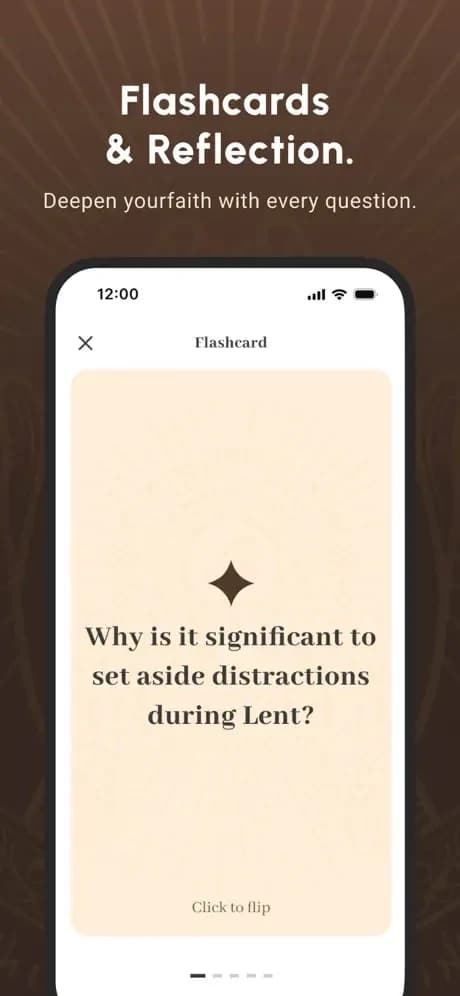
For an authorized sermon note, Bible Note can create flashcards, a five-day devotional plan, and small-group discussion questions from the note. Open one flashcard during the week, reread its supporting passage, and let the response you wrote remain connected to the original message.
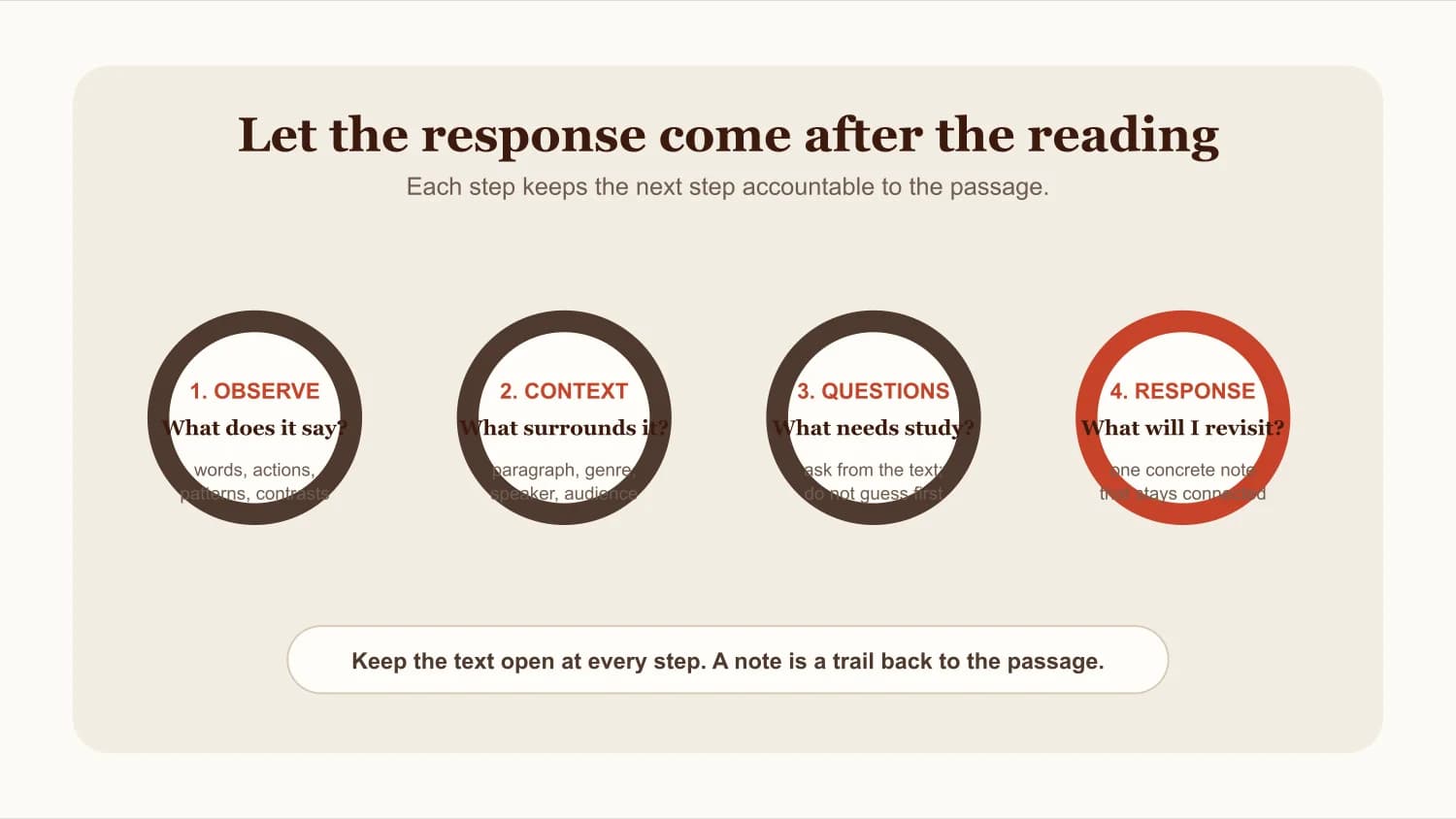
The order makes review easier. A response can point back to an observation, a paragraph, and a question you have taken seriously. That gives you a clear trail for the next reading, correction, or conversation.
Use Bible Note as the home for your study rhythm
Bible Note works alongside a physical Bible, a wide-margin Bible, or a notebook. Use paper for a quick mark during reading, then save the passage reference, question, and response in the app when you want a searchable record that stays connected to your study.
During personal reading: Open a passage, write the observation in your own words, and save the question that needs a second look. Bible Study Chat lets you ask from that passage or note and review the cited references.
During an authorized sermon: Use Bible Note sermon notes to record or import the message, then review the structured note, Scripture references, and the moment in the audio that raised your question.
During the week: Reopen one note, work through a flashcard, reread the passage, and revisit the response you wrote.
With a group: Bring one saved question to the discussion and keep the group anchored in the text.
The app helps you organize material and return to it. Keep the Bible open as you study, check any transcript against the original recording, and seek wise pastoral or community help for difficult questions.
Frequently asked questions
What should I write when taking Bible notes?
Start with the passage reference, then write visible observations, context you can support, questions to investigate, and one response you can revisit. A short, clear note gives you plenty to return to.
Is it okay to write in my Bible?
Yes, if that helps you return to the text and you are comfortable marking that copy. Use short symbols or observations in the margin, and keep a separate notebook when you need more space.
How many notes should I take on a passage?
Take enough notes to slow down and see the passage clearly, not so many that you lose the thread. For a short paragraph, three to five observations and one or two questions are a practical starting point.
What should I do when I do not understand a verse?
Write the question, reread the surrounding paragraph, and consult a responsible study resource or trusted teacher. Bible Study Chat can help you explore linked references from the passage or your note; check those citations in the biblical text.
How can Bible Note support a Bible note-taking habit?
Use it to keep a passage, your questions, and a saved response together. For an authorized sermon, Bible Note can also organize the note for review and create flashcards, a devotional plan, and small-group questions.
Sources
InterVarsity, “Leading Inductive Bible Study”, accessed August 13, 2026.
Cru, “How to Study the Bible”, accessed August 13, 2026.
Bible Gateway, “How to Read the Bible in 2026: A Beginner's Guide”, accessed August 13, 2026.
Bible Note Sermon Notes and Bible Note Bible Study Chat, first-party product references, accessed August 13, 2026.
Editorial status
Written and edited by Hans Keller for Bible Note. Sources, Scripture context, dates, and practical limitations are checked before publication.

About the author
Hans Keller
Editorial & Content Lead
Bible Study & Sermon Learning Content Editor
Hans helps Christians turn sermons and Scripture study into clear notes, thoughtful questions, and faithful next steps.
His work helps listeners and group leaders carry a sermon or study beyond the meeting: back to the passage, into clearer questions, and toward one practical response for the week.
Read with Scripture open
Use this guide alongside the full biblical passage and the practices of your local church. Interpretive details can differ across Christian traditions.
See more Bible Note on Google
Add Bible Note as a preferred source to help find our Bible study guides more easily in Google Search.
