


A woman sits in a hospital parking lot, phone in hand, knowing she needs to make a call she has avoided for weeks. A father rehearses a hard conversation with his boss on the drive to work. In moments like these, many readers reach for Bible stories about courage, hoping to find someone who faced fear and kept going.
Here is the short answer these stories give: courage in the Bible is a chosen response to danger, power, fear, or responsibility. The narratives never ask their characters to feel fearless first. Esther spoke while knowing the law could kill her. Daniel's friends answered while a furnace burned nearby. What these stories offer is a pattern of faithful decision-making under real pressure, and that pattern is something any reader can study and practice.
This guide walks through the main courage narratives, keeps their context in view, and ends with questions for any passage. These stories involve warfare, execution threats, and oppressive rulers, and this article names those realities plainly. Courage in Scripture can mean seeking help, choosing careful timing, or refusing an unsafe command; it never means chasing danger.
What courage looks like under pressure
Across these narratives, courage follows a recognizable shape. A character faces pressure that carries real cost: death, exile, public shame, or the loss of position. The character understands the risk clearly. Then the character acts anyway, because obedience, loyalty, or responsibility to others outweighs the fear.
The pressure is concrete: Pharaoh's order targeted real children, and Nebuchadnezzar's furnace was a genuine execution method. Reading these stories well means taking their danger seriously. The characters also prepare before they act. They gather information, consult people they trust, wait for the right moment, or build skill over years. Courage here is rarely impulsive; it is usually the visible tip of long, quiet faithfulness.
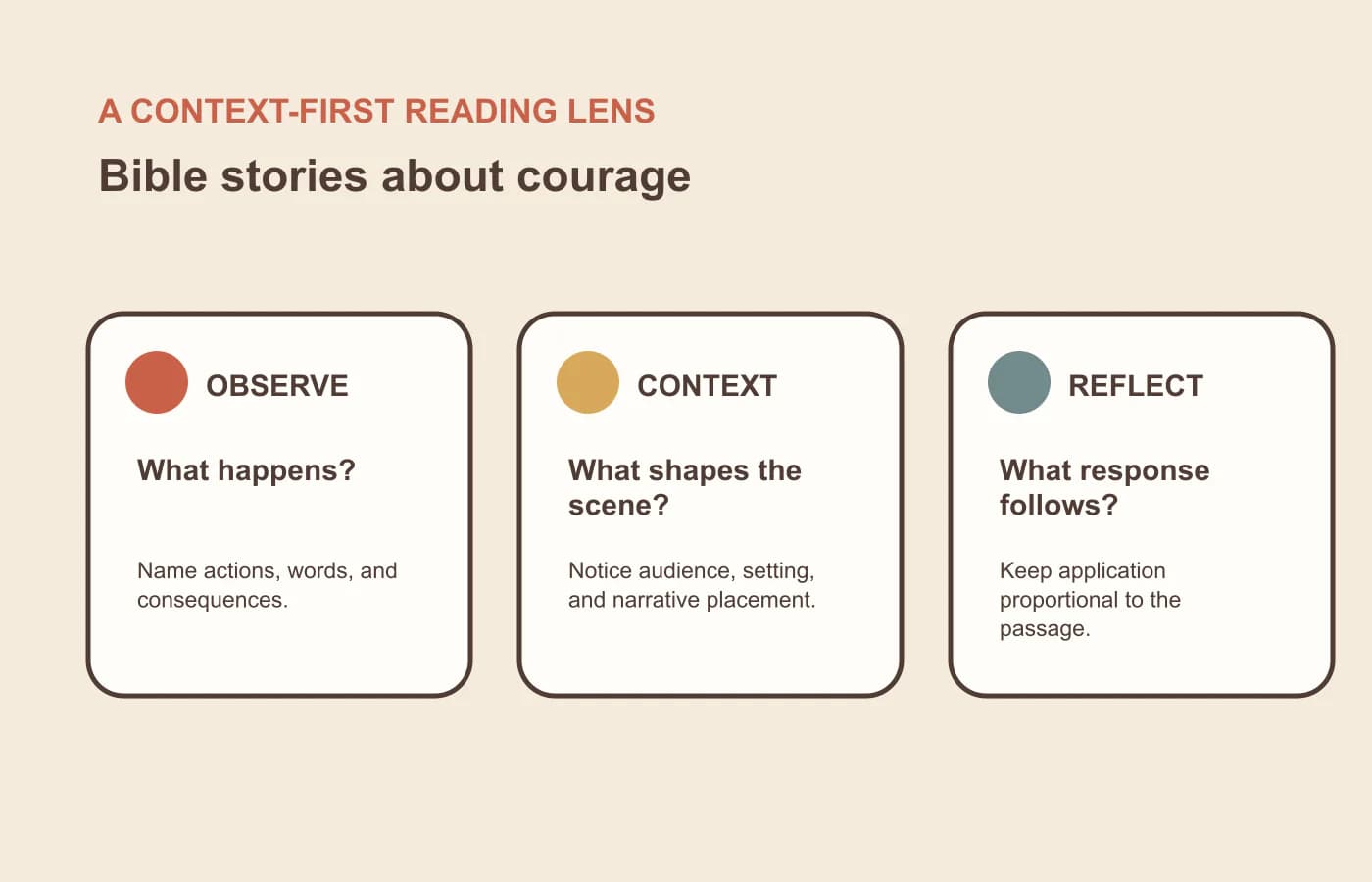
To keep these layers straight while you read, the guide on how to read the Bible in context treats observation, context, and application as separate steps. That same discipline shapes everything below.
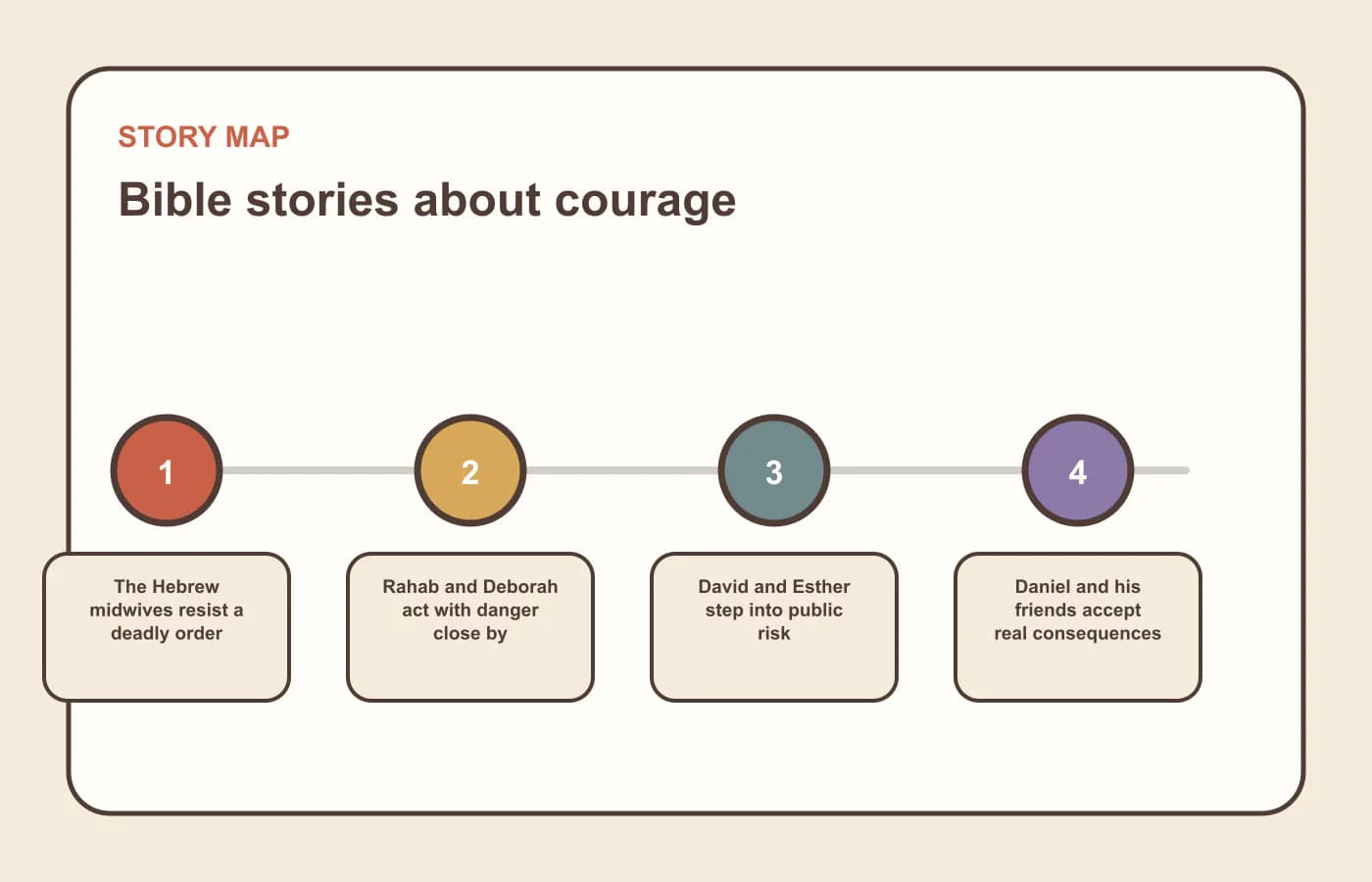
The Hebrew midwives resist a deadly order
The setting: a king's command
Exodus 1:8-2:10 opens with a new king over Egypt who does not know Joseph. Fearing the growing Israelite population, Pharaoh enslaves the people and then escalates: he orders the Hebrew midwives, Shiphrah and Puah, to kill every boy at birth. This is state power turned against the most vulnerable.
The choice: refusal with consequence
The midwives fear God and let the boys live. When Pharaoh confronts them, they answer him and continue their work. Their courage has two features worth noting. It is a refusal: they decline a deadly command from the highest authority in their world. And it is protective: their bravery exists for the sake of others, and the passage says God dealt well with them.
The same chapters widen the lens. Moses' mother hides her son for three months, then places him in a basket on the Nile when hiding is no longer possible. Her courage leans on a watchful sister and an unexpected ally in Pharaoh's own household. Resisting abusive power, in this story, is a family effort.
Rahab and Deborah act with danger close by
Rahab's calculated risk
In Joshua 2:1-24, Rahab hides two Israelite spies on her roof in Jericho while the king's men search the city. She misdirects the search party, then negotiates: she has heard what Israel's God has done, and she asks that her family be spared when the city falls. The spies agree, and the scarlet cord in her window becomes her household's protection.
Rahab's courage is discerning. She reads the situation accurately, chooses a side at real personal risk, and secures terms before the danger arrives. Her story shows bravery that thinks.
Deborah's steady presence
Judges 4:1-5:31 tells of Deborah, a prophetess and judge, during twenty years of Canaanite oppression. When she summons Barak and relays God's command to confront Sisera's army, Barak asks her to go with him. She agrees, while telling him the honor of victory will go to a woman. That woman turns out to be Jael, who kills Sisera in her tent. Judges 5 records the song Deborah and Barak sing afterward.
Deborah's courage is public, patient, and steady: she judges disputes, speaks hard assignments plainly, and walks toward the battle alongside the man who will not go without her. Presence itself becomes an act of courage.
David and Esther step into public risk
David: preparation made visible
First Samuel 17:1-58 places the young David before Goliath while Israel's army stands afraid. David's confidence has a history: he tells Saul that as a shepherd he killed a lion and a bear that attacked his flock, and he trusts the God who delivered him then. He refuses armor he has not tested, chooses his familiar sling, and runs toward the giant. His skill was built over years of unglamorous work, and this is a wartime confrontation. The pattern that transfers is this: faithfulness in small, hidden responsibilities becomes the ground for courage in large, visible ones.
Esther: timing under threat
Esther 4:1-8:17 finds the Jewish people under a royal decree of destruction, and Esther, the queen, is positioned to approach the king. Mordecai warns her that silence will not protect her, and asks whether she has come to her position for exactly this moment. Esther accepts the cost: she asks her people to fast, and she will go to the king even though approaching him uninvited can mean death.
Then she waits. Across two banquets and two days, she lets the king's curiosity build and exposes Haman's plot at the moment it will land hardest. Her courage includes strategic patience. She risks everything, and she chooses when and how.
Daniel and his friends accept real consequences
Daniel 3:1-30 sets three exiled Jews, Shadrach, Meshach, and Abednego, before Nebuchadnezzar's golden statue. Everyone must bow at the music, and the penalty for refusal is a blazing furnace. Their answer holds loyalty and uncertainty together: God is able to deliver them, and even if He does not, they will not serve the king's gods.
Daniel 6:1-28 shows an older Daniel facing a similar structure. A manipulated law forbids prayer to anyone but King Darius for thirty days, and the penalty is the lions' den. Daniel keeps praying at his open window, as was his habit, fully aware of the document. His courage is quiet consistency maintained in public view.
Both stories end in rescue, and it matters to say what they do not promise. The friends in the furnace expected the possibility of death and chose faithfulness anyway. Many faithful people in later history were not spared. These narratives celebrate God's power to save; they never turn courage into a transaction that always ends well.
Courage needs wisdom, community, and limits
Because these stories are vivid, they can be misread as invitations to seek out danger. A few guardrails keep reading honest.
Courage serves others. Every story above protects someone: children, a family, a people. Bravery aimed only at personal glory is a different thing.
Courage can refuse. The midwives' bravest act was declining a command. Saying no to an unsafe demand is often the faithful choice.
Courage uses timing. Esther waited two days. Preparation and patience belong to courage.
Courage leans on community. Rahab negotiated for her household; Esther asked her people to fast; Deborah went with Barak. Nobody in these stories carries everything alone.
Courage respects real danger. If you face violence, coercion, or abuse, the faithful step is to seek help from trustworthy people and qualified local professionals.
Questions for reading a courage story
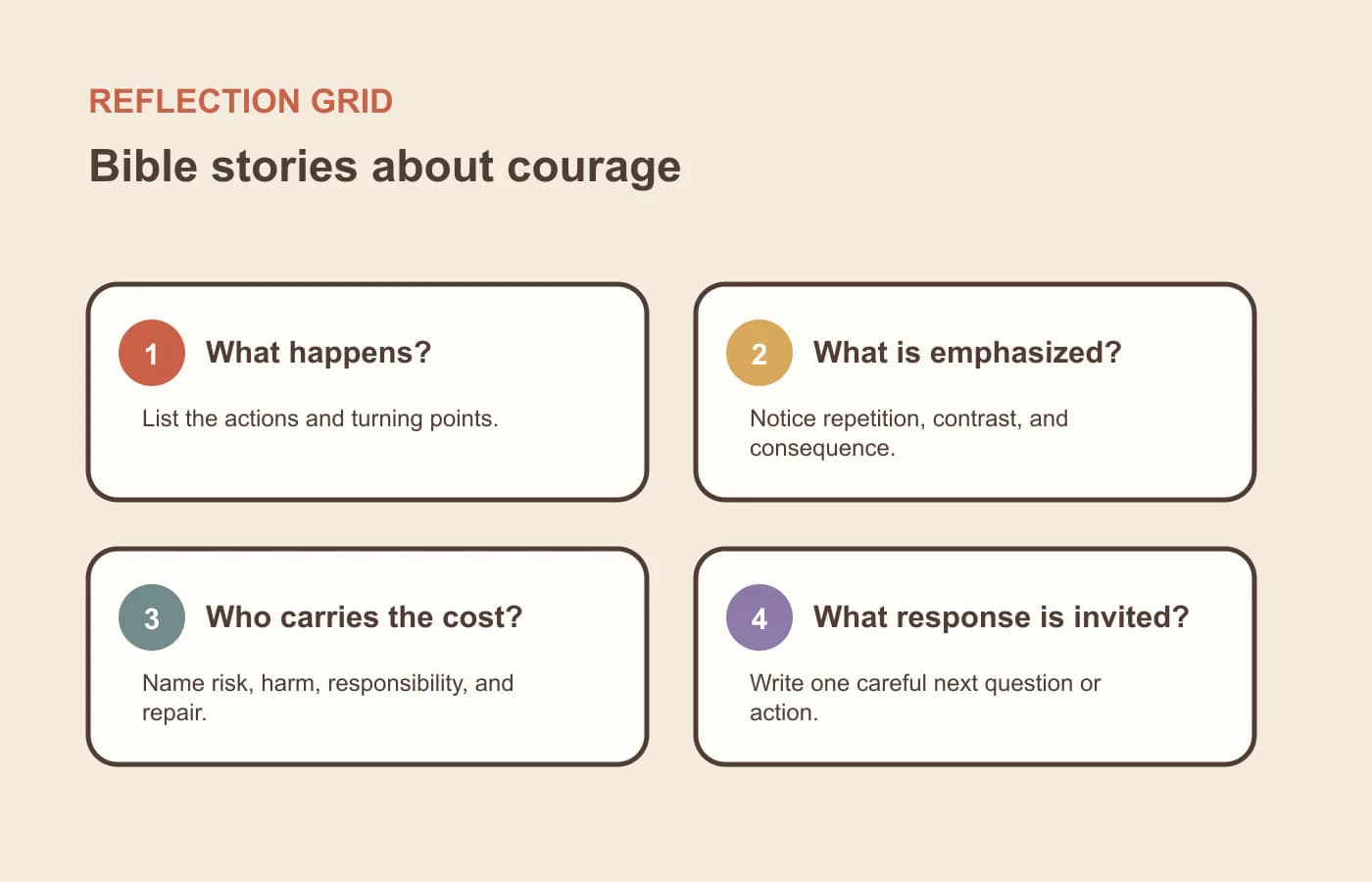
You can bring four questions to any courage narrative, including ones this article did not cover.
What pressure is the character under? Name the threat, the authority involved, and what obedience would cost.
What does the character know, and how did they learn it? Look for preparation, prior faithfulness, or counsel from others.
What exactly does the courageous act do? Separate refusal, protection, speech, and presence, since courage takes different forms.
How does the story end, and what does it leave open? Note where rescue comes and where the characters acted without expecting it.
Writing the answers down slows you in the best way. The guide on how to take notes while reading the Bible shows how to record observations and questions in a form you can revisit. When you are ready to sit inside complete narratives, the Modern Bible Stories collection offers full text and audio for the stories currently published there.
Frequently asked questions
Who was very courageous in the Bible?
This article traces seven examples: the Hebrew midwives Shiphrah and Puah, Moses' mother, Rahab, Deborah, David, Esther, and Daniel with his three friends. Each faced a different pressure, from a royal death decree to public execution threats.
Do Bible characters feel fear, or does courage remove it?
The narratives treat courage as a choice made under pressure. Esther fasted in dread before approaching the king, and David clearly understood what Goliath could do. The stories never make fearlessness a requirement.
Does courage in the Bible always lead to rescue?
No. Daniel's friends told the king they would refuse to bow even if God did not deliver them. The furnace and lions' den accounts end in rescue, but the characters acted without that guarantee.
How do I apply these stories without inviting danger?
Study the pressure, preparation, action, and outcome in each passage, then look for the form courage takes: protection, refusal, timing, or steady conviction. If your situation involves violence or abuse, seek help from trustworthy people and qualified local professionals.
Sources
This article retells the biblical text in original summaries, and every story above was checked against the passages listed below.
Exodus 1:8-2:10; Joshua 2:1-24; Judges 4:1-5:31; 1 Samuel 17:1-58; Esther 4:1-8:17; Daniel 3:1-30; Daniel 6:1-28, via the Bible Gateway passage lookup
Bible Note Modern Bible Stories, the collection of complete published story text and audio referenced in this article
Editorial status
Written and edited by Hans Keller for Bible Note. Sources, Scripture context, dates, and practical limitations are checked before publication.

About the author
Hans Keller
Editorial & Content Lead
Bible Study & Sermon Learning Content Editor
Hans helps Christians turn sermons and Scripture study into clear notes, thoughtful questions, and faithful next steps.
His work helps listeners and group leaders carry a sermon or study beyond the meeting: back to the passage, into clearer questions, and toward one practical response for the week.
Read with Scripture open
Use this guide alongside the full biblical passage and the practices of your local church. Interpretive details can differ across Christian traditions.
See more Bible Note on Google
Add Bible Note as a preferred source to help find our Bible study guides more easily in Google Search.