


You open your Bible after a hard week, hoping to meet people who trusted God with steady hearts. What you find in Genesis is a couple who laughed when they heard the promise, panicked their way through Egypt, and tried to hurry God's timetable themselves. If you came looking for unshakable heroes, the shelf feels wrong.
It is the right shelf. Read in context, the Bible's stories about faith rarely show people who felt certain. They show people who trusted enough to take one concrete step while questions, fear, or incomplete understanding stayed in the room. Faith appears as trust expressed through a real response, with plenty unresolved around it.
Each section keeps the narrative context visible and names the reference so you can read the whole account yourself.
What faith looks like inside a story
A definition can tell you what faith means. A story shows what faith does when the weather turns, the promise delays, or the army is visible on the ridge. Narrative gives faith real stakes, a costly response, and consequences the character cannot control. Abraham faces a delayed family future, Rahab risks her place in Jericho, and the disciples face a storm they cannot manage.
Ask two questions of each passage: what did this person do with what they knew, and what stayed unsettled while they did it?
Abraham and Sarah trust amid delay and missteps
Abraham and Sarah's story spans Genesis 12 through 22, holding faith and failure together.
The call and the long delay
Genesis 12 opens with a command and a promise. Abraham goes, though he is seventy-five, Sarah has no children, and the promise depends on descendants they do not have. Years pass, and both laugh when the promise is repeated — Abraham in Genesis 17, Sarah in Genesis 18.
The missteps stay on the record
Genesis keeps their failures in plain sight. Twice, in Genesis 12 and again in Genesis 20, Abraham presents Sarah as his sister out of fear, and both times the scheme endangers her and the promise. In Genesis 16 the couple tries to produce the heir through Hagar, a decision that wounds their household for generations. The narrative keeps these choices visible, showing that people who trust God still struggle.
What Genesis honors
Isaac is born in Genesis 21, and Genesis 22 closes the arc with the binding on Moriah, where Abraham's trust becomes obedience at terrible cost. Read the whole span and a pattern emerges: God keeps the promise across decades of delay, and the couple's faith survives their own missteps. The narrative honors their trust without airbrushing their record.
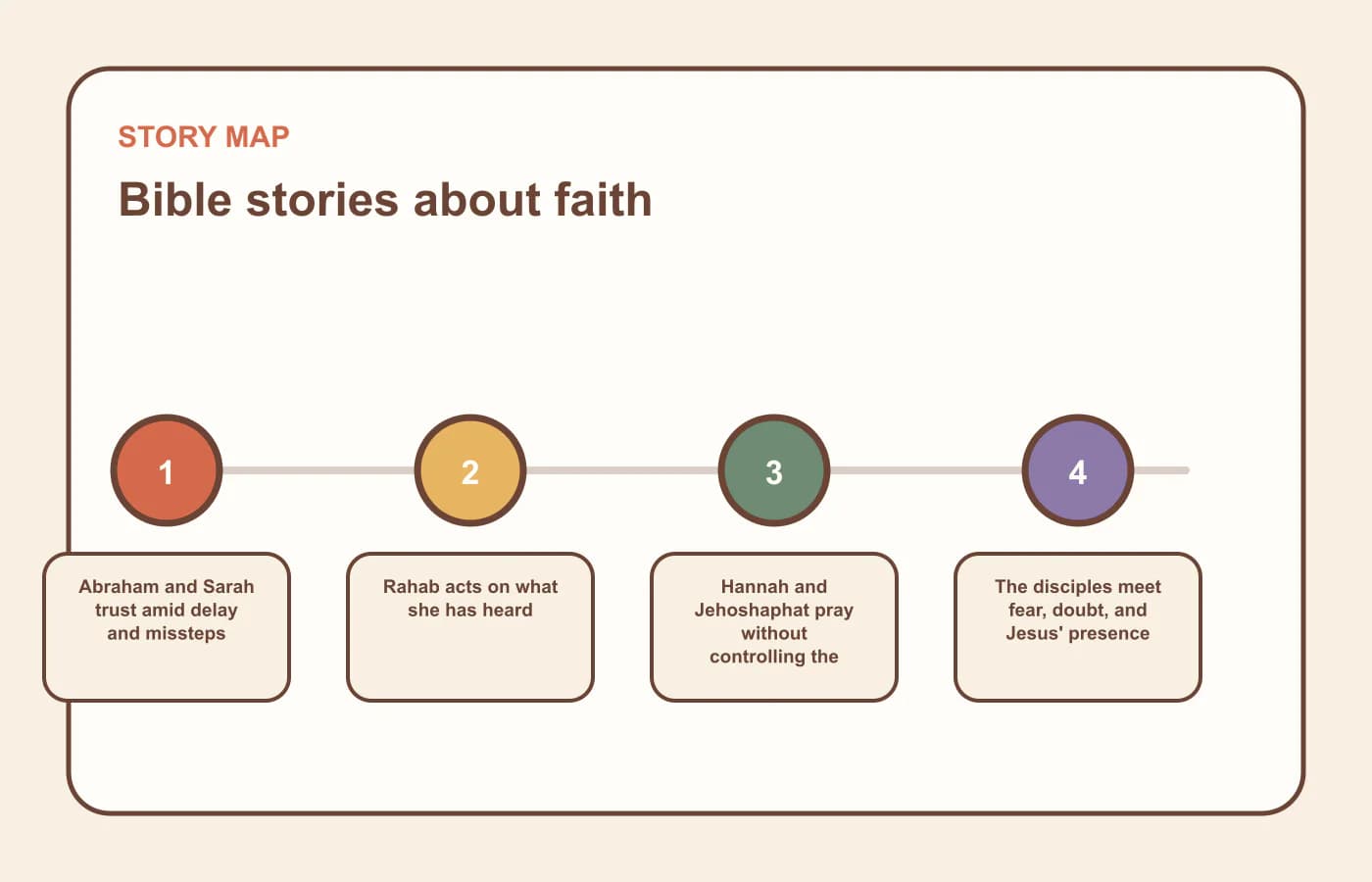
Rahab acts on what she has heard
Joshua 2 gives faith a different texture. Rahab lives in Jericho, outside Israel, with no promise addressed to her. What she has is rumor: reports that Israel's God dried up the sea and defeated kings across the Jordan. Her neighbors hear the same reports and melt with fear. Rahab hears them and acts.
Her belief becomes visible through a specific, dangerous choice. She hides Israel's spies on her roof, misdirects the king's search party, and then negotiates: she has shown kindness, and she asks for kindness in return — safety for her whole family when the city falls. The scarlet cord in her window turns the agreement into a plan.
Her faith rests on secondhand information and carries first-person risk. She acts inside that uncertainty, and the story treats her action as evidence of what she believed.
Hannah and Jehoshaphat pray without controlling the outcome
Two stories separated by centuries show dependence on God through prayer when the outcome is out of reach.
Hannah prays from inside the ache
In 1 Samuel 1, Hannah's childlessness is compounded by a rival wife who provokes her year after year. At the house of the Lord she prays silently, lips moving, and Eli the priest misreads her anguish as drunkenness. She tells him plainly that she is deeply troubled and has been bringing her grief before the Lord. Then the text records a quiet turn: she eats, and her face lifts — before anything in her situation has changed. Samuel is born later, in the story's own time, and her prayer in 1 Samuel 2 looks back on the whole road.
Jehoshaphat prays before he has a plan
In 2 Chronicles 20, Jehoshaphat learns that a coalition army is marching. He calls Judah to fast and admits publicly that the nation has no power and does not know what to do. The answer assigns an odd battle plan — singers ahead of soldiers — and the conflict resolves before Judah fights. His faith looks like admitted helplessness plus ordered action.
The disciples meet fear, doubt, and Jesus' presence
The Gospels are candid about the people closest to Jesus. Two scenes show how fear and doubt function inside faith.
Fear in the boat
Mark 4:35–41 puts the disciples in a boat at night while a storm swamps it and Jesus sleeps. They wake him in fear. He stills the wind, then asks why they are afraid and whether they still have no faith. Their fear gives way to awe, and they ask who this man can be.
Thomas asks for evidence
John 20:19–29 finds the disciples behind locked doors after the resurrection, afraid. Jesus appears among them, and Thomas, who was absent, states his terms: unless he can see and touch the wounds, he will not believe. A week later Jesus returns and offers Thomas exactly the evidence he asked for. Thomas answers with one of the clearest confessions in the Gospel, and Jesus' closing word blesses those who will believe without seeing — a word aimed forward at readers.
The narrative does not shame Thomas. His doubt receives evidence and a personal invitation.
How to reflect on faith without promising an outcome
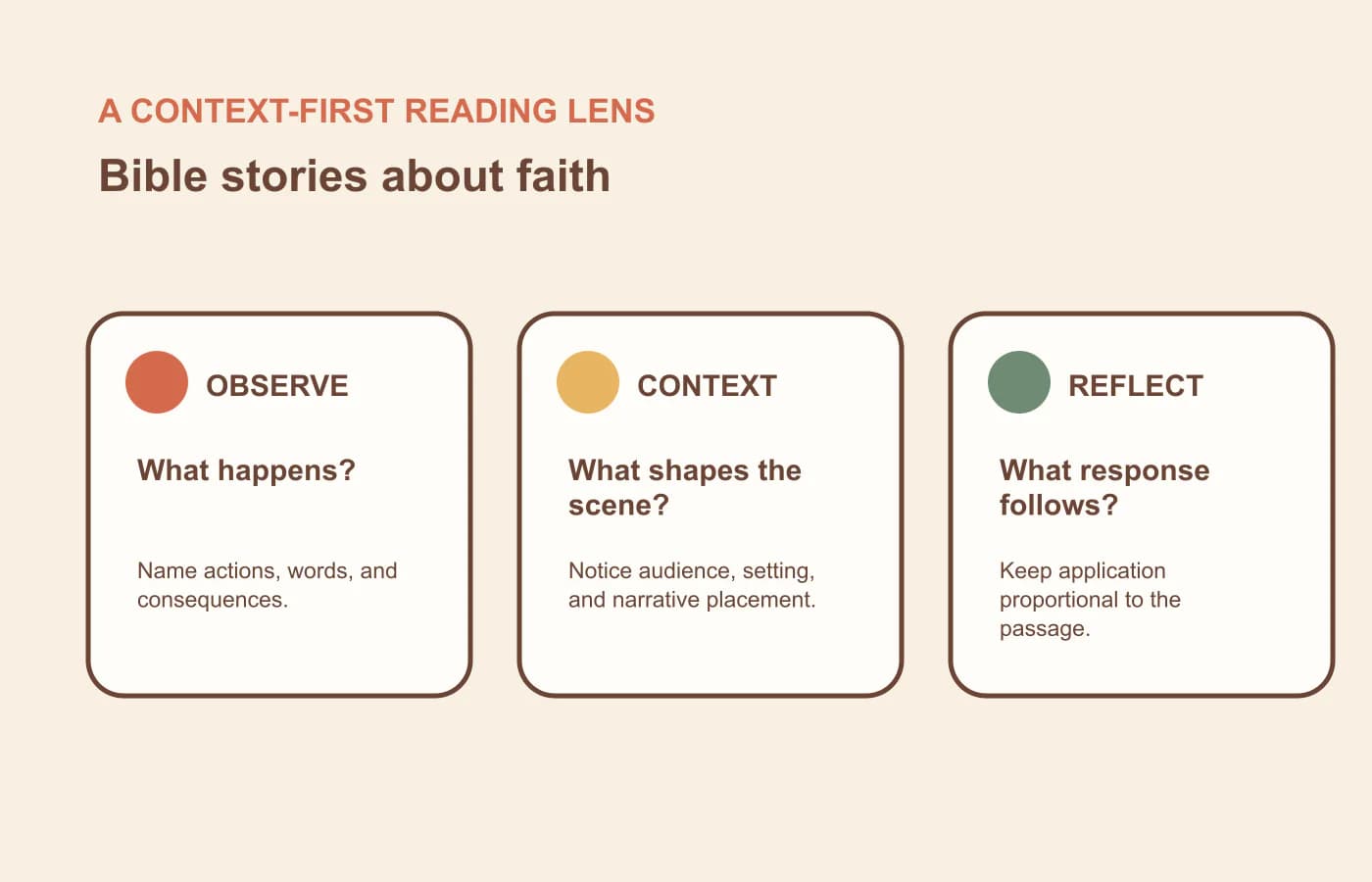
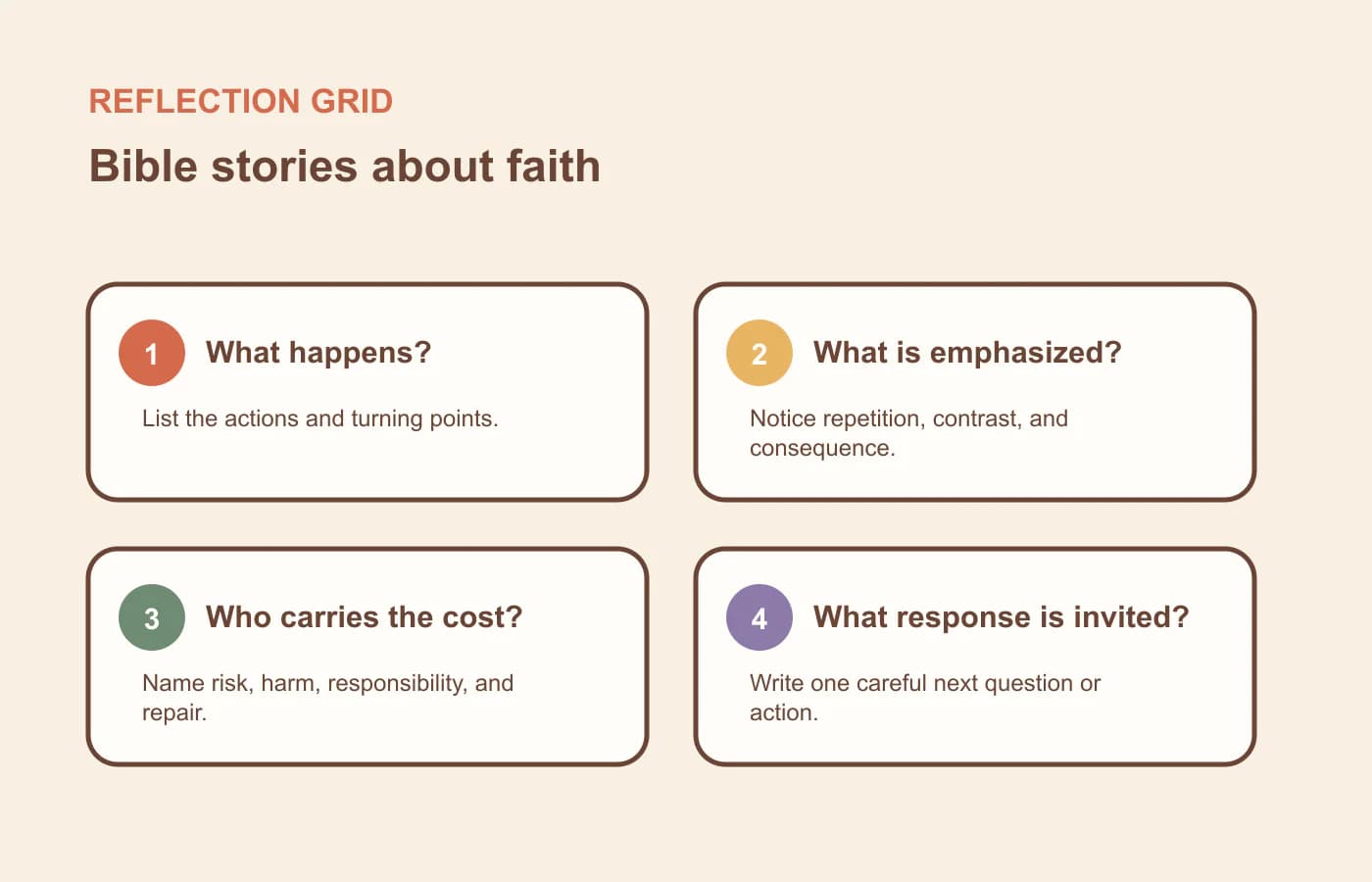
Because these stories include delay, danger, and unresolved questions, applying them takes care. A formula — trust hard enough and the storm stops — goes past what any of these passages claims. Four questions keep reflection close to the text:
Observe the action. What does the character actually do? Name the concrete step: Abraham leaves, Rahab hides, Hannah prays, Jehoshaphat gathers, Thomas asks.
Locate the knowledge. What did this person know, and what stayed unresolved? Rahab had rumors. Hannah had an unanswered ache. The disciples had a sleeping teacher.
Count the cost and the limit. What did the response risk, and what did the story leave unfixed? Sarah's household carried wounds no miracle removed.
Choose one honest response. Given your situation, what single step would express trust this week — a prayer said aloud, a conversation started, a next step taken before the outcome is visible?
Write your answers down. The guide on taking notes while reading the Bible offers a simple structure.
Continue with complete Bible stories
Every passage in this article rewards a slow reading of the full narrative, and the guide on how to read the Bible in context walks through an observation-first approach.
When you want the stories themselves, the Modern Bible Stories collection gathers complete story text and audio for stories Bible Note has published so far. Check whether the story you want is already there, and read the rest directly in your Bible using this guide's references.
Frequently asked questions
Who in the Bible struggled with faith?
Abraham and Sarah wavered across decades of waiting (Genesis 12–22), the disciples feared the storm (Mark 4:35–41), and Thomas asked for evidence (John 20:19–29). Their struggles stayed in the record.
Is doubting a sign that faith has failed?
Thomas states his doubt plainly, and Jesus answers it with evidence and an invitation. The story gives doubters a place rather than a rebuke.
Do these stories promise that faith guarantees a good outcome?
No. Faith in these passages is not a mechanism that guarantees safety or success. Some stories end in rescue and others pass through real loss and long delay, so application means imitating a posture of trust while honestly naming what remains unresolved.
Where can I read the full stories?
Start with Genesis 12:1–22:19, Joshua 2:1–24, 1 Samuel 1:1–3:21, 2 Chronicles 20:1–30, Mark 4:35–41, and John 20:19–29. Bible Note's Modern Bible Stories collection offers text and audio for stories published so far.
Sources
Editorial status
Written and edited by Hans Keller for Bible Note. Sources, Scripture context, dates, and practical limitations are checked before publication.

About the author
Hans Keller
Editorial & Content Lead
Bible Study & Sermon Learning Content Editor
Hans helps Christians turn sermons and Scripture study into clear notes, thoughtful questions, and faithful next steps.
His work helps listeners and group leaders carry a sermon or study beyond the meeting: back to the passage, into clearer questions, and toward one practical response for the week.
Read with Scripture open
Use this guide alongside the full biblical passage and the practices of your local church. Interpretive details can differ across Christian traditions.
See more Bible Note on Google
Add Bible Note as a preferred source to help find our Bible study guides more easily in Google Search.