


Maybe this has happened to you. You open a search bar and type "Bible stories about forgiveness," hoping for something you can bring to a small group, a hard conversation, or your own unfinished business. What comes back is usually a list: Joseph, David, the prodigal son, each reduced to a single sentence. The sentences are mostly true, and they leave out the parts that make forgiveness difficult.
Here is a sturdier answer. Bible stories connect forgiveness with mercy, truth, repentance, and repair, and they let reconciliation and restored access unfold differently from one narrative to the next. Joseph feeds the brothers who harmed him, and he also tests them before he tells them who he is. David is forgiven, and the consequences of his choices reach into his household. The father in Jesus' parable runs to meet a returning son, and the same chapter holds an older brother who will not come inside.
This guide walks through four story studies where forgiveness does real narrative work, then names the boundaries readers should keep visible and offers a set of questions you can reuse on any story.
What forgiveness means inside a Bible story
A forgiveness story in the Bible is rarely a single moment. It is usually a chain of movements, and the links in the chain change from story to story. For this guide, keeping those movements distinct is the first reading skill this topic asks for.
As a reading aid, this guide uses mercy for the release of what is owed, truth for harm named accurately, repentance for the wrongdoer's turn, and repair for the concrete step that follows the turn. It uses reconciliation for a restored relationship, while trust is rebuilt slowly, on evidence. Access — how close someone gets to your life again — is its own decision. Accountability, including legal accountability, runs on its own track as well.
The stories below show different orderings of those movements. In one, provision arrives before disclosure. In another, forgiveness arrives and consequences continue anyway. Watching the order is most of the lesson.
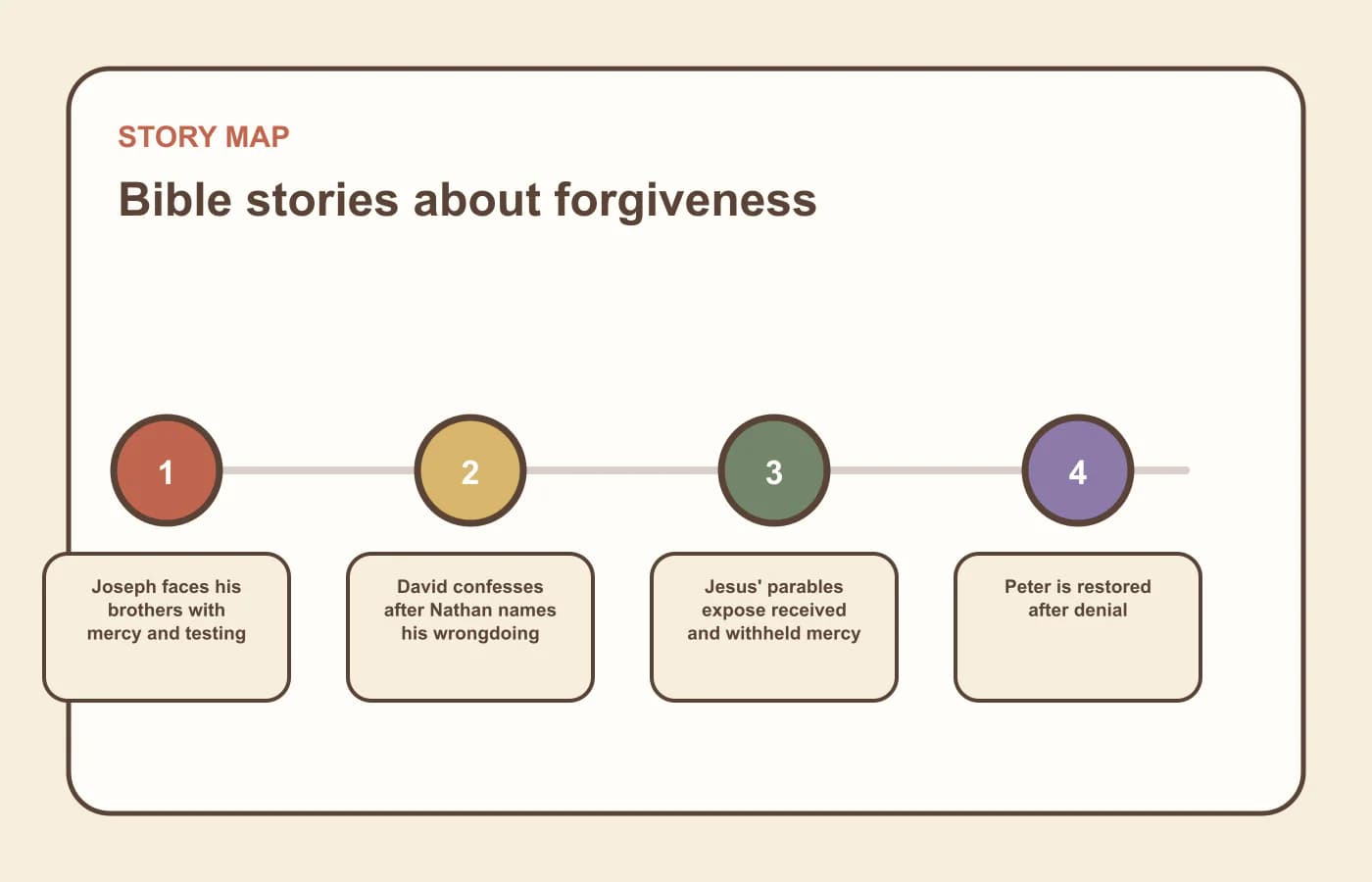
Joseph faces his brothers with mercy and testing
Genesis 42 through 46 refuses to make forgiveness quick. Famine drives Joseph's brothers to Egypt for grain. Joseph, now governing Egypt, recognizes them. They do not recognize him.
What follows is a long examination. Joseph accuses them of spying, holds Simeon, and demands they bring Benjamin, the youngest, back with them. On the second journey he plants his silver cup in Benjamin's sack and threatens to keep the boy as a slave. Then Judah offers himself as a slave in Benjamin's place.
That offer is the hinge. Joseph has been watching to learn what his brothers have become, and Judah's plea answers the question. Joseph weeps, tells them who he is, and provides for the family as the famine continues.
Provision and accountability sit in the same scene. Joseph does not pretend the sale never happened, and he does not disclose himself until testing has surfaced real change. Mercy, in this story, moves at the speed of truth.
David confesses after Nathan names his wrongdoing
Second Samuel 11 through 12 tells a harder story, because the forgiven person is also the one with power. David takes Bathsheba, arranges Uriah's death at the front lines, and marries the widow. Months pass. The text records no confession during that silence.
Then Nathan arrives with a small story about a rich man who takes a poor family's single lamb to feed a guest. David burns with anger at the injustice and pronounces judgment. Nathan names David as the man in the story.
David's confession is short, and the narrative treats it as real. Nathan tells him the Lord has put away his sin — he will not die. In the same breath, Nathan announces consequences within this account: violence will enter David's household, and the child born from the affair dies.
The story holds two things at once without apology. Forgiveness within the narrative is immediate and genuine. Consequences are also immediate and genuine. Any reading that drops either half misreads the passage.
Jesus' parables expose received and withheld mercy
Jesus teaches forgiveness in stories twice over — once about mercy received with joy, once about mercy received and then refused. Reading the two together keeps the picture honest.
The lost son in Luke 15
A younger son asks for his inheritance early and leaves. He spends everything and ends up feeding pigs. He decides to go home and ask for a place among the hired servants.
The father sees him while he is still far off, runs to him, and embraces him before the rehearsed speech is finished. Robe, ring, feast. The restoration is lavish and fast. Then the camera moves: the older brother, who never left, refuses to enter the celebration, and the father goes out to plead with him too. Mercy is extended toward both sons, and the story ends with the older brother's answer still open.
The unforgiving servant in Matthew 18
Peter asks Jesus whether forgiving a brother seven times is enough, and Jesus answers with a figure far beyond bookkeeping. He then tells of a servant who owes his king an unpayable sum — ten thousand talents, lifetimes of wages. The king forgives the whole debt. That same servant walks out, seizes a fellow servant over a few months' wages, and has him imprisoned when he cannot pay.
The king hears of it and revokes the mercy. The parable ties received forgiveness to practiced forgiveness: the servant accepted the release as information about himself and changed nothing about how he treated anyone else. Jesus leaves the arithmetic behind entirely.
Peter is restored after denial
John 21 finds Peter back on a boat. The risen Jesus stands on the shore, prepares breakfast, and shares the meal with the disciples. During the conversation that follows, Jesus asks Peter three times whether he loves him.
Peter answers, and the third asking grieves him — the text says so plainly. Each answer is met with a commission: feed my lambs, tend my sheep. Then Jesus tells Peter about the death that waits ahead of him.
Truth, grief, and renewed responsibility meet in one conversation. The denials are revisited, not erased. The grief is named, not smoothed over. And the restoration arrives as work — care of the flock — given back into the hands of the man who failed. Forgiveness here restores Peter to responsibility, which is a larger gift than restored comfort.
Forgiveness, reconciliation, and boundaries
These stories also guard against a common collapse: treating forgiveness, reconciliation, trust, access, and accountability as one step. For this guide, they are related reading categories that remain distinct.
As a reading distinction, forgiveness is the release of a debt and can happen on one side of a relationship. Reconciliation is a restored relationship and takes two people, truth, and time. Trust is rebuilt on evidence and may lag far behind a sincere decision to forgive. Access — how much of your life someone re-enters — is a separate judgment call. Accountability, including reporting and legal consequence, continues on its own track regardless of anyone's heart posture.
This distinction carries real safety weight. If contact with the person who harmed you is unsafe, you are not required to remain in it or return to it, and forgiving them does not change that. Bring situations involving abuse or danger to qualified, local help — trusted church leadership, a licensed counselor, or the appropriate authorities — alongside your own reading of these texts.
The narratives model the separation. Joseph fed his brothers from the first day and revealed himself only after testing showed change. David's forgiveness was announced in a sentence, and the consequences ran for chapters.
Questions for reading a forgiveness story
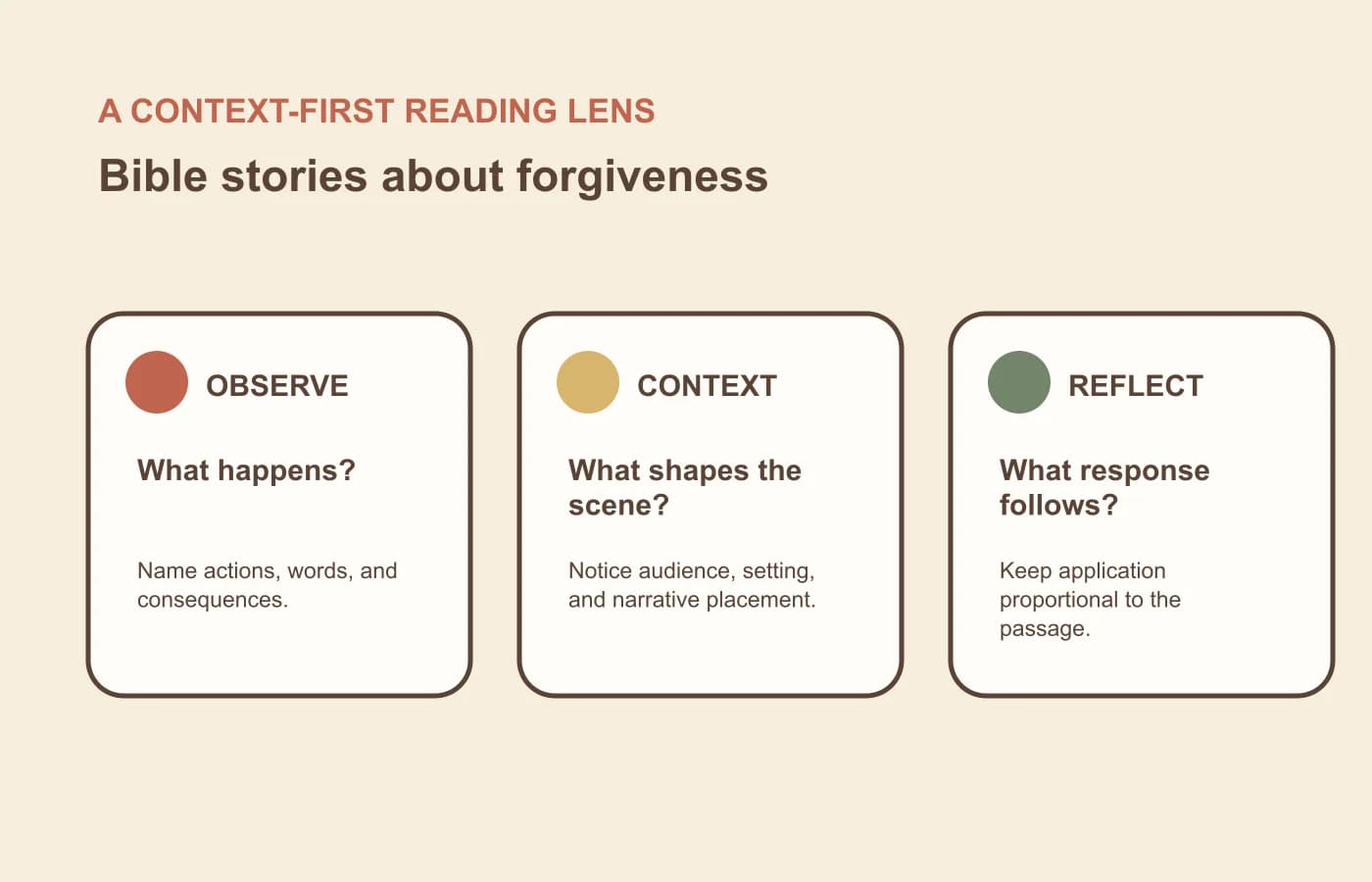
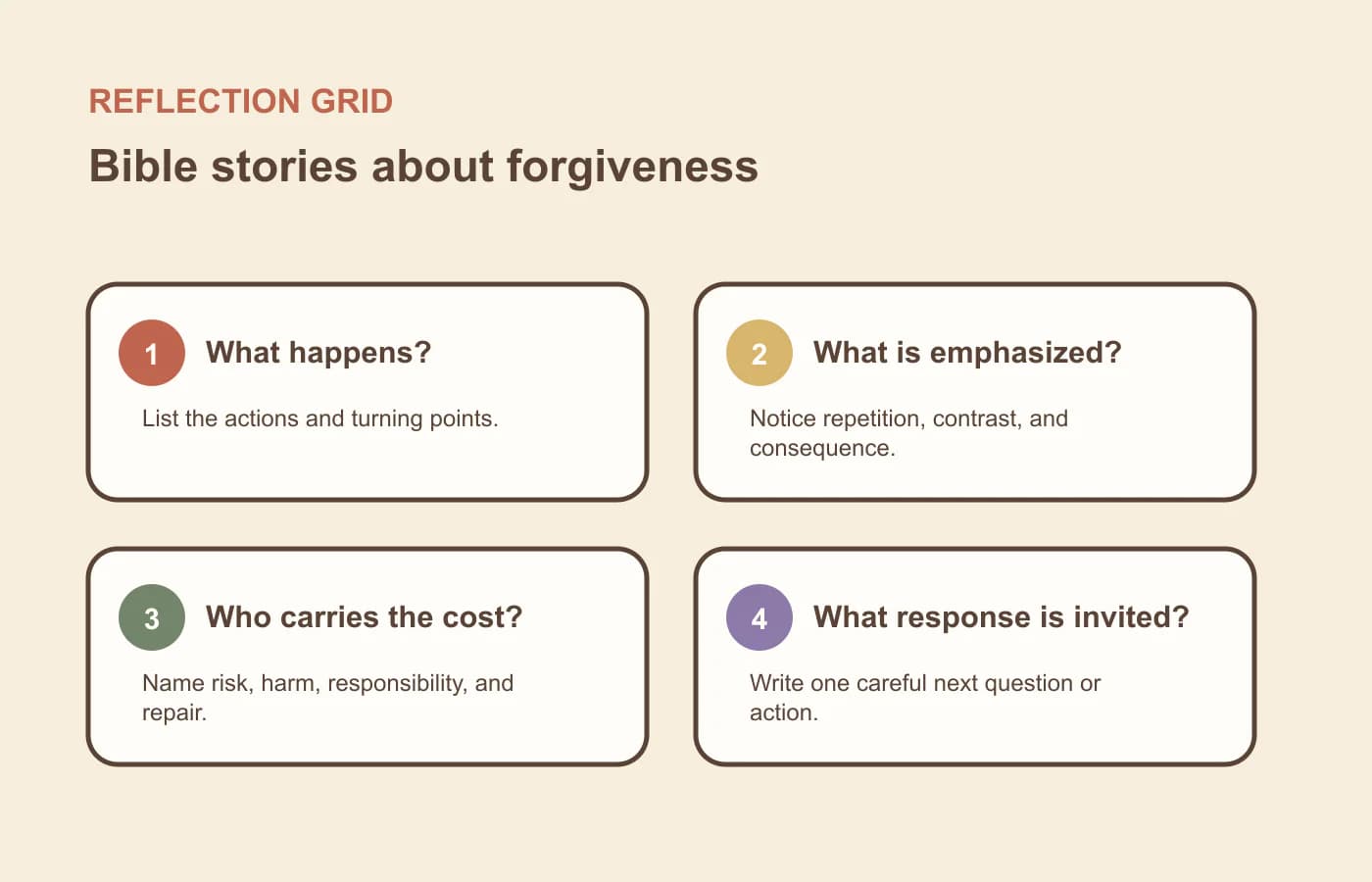
You can carry a small framework into any forgiveness passage, including ones this guide did not cover. Four questions keep harm and mercy visible at the same time:
What harm does the text actually name? Stay with observation before interpretation. Who was wronged, and does the narrative say so?
Who extends mercy, and what does it cost? Joseph's provision, the father's embrace, the king's cancellation of debt — each mercy has a shape and a price.
What repair or testing accompanies the forgiveness? Look for changed behavior, restitution, examination, or new responsibility.
What remains unresolved when the story closes? The older brother at the doorway, the consequences in David's house — unfinished threads are part of the teaching.
If you want a fuller method behind these questions, the guide on how to read the Bible in context walks through observation, context, and application step by step. The companion guide on how to take notes while reading the Bible shows how to keep your observations and open questions in one place as you work through a passage.
Frequently asked questions
Why did Jesus answer Peter's question about forgiving seven times with a much larger number?
In Matthew 18, Peter proposes seven as a generous ceiling, and Jesus answers with a figure beyond bookkeeping, then tells the parable of the unforgiving servant. The answer moves the discussion away from arithmetic and toward a settled posture of mercy shaped by the mercy we have received.
Does forgiving someone mean the relationship must go back to how it was?
No. Forgiveness and reconciliation are distinct movements. Forgiveness can be one-sided; reconciliation requires truth, change, and time from both sides. If contact is unsafe, you are not required to remain in or return to it, and qualified local help belongs in that situation alongside Scripture.
Which Bible characters struggled with unforgiveness?
The older brother in Luke 15 stays outside the feast and resents his brother's welcome. The servant in Matthew 18 receives an enormous release and immediately refuses a small one. Scripture treats withheld mercy as a serious failure, not a personality quirk.
What is a good first step for studying one of these stories on my own?
Read the full passage range in one sitting, then write down what the text names as the harm, what repair or testing accompanies the mercy, and one question the story leaves open. Keep those observations visible before moving to application.
Sources
Editorial status
Written and edited by Hans Keller for Bible Note. Sources, Scripture context, dates, and practical limitations are checked before publication.

About the author
Hans Keller
Editorial & Content Lead
Bible Study & Sermon Learning Content Editor
Hans helps Christians turn sermons and Scripture study into clear notes, thoughtful questions, and faithful next steps.
His work helps listeners and group leaders carry a sermon or study beyond the meeting: back to the passage, into clearer questions, and toward one practical response for the week.
Read with Scripture open
Use this guide alongside the full biblical passage and the practices of your local church. Interpretive details can differ across Christian traditions.
See more Bible Note on Google
Add Bible Note as a preferred source to help find our Bible study guides more easily in Google Search.