


You sit down with your Bible on a week when nothing has gone right. Maybe the diagnosis came back, the job ended, or someone you love is gone, and every devotional you open seems to skip past the hard part. You want Bible stories about hope in suffering that take the pain seriously before they point anywhere.
Here is the honest starting point: biblical hope can remain present while grief, unanswered questions, loss, and long endurance are still part of the story. The Bible's great narratives rarely move from suffering straight to relief. They linger in the middle, sometimes for chapters, sometimes for years inside the story. That lingering is what makes them worth reading in a hard season: they show what faith looks like while the outcome is still unknown.
This article walks through four such narratives and the Gospel accounts that finish the arc, then gives you a gentle way to reflect on them without turning your own pain into a lesson too quickly. Keep the passages open as you read.
Hope does not require denying suffering
A common instinct is to treat hope as the absence of negative emotion: if you truly trust God, you will stop grieving. The Bible's own stories quietly disagree. In them, hope looks like people continuing to bring their full, unedited situation to God while the situation itself stays bad.
Job argues with God at length. Joseph weeps. Naomi names herself bitter. David pours out complaint after complaint. The widows, exiles, and mourners of the Gospels cry at gravesides. In every case, the text lets those reactions stand as faithful responses and never corrects them for feeling too much.
That pattern matters for how you read: a story's restoration is its own conclusion, arrived at through loss, delay, and honest speech. Reading the whole arc keeps you from using someone else's ending to rush your own middle.
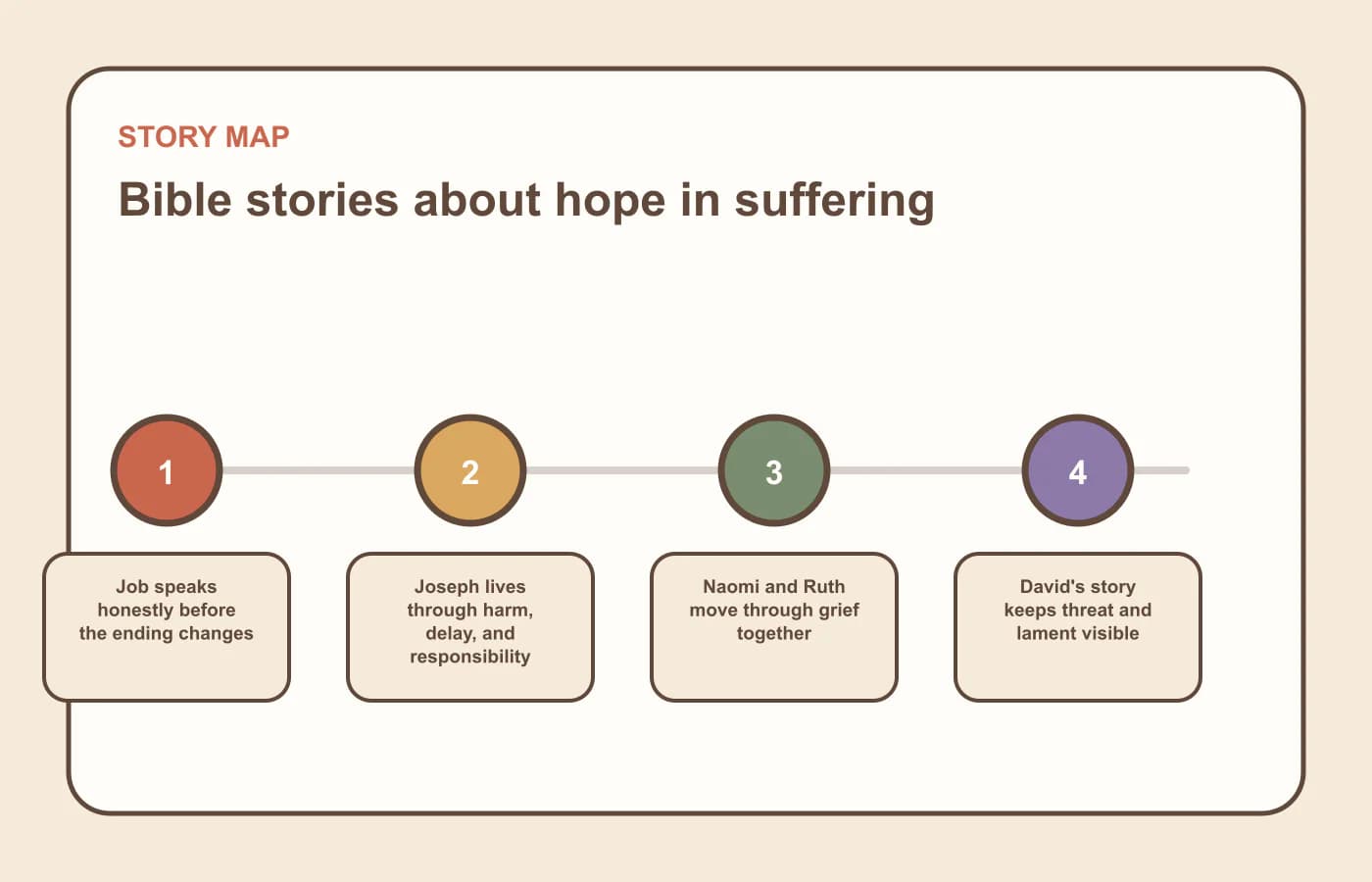
Job speaks honestly before the ending changes
Job opens with loss on a scale that is hard to absorb (Job 1:1-2:13). He loses his children, his livelihood, and his health in rapid sequence, and then he sits in ashes while his friends sit with him in silence for a week.
The middle is the argument
Most of Job is dialogue. Job refuses to pretend his suffering makes sense, and he refuses the tidy explanations his friends offer. He brings his questions directly to God, and the book treats that honesty as part of faith. When God speaks in Job 38, he rebukes the friends' confident theories while leaving Job's raw speech uncorrected.
The ending stays inside the story
Job's later restoration (Job 42) belongs to Job. It shows that the God who answers is also the God who restores, and it never becomes a rule that suffering ends in doubled livestock. What the book offers a reader in pain is permission to keep asking, to refuse false explanations, and to stay in conversation with God through a middle that lasts longer than anyone would choose.
Joseph lives through harm, delay, and responsibility
Joseph's story in Genesis 37-50 is often told as a success arc: favored son, betrayal, rise to power. Read at its own pace, it is mostly a story about delay. Joseph is sold by his brothers, serves faithfully in Potiphar's house, is falsely accused, and spends years in prison. Even after he interprets a cupbearer's dream, the text adds a quiet sentence: the cupbearer forgot him.
Two more years pass before anything changes. Through all of it, Joseph does the work in front of him well, and the text notes that God is with him in the pit, the house, and the prison alike. Presence comes before resolution, on a timeline Joseph never controls.
When Joseph finally speaks to his brothers, he names what they did honestly and also names a larger purpose God carried through it. That is testimony spoken from the far side of his own story. For a reader inside a prison season, the usable insight is steadier: faithfulness in the middle counts as faithfulness, even when no one remembers you yet.
Naomi and Ruth move through grief together
The book of Ruth begins with a famine, a move to Moab, and three funerals. Naomi returns to Bethlehem having buried her husband and both sons; when the town greets her, she asks to be called Mara, bitter (Ruth 1). The text records it without softening.
Grief and loyalty travel side by side
Ruth's famous pledge to stay with Naomi comes after the losses, spoken into them. What follows is ordinary, slow provision: gleaning in a relative's field, a cautious arrangement with Boaz, a marriage, a child. Nothing miraculous interrupts the story. Hope here takes the shape of people who keep showing up for each other inside a loss that never gets reversed.
The ending honors the empty years
When the women of Bethlehem celebrate the baby's birth, they name what God has restored to Naomi (Ruth 4). The story's redemption is real, and it still leaves her husband and sons in the ground. Ruth refuses to trade one truth for the other: the grief stays true, and provision arrives anyway, through loyalty and ordinary means.
David's story keeps threat and lament visible
David is anointed as a young man and then spends years running from Saul, hiding in caves, living among enemies, and composing prayers while hunted (1 Samuel 18 through 2 Samuel 5). David fills that long gap between promise and throne with lament.
Lament as a form of hope
The prayers preserved from this season move in a recognizable pattern: honest description of danger, direct appeal to God, and a declared turn toward trust while the danger is still present. The trust does not cancel the fear. David keeps both in the same prayer, which is what makes lament usable in an unresolved season. You do not have to feel safe to pray; the prayer itself is how you carry the fear to God.
Waiting without grabbing
Twice David has Saul within reach and refuses to take the throne by violence. That restraint shows hope working as patience: David trusts the promise enough to wait for it along a clean path, active and honest about the threat that makes waiting costly.
The Gospels place hope beside death and grief
In John 11, Jesus arrives at Bethany four days after Lazarus has died. Martha and Mary each tell him the same thing: if you had been here, our brother would still be alive. Jesus does not correct their grief or hurry past it. Standing at the tomb of a friend he is about to raise, he weeps. Resurrection hope and real tears occupy the same moment.
The resurrection accounts in Luke 22-24 keep that pattern. The women come to the tomb carrying spices for a body, fully expecting death to have the last word. The disciples on the Emmaus road describe their disappointment in past tense: they had hoped. Even after the empty tomb, recognition comes slowly, through conversation and a shared meal.
These narratives anchor Christian hope in something God has done in history, and they still make room for the grief of everyone standing at a grave. If your hope feels thin this week, you are in the company of people who walked to a tomb expecting a corpse.
A gentle way to reflect when life is hard
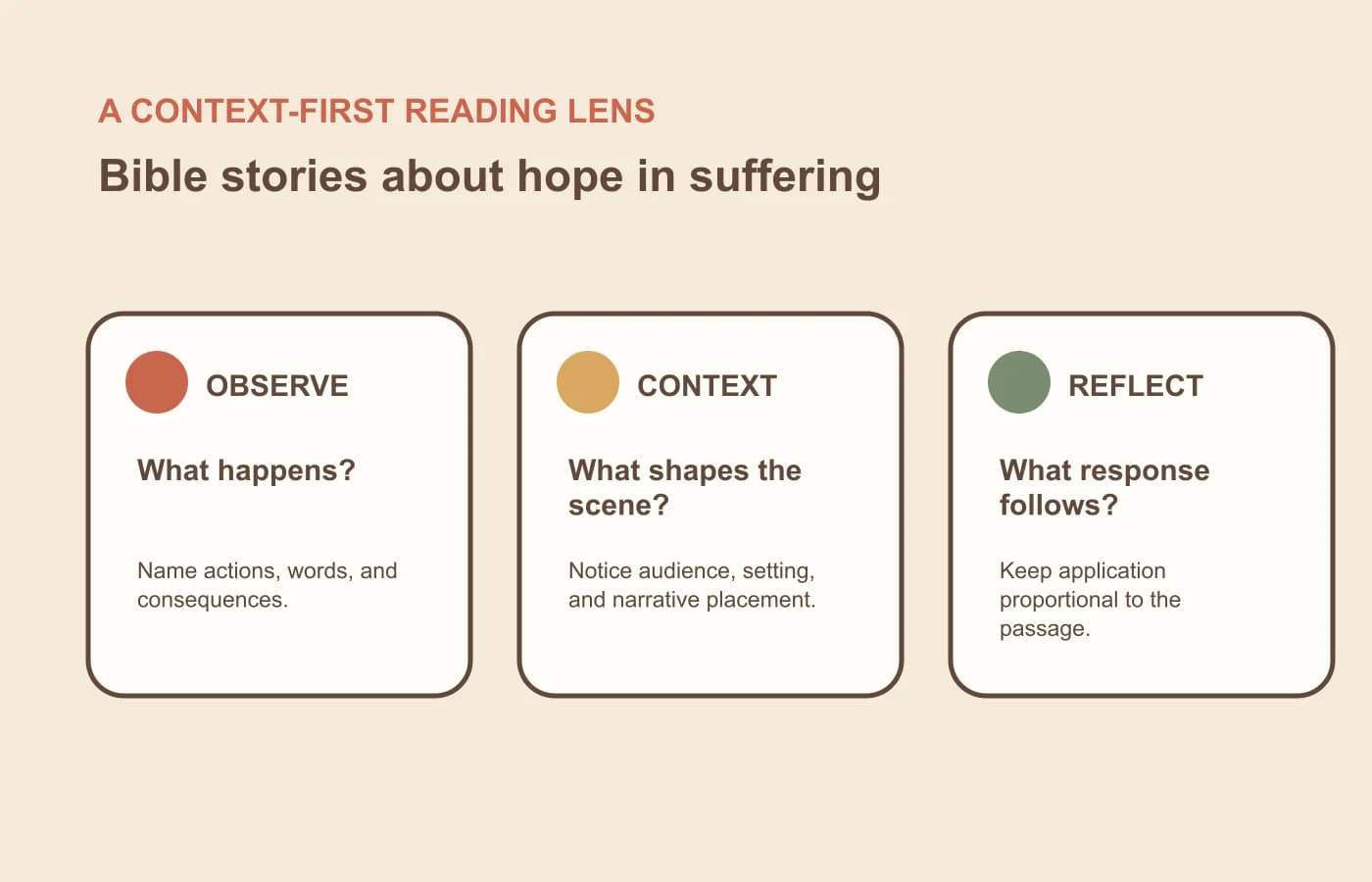
When you read one of these stories in a hard season, resist the urge to jump straight to application. A simple four-question grid keeps you honest with the text and gentle with yourself.
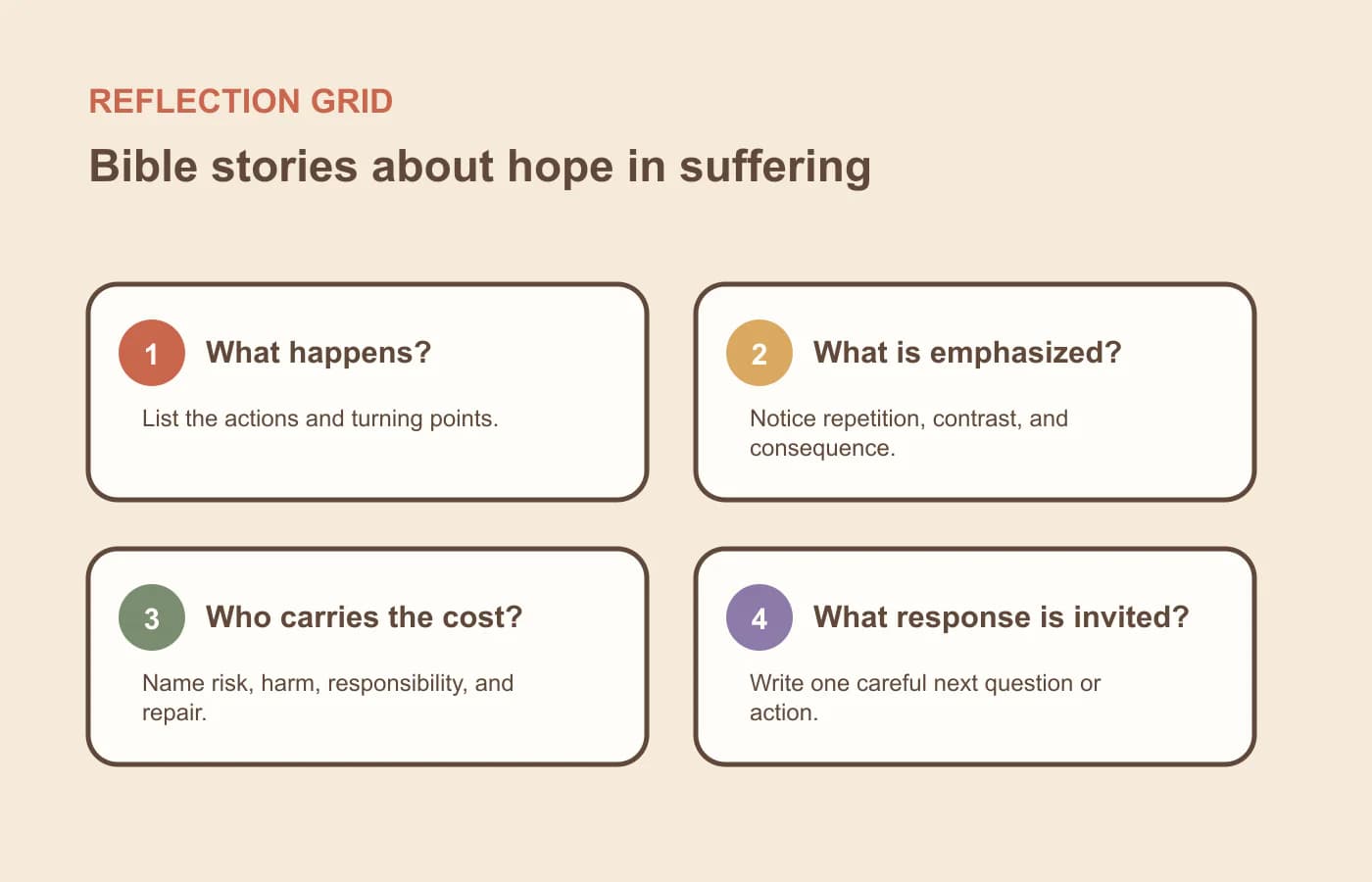
What actually happens? Observe the losses, delays, and reactions the text records, including the uncomfortable ones.
Where does hope appear, and in what form? Look for presence, loyalty, honest prayer, or quiet provision; hope often shows up in these shapes long before any resolution.
What does the story not claim? One character's restoration belongs to their story; it testifies about God without becoming a schedule for yours.
What is one honest response? A prayer in your own words, a conversation with someone you trust, or simply sitting with the passage again tomorrow.
To keep observation and interpretation distinct, it helps to read the Bible in context and to take notes while reading the Bible, so your questions and observations stay on the page instead of circling in your head. When you are ready to sit with a complete story, including its audio, the Modern Bible Stories collection gathers the published narratives in one place.
Frequently asked questions
What does the Bible say about hope in suffering?
Across these narratives, hope appears as God's presence and faithful endurance inside unresolved pain, with grief and honest questions still fully voiced.
How do I find hope in the midst of suffering?
Start by reading one whole story slowly, naming your own situation honestly in prayer, and staying connected to people you trust rather than forcing a quick lesson.
Who in the Bible struggled with hope?
Job questions at length, Naomi names herself bitter, David laments while hunted, and the Emmaus disciples admit they had hoped; the text treats each as faithful honesty.
Do these stories promise my situation will turn around?
Each restoration belongs to its own story; the passages invite trust and honest prayer without offering a guaranteed timeline for any reader.
Sources
Editorial status
Written and edited by Hans Keller for Bible Note. Sources, Scripture context, dates, and practical limitations are checked before publication.

About the author
Hans Keller
Editorial & Content Lead
Bible Study & Sermon Learning Content Editor
Hans helps Christians turn sermons and Scripture study into clear notes, thoughtful questions, and faithful next steps.
His work helps listeners and group leaders carry a sermon or study beyond the meeting: back to the passage, into clearer questions, and toward one practical response for the week.
Read with Scripture open
Use this guide alongside the full biblical passage and the practices of your local church. Interpretive details can differ across Christian traditions.
See more Bible Note on Google
Add Bible Note as a preferred source to help find our Bible study guides more easily in Google Search.