


A small group leader sits down on a Tuesday night to plan a series on leadership. She has two lists in front of her: Bible leaders usually presented as heroes, and the same leaders at their worst moments. The lists overlap almost completely. Moses, Gideon, David, Solomon — the same names appear on both. Her honest question is a good one: which Bible stories about leadership actually teach leadership, and what do the failures have to do with it?
The Bible's own answer is more useful than either list. Bible stories evaluate leadership by responsibility, treatment of people, response to counsel, use of power, and response after failure, not by visible influence alone. A leader can show real courage and still misuse power. A leader can confess sincerely and still face lasting consequences. The narratives keep these truths side by side, and that is what makes them worth studying.
This guide compares five sets of leadership stories — Moses, Gideon and Samson, Saul, David, and Solomon with Rehoboam — with their contexts intact, and ends with a short framework you can use on any leader before trusting a summary.
How Bible stories evaluate leadership
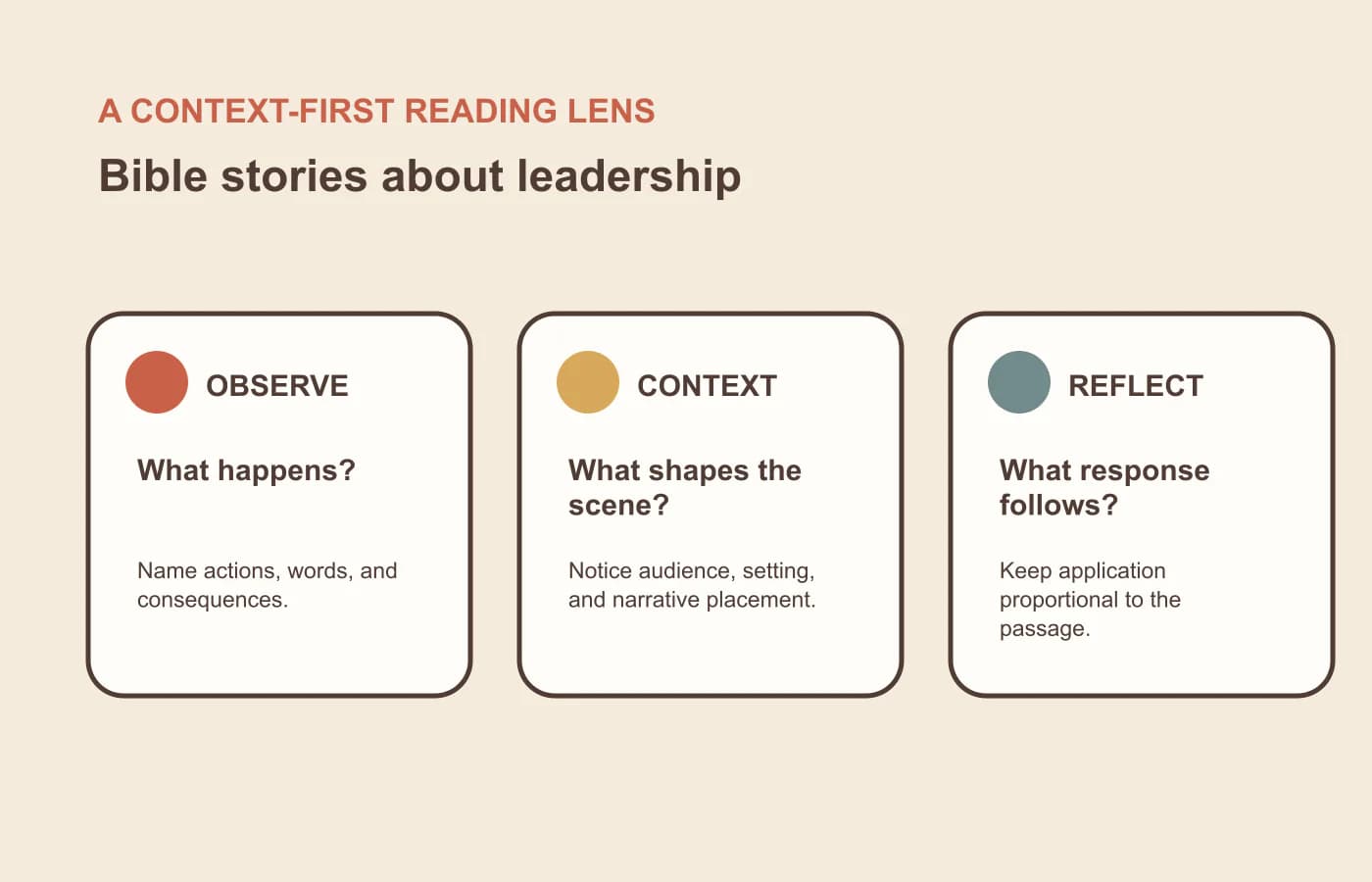
Read across the narrative books, and a consistent set of measures appears. The stories rarely grade a leader on charisma, military success, or the size of a following. They return instead to five questions:
Responsibility. Does the leader carry the weight of the role, or shift it onto the people, the circumstances, or God?
Treatment of people. Are the people served, protected, and heard — or managed, burdened, and used?
Response to counsel. What happens when someone wiser speaks a hard word?
Use of power. When the leader holds real authority, whom does that authority serve?
Response after failure. When the leader fails — and nearly every leader in these stories fails — what comes next: concealment, excuse, partial admission, or open confession?
These five measures show up from the wilderness to the divided kingdom. Watching them at work in the text teaches more than any extracted leadership principle, because the narratives show what each measure costs.
Moses leads under pressure and needs shared help
Moses is the Bible's longest leadership study, and it begins with reluctance. At the burning bush (Exodus 3–4), he objects repeatedly — about his credibility, his knowledge, and his speech — before accepting the call. Leadership in these stories is assigned under God; confidence in the leader's own ability is a shaky foundation from the start.
The wilderness years show what sustained pressure does. In Exodus 18, Moses sits from morning to evening judging every dispute personally, until his father-in-law Jethro names the problem: the work is too heavy for one man, and it will wear out both Moses and the people. Moses listens and appoints capable men over thousands, hundreds, fifties, and tens. A leader of unmatched authority accepts structural correction from a relative outsider — a quiet model of receiving counsel.
The same Moses later fails at Meribah (Numbers 20:1–13). Told to speak to the rock, he strikes it twice in anger. The water still comes; the consequence still stands — Moses is barred from entering the promised land. The narrative holds together what readers often separate: God provides for the people through a flawed leader, and the leader's failure still carries weight.
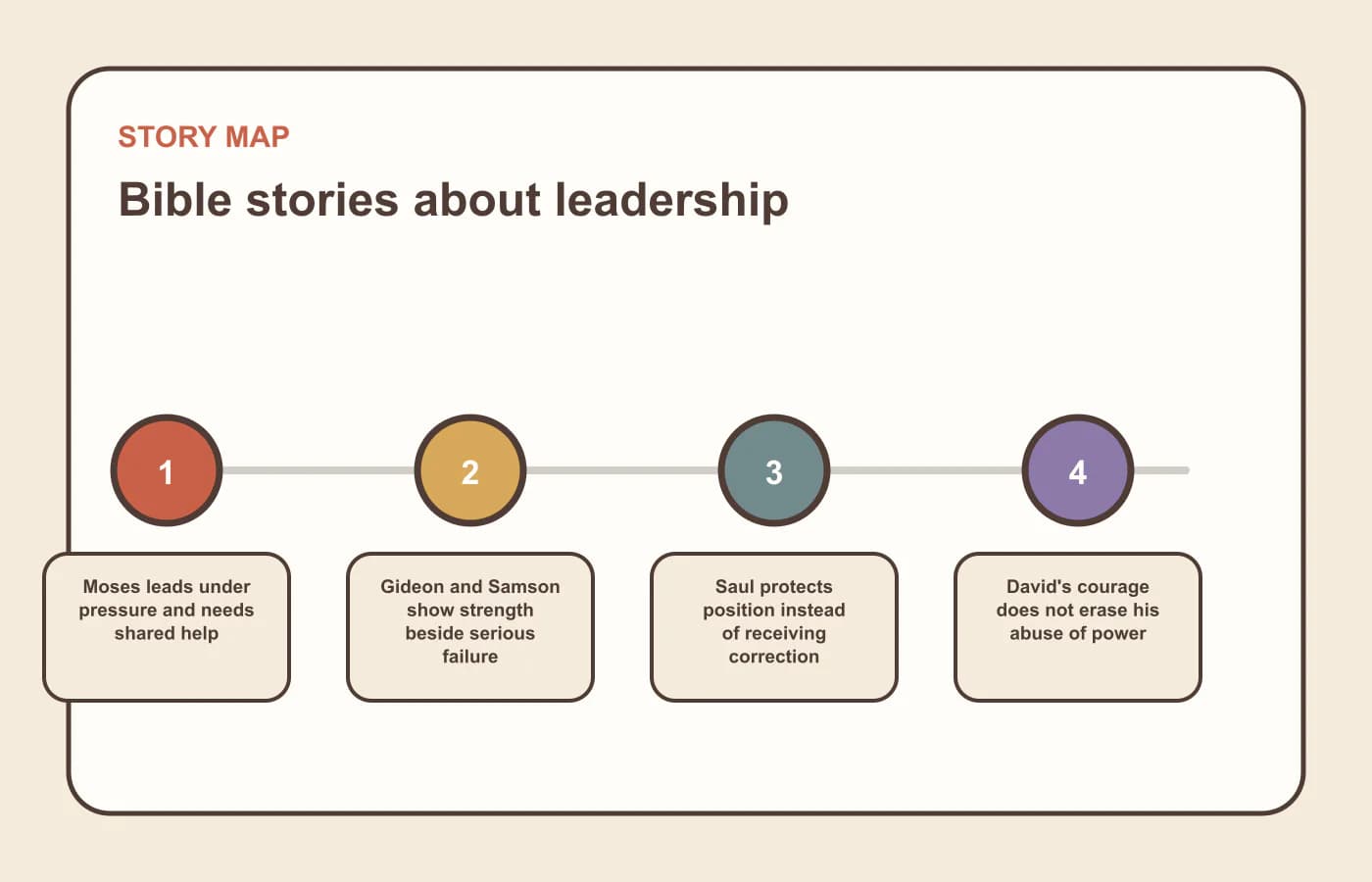
Gideon and Samson show strength beside serious failure
Gideon: courage that grows, then a compromised legacy
Gideon's story (Judges 6–8) begins with a man threshing wheat in hiding, addressed as a mighty warrior. He asks for signs, reduces his army at God's direction to three hundred, and wins a victory the narrative attributes to God rather than numbers. When the people want to make him a dynastic ruler, he refuses the crown.
Then the same Gideon collects gold from the plunder and makes an ephod — a priestly object that becomes an object of worship and, the text says, a snare to him and his family. Courage in the crisis and compromise in the aftermath belong to the same story.
Samson: strength without stewardship
Samson's account (Judges 13–16) is announced before his birth, and his strength is genuinely given. Yet the stories show a leader who spends that gift on personal appetite and private grievance. He breaks his Nazirite commitments, trusts the wrong people with his secret, and loses his strength, his sight, and his freedom.
Together, Gideon and Samson answer a question readers bring to these stories: real courage and serious failure can coexist in one leader, and the text presents both without canceling either. The lesson is not that the courage was fake — it is that courage alone does not complete a leader.
Saul protects position instead of receiving correction
Israel asks for a king (1 Samuel 8), and Saul looks the part — tall, striking, initially hesitant. His decline is worth reading slowly, because it happens through decisions that each look defensible from the inside.
In 1 Samuel 13, with the army scattering and Samuel delayed, Saul offers the sacrifice himself. In 1 Samuel 15, commanded to destroy Amalek completely, he spares the king and the best livestock — and then describes the spared animals as a sacrifice to God. When Samuel confronts him, Saul explains, then justifies, and admits only under pressure; even then, his concern is that Samuel honor him before the people.
The pattern the narrative draws is partial obedience paired with image management. Saul rarely rejects instruction outright; he adjusts it, performs most of it, and protects how it looks. Each adjustment moves him further from the role he was given. For readers evaluating leaders today, Saul's story is a study in how decline often arrives: as a series of reasonable-sounding exceptions.
David's courage does not erase his abuse of power
David's courage is famous and real — the young shepherd facing Goliath remains one of Scripture's defining scenes of trust under pressure. That same David, years later as king, is the subject of 2 Samuel 11–12, and the passage has to be read for what it actually describes.
David sees Bathsheba, the wife of Uriah, one of his own loyal soldiers. He sends for her — an act a king can perform and a woman in her position can hardly refuse — and she becomes pregnant. David tries to cover the pregnancy by recalling Uriah from battle; when Uriah's integrity defeats the scheme, David arranges his death at the front and takes Bathsheba into his house. This is a misuse of royal power at every stage: power to summon, power to conceal, power over life itself. The text assigns responsibility to David, and a faithful reading does the same.
When the prophet Nathan confronts him with a parable about a rich man who takes a poor man's lamb, David names himself as the man and confesses without excuse. Nathan announces forgiveness — and also consequence. The child born from the affair dies, and violence enters David's own household for the rest of his reign.
This distinction matters for how the story gets used. Confession is real, and forgiveness is announced. Consequences are also real, and they are not retracted. Trust, once broken at this scale, is its own long work, and fitness for leadership is a separate judgment again. A story that shows grace and consequence at full weight teaches more than either half alone.
Solomon and Rehoboam expose failures of counsel and power
Solomon: wisdom received, wisdom drifted
Solomon begins well. Offered anything at Gibeon (1 Kings 3), he asks for discernment to govern the people, and the request pleases God. His early reign shows what that wisdom produces: justice people travel to see, and a reputation that draws the Queen of Sheba.
The same account records the drift (1 Kings 11). Solomon's many marriages turn his heart toward other gods, and the king who built the temple builds high places for them. The failure is gradual — the text describes a heart slowly divided — and the announced consequence falls on the kingdom itself.
Rehoboam: counsel refused, a kingdom divided
The division arrives through a failure of counsel. At Shechem (1 Kings 12), the people ask Rehoboam to lighten the heavy labor his father imposed. The older advisors tell him to serve the people and answer them kindly; the younger men tell him to increase the burden. Rehoboam chooses the harsh answer, and ten tribes walk away. The united kingdom ends in a single scene, over a question about how much weight leadership will place on other people's backs.
Solomon and Rehoboam belong together: a leader can begin with wisdom, make burdens heavier, and leave division for a successor who refuses corrective counsel.
A leadership review built around responsibility
The five measures from the first section form a short review for any leader or decision. Work through it with the text or facts open.
Responsibility: When something goes wrong, does the leader own it or shift blame?
Treatment of people: Who carries the cost? David's treatment of Uriah and Rehoboam's heavier yoke make the answer visible.
Use of power: Whom does this leader's authority serve, and who bears its cost?
Response to counsel: What happened when correction came? Moses listened; Saul explained himself; Rehoboam chose flattery.
Response after failure: Keep confession, forgiveness, consequence, and future trust distinct. Repentance can be genuine while accountability or a different role remains necessary.
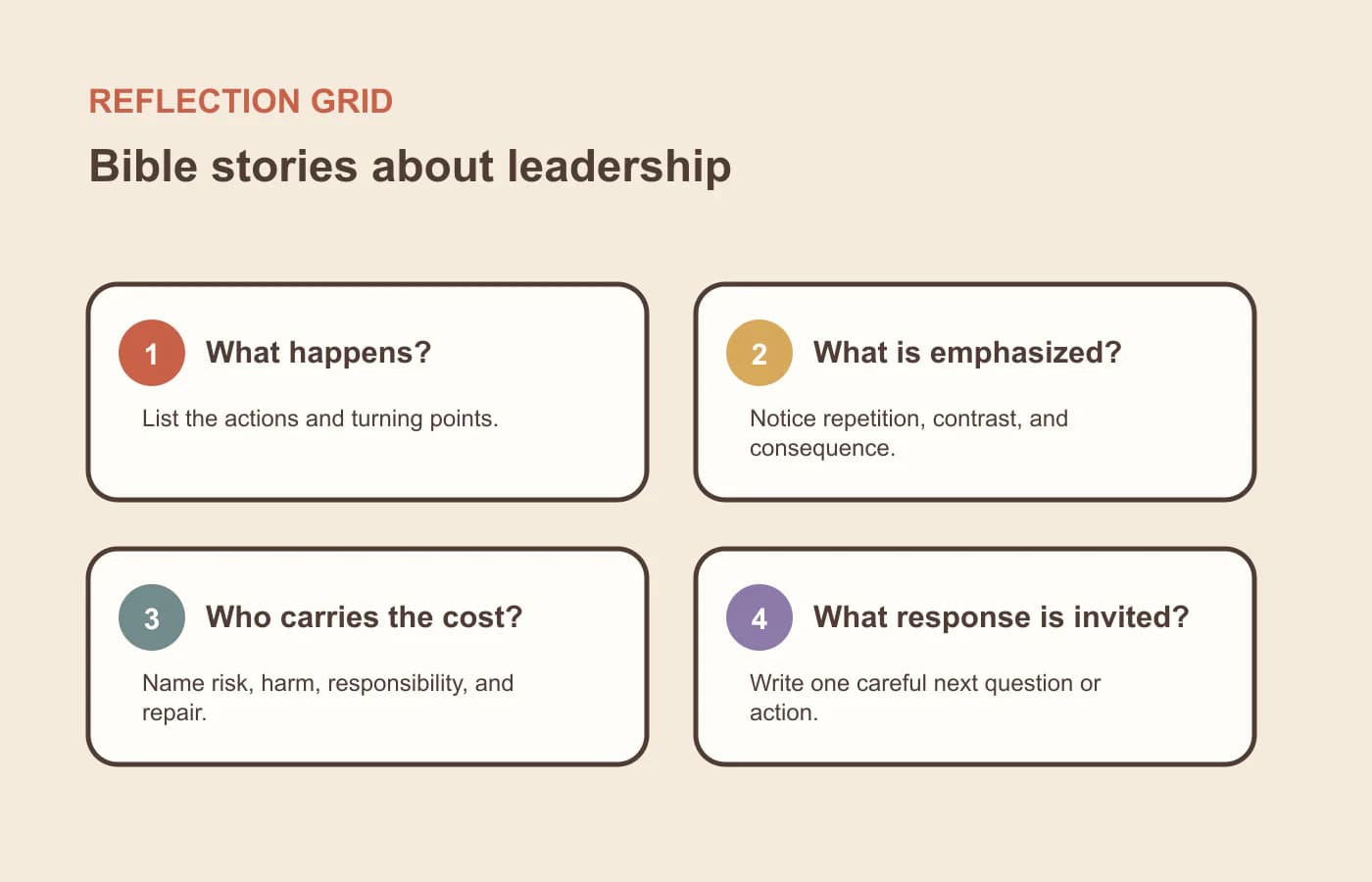
For close reading, read the Bible in context and take notes while reading. The Modern Bible Stories collection gathers currently published accounts with complete text and audio.
Frequently asked questions
What makes a Bible leader worth studying?
The stories return to responsibility, treatment of people, counsel, power, and response after failure. Moses, David, and Solomon show courage and failure together.
Does failure disqualify a leader in the Bible?
The stories separate repentance, forgiveness, consequence, restored trust, and fitness for a role. Moses and David show why each deserves attention.
Which book of the Bible teaches leadership?
No single book owns it. Exodus, Numbers, Judges, Samuel, and Kings teach through leaders under pressure and failure. Read the full narratives.
How do I study these stories without flattening them into morals?
Read each story at the length the passage gives it, note what the text says before deciding what it means, and keep one honest question open. The four-question review in this article gives you a repeatable structure for that work.
Sources
Editorial status
Written and edited by Hans Keller for Bible Note. Sources, Scripture context, dates, and practical limitations are checked before publication.

About the author
Hans Keller
Editorial & Content Lead
Bible Study & Sermon Learning Content Editor
Hans helps Christians turn sermons and Scripture study into clear notes, thoughtful questions, and faithful next steps.
His work helps listeners and group leaders carry a sermon or study beyond the meeting: back to the passage, into clearer questions, and toward one practical response for the week.
Read with Scripture open
Use this guide alongside the full biblical passage and the practices of your local church. Interpretive details can differ across Christian traditions.
See more Bible Note on Google
Add Bible Note as a preferred source to help find our Bible study guides more easily in Google Search.