


Imagine a Wednesday evening when a small group reads the story of Saul and the Amalekites, and the room divides. One reader hears a straightforward lesson about doing what God says. Another sits with the troubling parts and wonders what the story is really asking of her. Both readers are closer to the text than the person who reduces the story to a single sentence about obeying your parents.
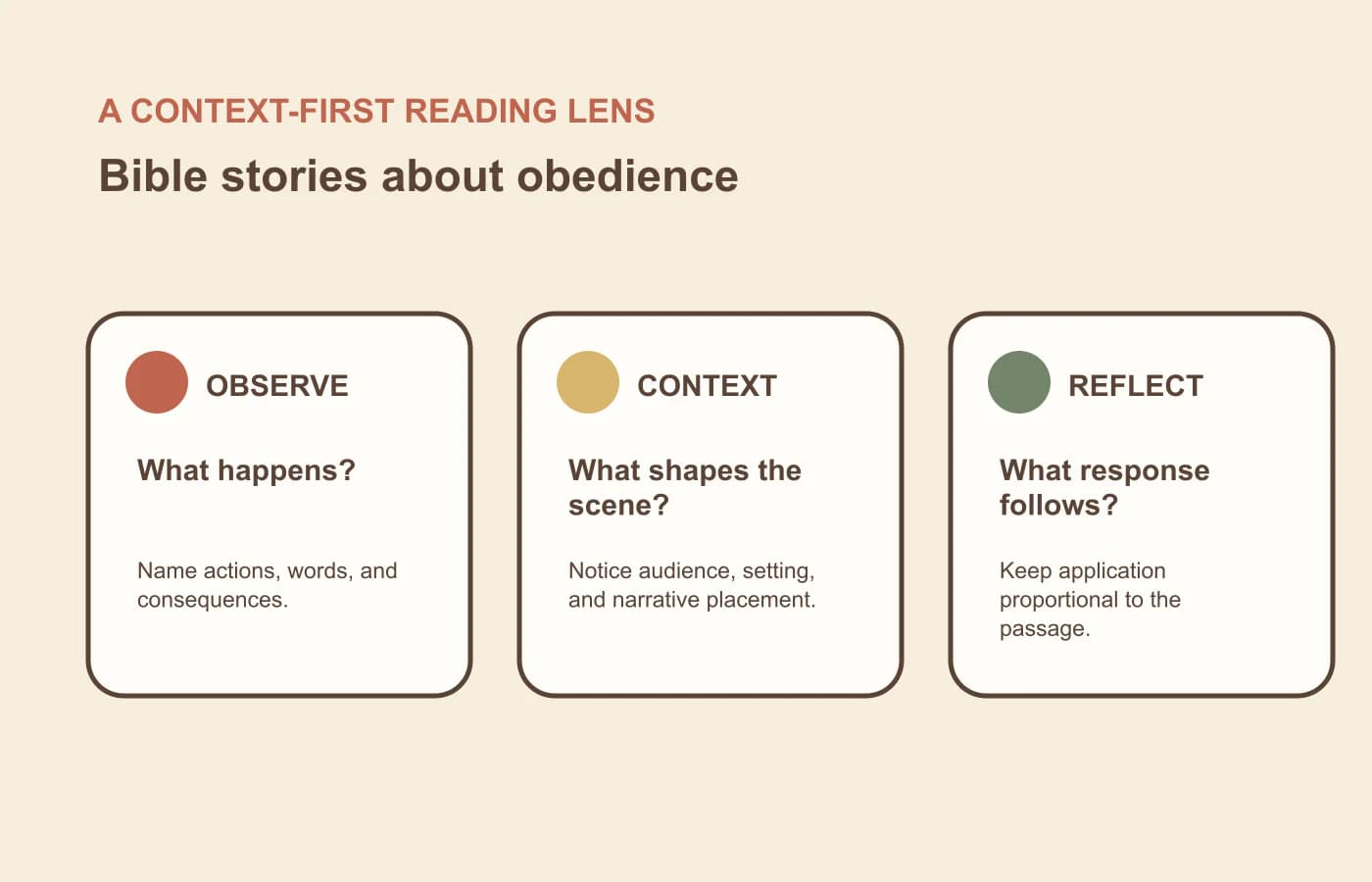
Before drawing a moral from any Bible story about obedience, ask five questions: Who is speaking? What exactly is commanded? How does the person respond? Who bears the consequence? And does mercy open a renewed response? Those five questions keep the narrative in charge of the lesson, and they work across every story in this guide. We will trace them through Noah and Abraham, the twelve spies, Saul, Jonah, and Jesus' disciples, watching how listening, resistance, consequence, mercy, and renewed response actually appear in the text.
How to read a story about obedience
The five questions above form a simple framework you can carry into any narrative. Take them in order, and let each one slow you down.
Who is speaking? In these stories, the command comes from God directly or through a prophet the narrative identifies. That claim carries weight, so the first task is noticing how the text establishes it.
What is commanded? Name the actual instruction. Noah receives directions about a boat. Saul receives a specific order about Amalek. Vague impressions are harder to test than the concrete commands the text records.
How does the person respond? Watch for the full range: prompt action, delay, flight, partial compliance, argument, and quiet resistance after outward agreement.
Who bears the consequence? Sometimes the individual does. Sometimes a family, an army, or an entire generation carries it.
Does mercy open a renewed response? Many of these stories continue past the failure. Look for whether the person is addressed again and what changes the second time.
Write the five answers in a notebook as you read, even in a few words each. The habit of answering them from the passage itself is the whole method, and the guide on how to read the Bible in context walks through the wider discipline behind it.
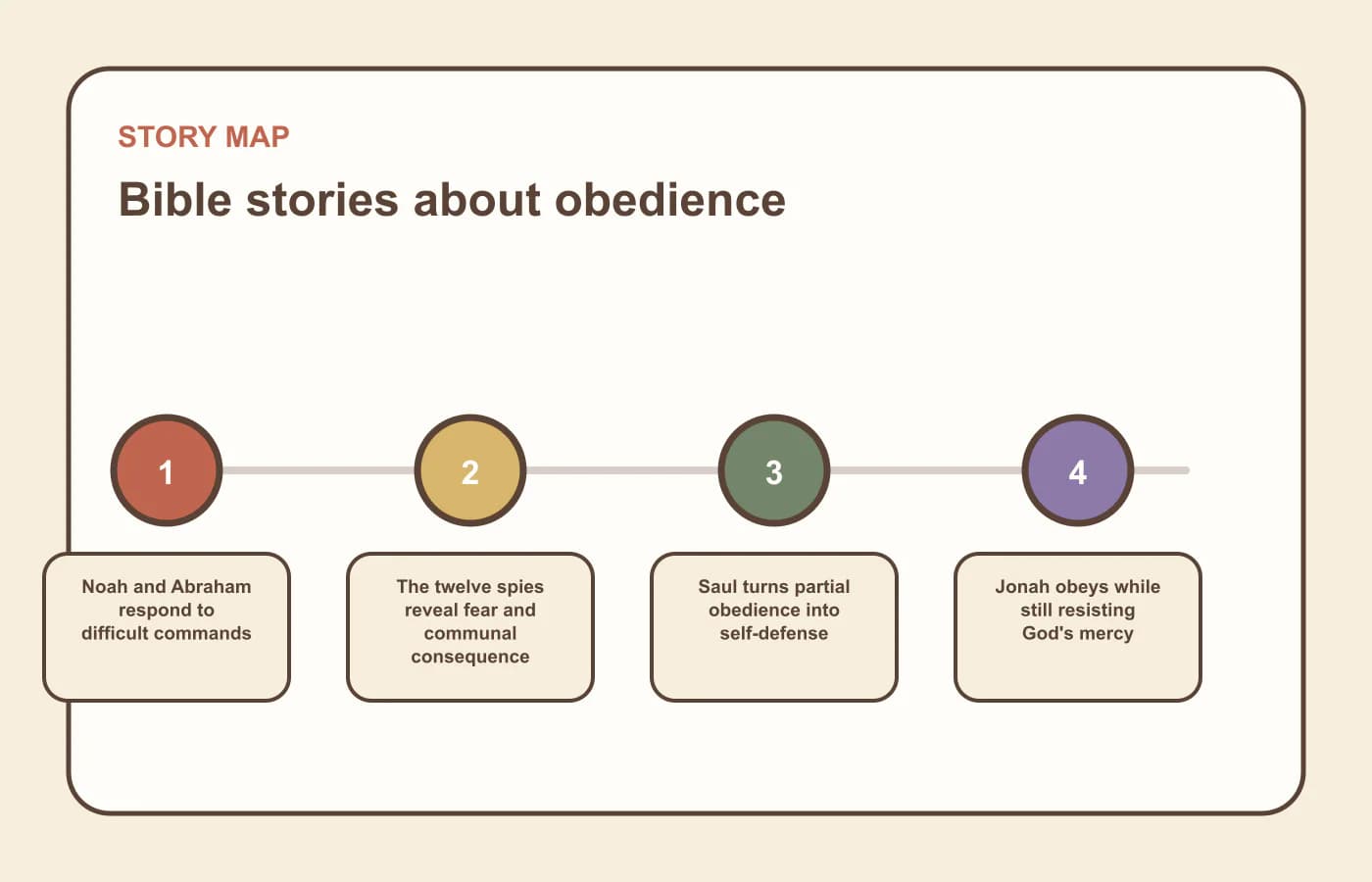
Noah and Abraham respond to difficult commands
The opening books of Genesis give two obedience stories that share a shape and differ in almost every detail.
Noah builds through sustained work
In Genesis 6:5-9:17, God announces judgment on a violent world and directs Noah to build an ark with exact dimensions. Noah's obedience is quiet, expensive, and slow. The text repeats that he did what God commanded, and the work demands sustained action through ordinary days. Trust here looks like faithful work with no visible evidence until the rain begins. When the flood recedes, God makes a covenant with Noah and every living creature, marked by the rainbow. Consequence falls on the world; mercy lands on a family and, through them, on the future.
Abraham trusts across a lifetime
Abraham's story runs from Genesis 12:1 through 22:19. He is called to leave his country for a land he will receive later, and he goes. Decades of waiting, detours, and failures sit between that departure and the test on Mount Moriah, where God asks for Isaac and then stops Abraham's hand, providing a ram instead. The narrative is deliberate about the intervention: the command is rescinded within the story, Isaac lives, and the account closes with promise. The passage presents trust under extreme testing within Abraham's unique calling. The account belongs to Abraham alone, and the article's final section explains why it can never be turned into a model for anyone's treatment of a child.
The twelve spies reveal fear and communal consequence
Numbers 13:1-14:45 shows how resistance moves through a community. Twelve men scout the promised land and return with its fruit. All twelve agree the land is good. Ten then describe its inhabitants as unbeatable, and their report spreads through the camp overnight. By morning the whole assembly is weeping, proposing a return to Egypt, and ready to stone the two men, Caleb and Joshua, who urge them to trust God and go forward.
The consequence falls on the generation that refused to enter: forty years in the wilderness, one for each day of the scouting trip. When part of the group then tries to invade the land on its own timing, that effort fails too. The narrative is unusually honest about the mechanism of disobedience here. Nobody announces rebellion. Fear is presented as sober realism, repeated until an entire community calls it wisdom, and the two dissenting voices are nearly silenced by the crowd they were sent to serve.
Saul turns partial obedience into self-defense
In 1 Samuel 15:1-35, King Saul receives a specific command through the prophet Samuel concerning Amalek. Saul wins the battle and keeps the king alive along with the best of the livestock. When Samuel arrives, Saul greets him with a report of completed obedience. Samuel answers that he can hear sheep. Saul then reframes the spared animals as material reserved for sacrifice, and finally admits he feared the people and listened to their voice.
Every layer of the story exposes selective listening. Saul hears the command, edits it, performs the edited version, and defends the edit with religious language. Samuel's verdict, that attentive obedience matters more to God than sacrifice, lands precisely because Saul had just used sacrifice as his excuse. The consequence is severe and personal: the kingdom is torn from him. Read slowly, this is one of the Bible's sharpest studies of how a person can do most of what was asked, say all the right words, and still be resisting.
Jonah obeys while still resisting God's mercy
Jonah's four chapters hold two different acts of obedience and one sustained inner refusal. In Jonah 1:1-3, God's word sends him to Nineveh and he buys a ticket in the opposite direction. The storm, the sailors, and the great fish follow, and Jonah prays from inside the fish in chapter 2. In chapter 3 the word comes a second time, and Jonah goes. He preaches, and Nineveh repents.
Then chapter 4 reveals what the outward obedience was covering. Jonah is angry that God showed mercy to the city, angry enough to say this is exactly why he ran. He had complied with the mission while disagreeing with its point. God's closing question, whether Jonah is right to be angry and whether God should care about the great city, is left hanging for the reader. The story separates outward action from inward assent more cleanly than any other in this guide: a person can complete the assignment and still be at war with the mercy behind it.
Jesus' disciples learn through failure and renewed response
The Gospels extend the pattern into a community of learners. In Mark 8:27-10:52, Peter correctly names Jesus as the Christ and then immediately objects to Jesus' teaching about suffering. The disciples argue about which of them is greatest. James and John ask for the seats of honor. Again and again they hear, misunderstand, and push back, and again and again Jesus corrects them and keeps them close. Their slowness is recorded without flinching, and so is the continued calling.
John 21:1-19 shows the far side of that patience. After the resurrection, Jesus meets the disciples at the Sea of Galilee, where they have gone back to fishing. Over a charcoal fire he asks Peter three times whether Peter loves him, and three times entrusts him with the care of the flock. Peter, who had failed most publicly, is addressed again and sent back to work. Here the fifth question of our framework gets its clearest answer: mercy opens a renewed response, and the renewal is given to someone who had already fallen short.
Obedience, conscience, authority, and harm
These stories require one boundary held firmly. In each narrative, the command comes from God, identified by the text itself. Nothing in them authorizes a human being to claim that same authority over another person. Obedience language has been misused to demand unquestioning submission to parents, spouses, leaders, and institutions, and Scripture's obedience stories were not written for that purpose. Anyone facing coercion or abuse deserves safety and qualified local help, and no Bible story should be used to delay either.
A boundary for conscience and harm
The Abraham and Isaac account records God's intervention stopping the act and stands alone in Scripture. It cannot serve as a template for harming a child or calling such harm faith. These stories also do not teach that every hardship is a consequence of disobedience; readers should resist assigning guilt the passage never assigns.
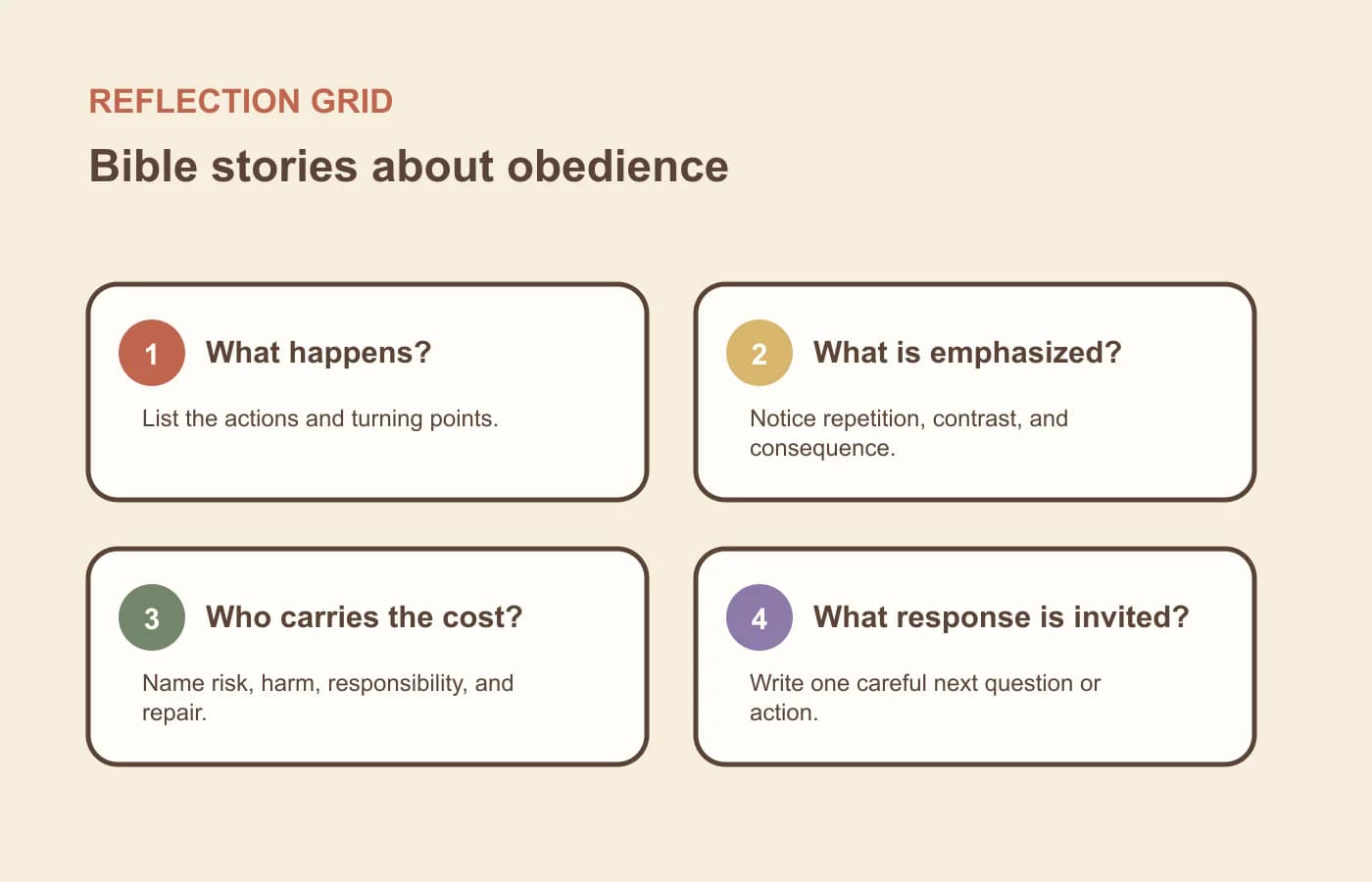
A four-question reflection grid keeps study inside these boundaries:
What does the text actually record? Separate observation from the lesson you want to draw.
Who is speaking, and how does the narrative establish it? Treat that claim with the seriousness the text gives it.
Who bears the consequence, and does mercy reopen the story? Follow both threads to the end of the passage.
Does my reading protect the vulnerable? If an application would excuse coercion or harm, the application has left the text behind.
Writing these answers down makes the method repeatable, and the guide on how to take notes while reading the Bible offers a practical structure for observations and questions. The Modern Bible Stories collection holds complete text and audio for stories Bible Note currently publishes.
Frequently asked questions
Who in the Bible showed obedience?
Noah, Abraham, Caleb, Joshua, and the disciples show obedience in distinct settings. Read their whole narratives alongside their failures.
Is every hardship a consequence of disobedience?
No. Numbers 14 names a consequence, while many hardships receive no such explanation. Assign guilt only where the narrative does.
How should I read the story of Abraham and Isaac with children?
Read the whole account in Genesis 22, including God's intervention that stops the act and provides the ram. The story belongs to Abraham's unique calling and stands alone in Scripture. Presenting it as a model for how anyone should treat a child reverses what the narrative itself insists on.
Where can I read these obedience stories in full?
Read the passages listed in the Sources section in your own Bible, working through whole chapters so context stays visible. Bible Note's Modern Bible Stories collection provides complete text and audio for stories it currently publishes.
Sources
Editorial status
Written and edited by Hans Keller for Bible Note. Sources, Scripture context, dates, and practical limitations are checked before publication.

About the author
Hans Keller
Editorial & Content Lead
Bible Study & Sermon Learning Content Editor
Hans helps Christians turn sermons and Scripture study into clear notes, thoughtful questions, and faithful next steps.
His work helps listeners and group leaders carry a sermon or study beyond the meeting: back to the passage, into clearer questions, and toward one practical response for the week.
Read with Scripture open
Use this guide alongside the full biblical passage and the practices of your local church. Interpretive details can differ across Christian traditions.
See more Bible Note on Google
Add Bible Note as a preferred source to help find our Bible study guides more easily in Google Search.