


A waiting season often sends people to the Bible with a specific kind of search. A medical result is still pending. An application has gone quiet. A prayer has been repeated so many times it has started to feel rehearsed. The question underneath a search for Bible stories about patience is usually personal: has anyone in Scripture waited this long, and what did they actually do while they waited?
The answer is yes, and the honest answer is richer than a list of tidy morals. Biblical patience is active endurance: people wait, pray, work, prepare, and sometimes struggle while the outcome remains outside their control. The five accounts below — Abraham and Sarah, Joseph, Hannah, David, and the waiting witnesses Simeon and Anna — show patience in different shapes, with references so you can read each story at full length.
What patience looks like in a Bible story
Passivity is rare in these accounts. The patient people of Scripture are busy: Abraham travels and builds altars, Joseph manages a household and then a prison, Hannah keeps showing up at Shiloh to pray, David fights battles and spares a king, Simeon and Anna keep returning to the temple. Waiting fills their calendars with ordinary faithfulness rather than freezing them in place.
These stories also refuse to flatter their heroes. The same chapters that praise endurance preserve doubt, misreadings, and real harm. Genesis includes Abraham and Sarah's shortcut through Hagar and the fallout that follows. Patience appears in the text as something people practice imperfectly, inside families and courts and sanctuaries, across years that rarely come with explanations.
Abraham and Sarah wait through promise and doubt
The longest wait in this guide belongs to Abraham and Sarah (Genesis 12:1–21:7). Abraham is seventy-five when God calls him to leave home with a promise of descendants, and he is a hundred when Isaac is finally born. Between those two verses stand about twenty-five years of travel, famine, conflict, and silence.
A promise that outlasts the calendar
Genesis lets the strain show. Sarah, hearing the announcement of a son in her old age, laughs. Abraham asks questions and negotiates. The text records the waiting with the doubt left in, which makes the birth of Isaac land as the fulfillment of a promise that survived the couple's own timetable — and sometimes their own confidence.
A shortcut with real costs
The middle of the story includes a human attempt to hurry the promise: Sarah gives her servant Hagar to Abraham, and Ishmael is born. The chapter does not commend that arrangement, and the household fractures under it. A careful reading holds both facts together. God keeps the promise, and the shortcut still wounds people. Waiting poorly is part of the record, which is part of why the story can teach.
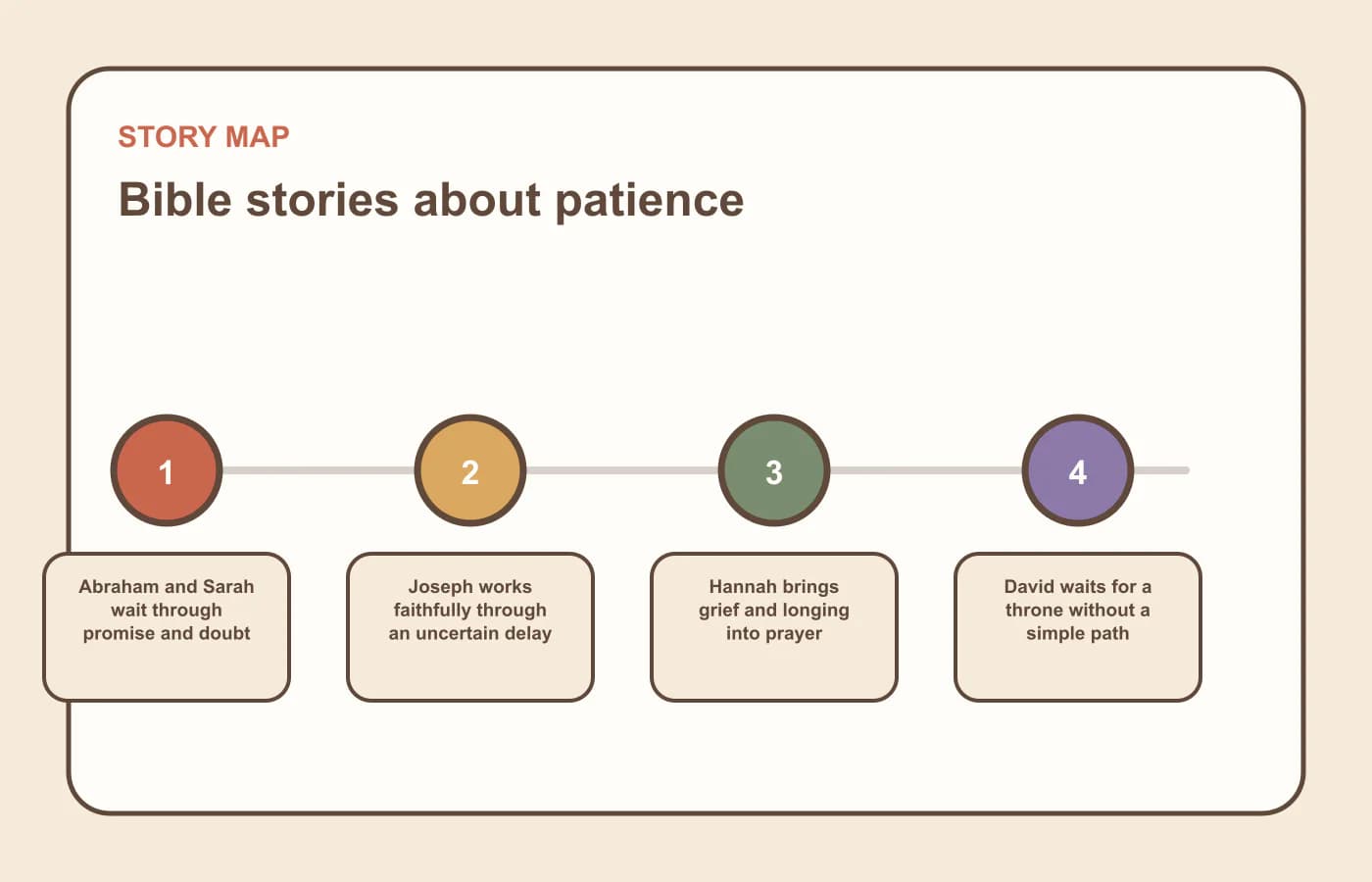
Joseph works faithfully through an uncertain delay
Joseph's patience carries no promise he can see (Genesis 39:1–41:57). Betrayed by his brothers and sold into Egypt, he serves faithfully in Potiphar's house, refuses his master's wife, and lands in prison for the refusal. In prison he is again found reliable, interprets dreams for two officials, and asks the cupbearer to remember him. The cupbearer forgets, and Genesis notes that two full years pass before Pharaoh's dreams pull Joseph out.
What stands out is where Joseph's patience lives. He cannot fix his circumstances, and the text never explains to him why the delay stretches on. What he can do is the work in front of him: administrate a household, serve fellow prisoners, interpret dreams honestly. When circumstances stay unfair, patience in this story looks like continuing faithful work in a place you did not choose, without a visible timetable.
Hannah brings grief and longing into prayer
Hannah's story (1 Samuel 1:1–3:21) opens in a household marked by rivalry. She is childless, her husband's other wife provokes her year after year, and even her husband's comfort misses the point. At Shiloh she prays so intensely, and so silently, that the priest Eli mistakes her for drunk. She corrects him plainly: she is pouring out her grief.
Prayer that tells the truth
Persistence and honesty travel together here. Hannah returns to the same longing year after year, and she does not tidy it up before bringing it to God. When Samuel is born, she keeps her vow and dedicates him to God's service, and her prayer in chapter 2 widens into praise that reaches beyond her own household.
One boundary matters for every reader who brings infertility, illness, or loss to this passage: Hannah's story is a narrative, not a fertility promise. Scripture does not present her outcome as a template God owes anyone. What the story offers is a pattern of truthful, persevering prayer, held alongside God's freedom to answer differently.
David waits for a throne without a simple path
David is anointed as a shepherd boy (1 Samuel 16:1–2 Samuel 5:5) and becomes king of Judah at thirty, and king over all Israel later still. Between the anointing and the throne lie years of service in Saul's court, military success, and then Saul's murderous jealousy, which turns David into a fugitive.
Twice during those years David has Saul within reach — once in a cave, once in a camp at night — and twice he refuses to kill the man who stands between him and the crown. That restraint is the heart of his patience. A shortcut to the throne exists, and he declines it because of what Saul's office means. Waiting, for David, includes refusing the wrong door when it opens.
The years in caves and foreign towns also include fear, compromise, and some ugly decisions, and the account stays honest about those too. David's patience is a long obedience punctuated by failure, ending with a coronation he never seized by violence against Saul.
Simeon and Anna keep watch across many years
Luke 2:22–38 gives patience two faces. Simeon is a Jerusalem man described as waiting for the consolation of Israel, with a personal assurance that he will see the Lord's Christ before he dies. Anna is a prophet and a widow of many decades who worships at the temple with fasting and prayer. When Mary and Joseph bring the infant Jesus for the presentation, both recognize him.
Their patience is sustained attention. Nothing in their lifetimes has announced that the wait is ending; they simply keep showing up to the place where God has promised to be found. That attention prepares recognition. Many people passed through the temple courts that day. Simeon takes the child in his arms and blesses God, and Anna begins speaking about him to everyone else who is waiting for the redemption of Jerusalem. The long watches of Israel's story meet their fulfillment in a child carried through an ordinary gate.
A framework for patient, faithful action
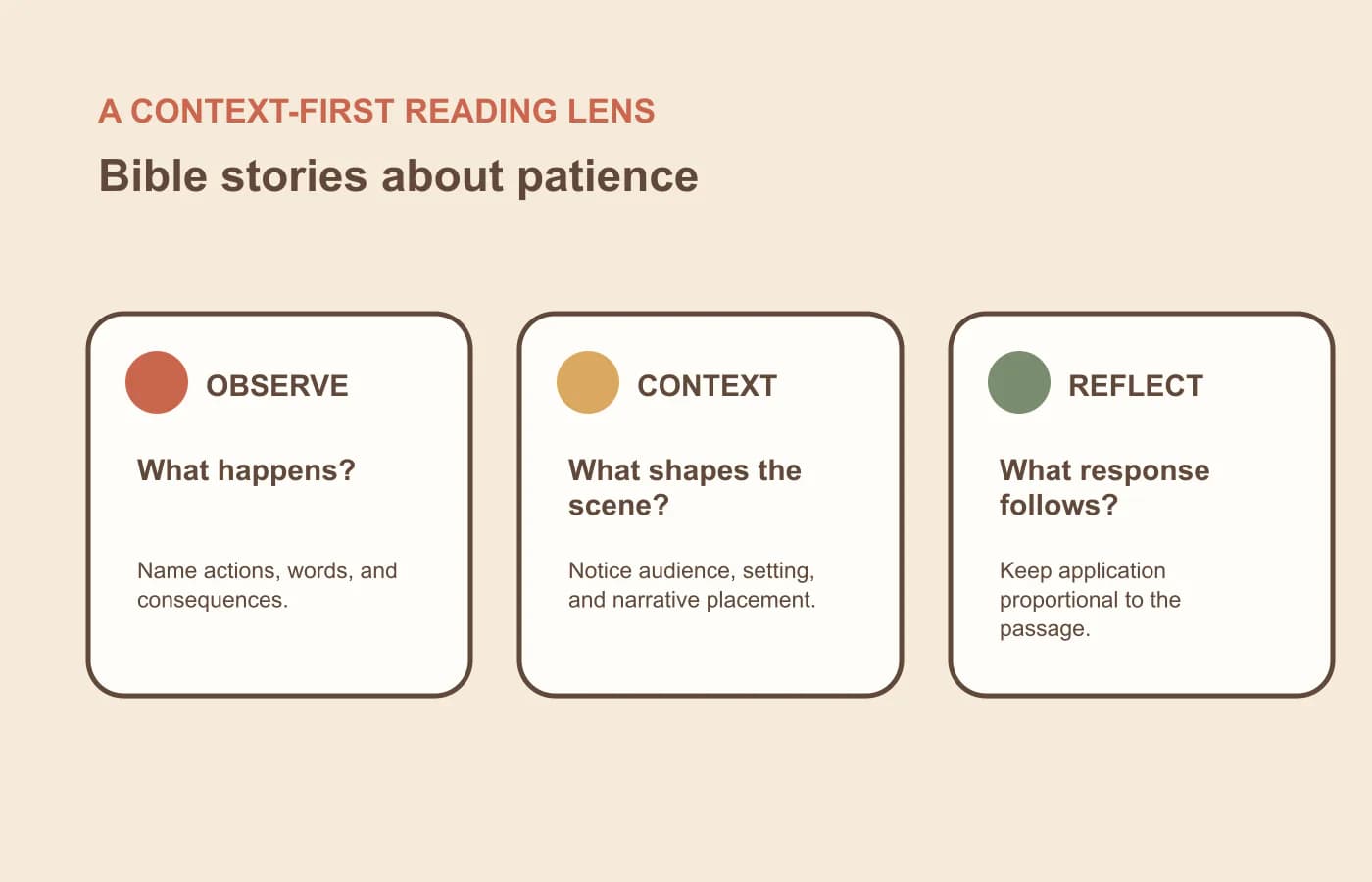
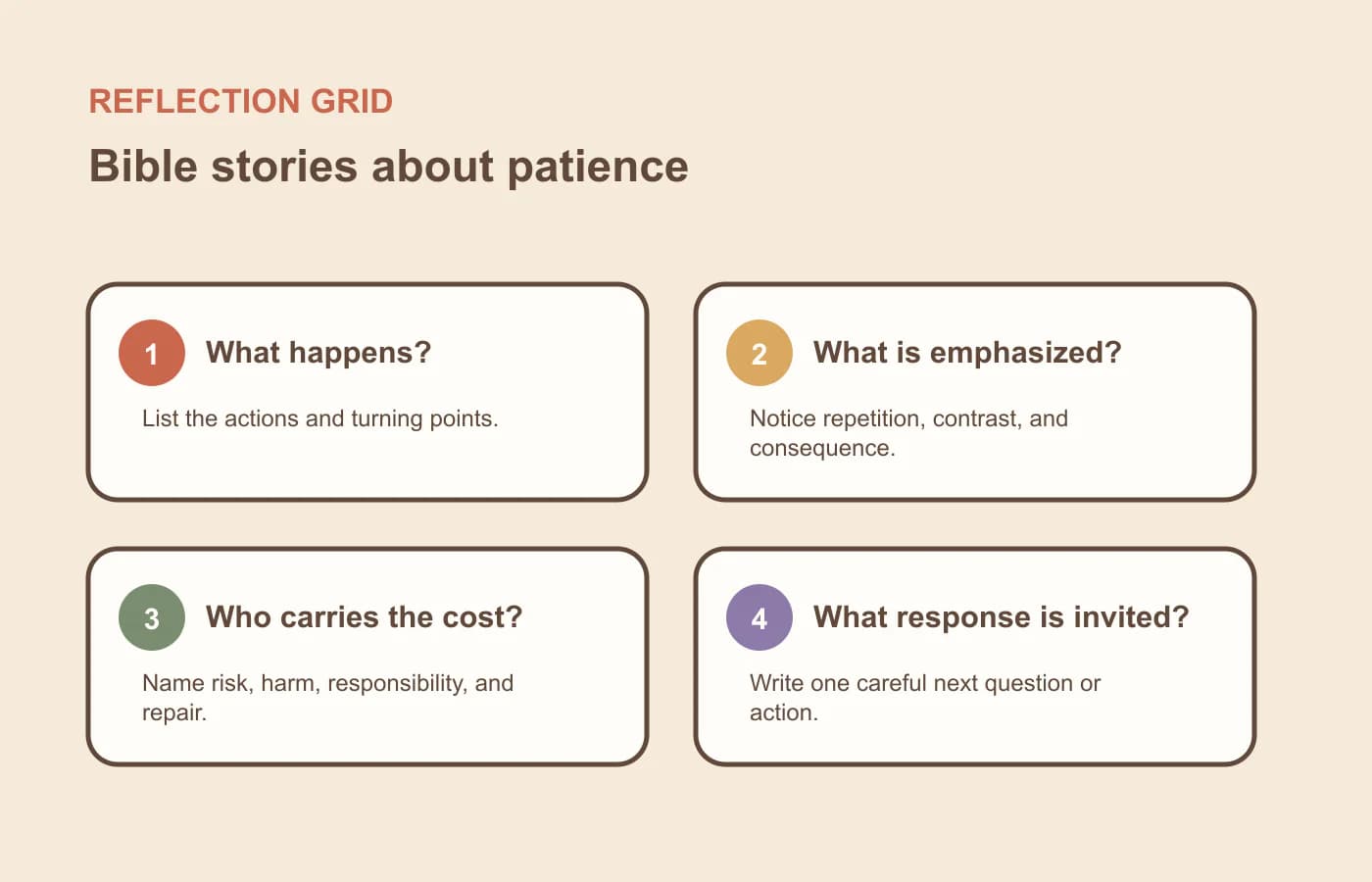
These five stories share a structure worth borrowing. Start with one step that needs no tools: pick a single account from this guide and read the full passage range in one sitting this week, noting what the person could not control and what they did anyway. Then work through four questions:
What does the passage say? List the events and words you can point to on the page before deciding what any of them mean. The guide on how to read the Bible in context walks through that discipline step by step.
What was outside the person's control? Timelines, other people's choices, and God's answer all sat beyond their reach. Naming that honestly keeps a study from promising what the text does not.
What did they do while they waited? Joseph administrated, Hannah prayed, David showed restraint, Simeon and Anna kept watch. Patience usually has a verb attached.
What is your faithful action this week? Write one concrete response — a prayer to keep praying, a task to do well, a door you will not force — and revisit it in seven days. If you want those observations in a form you can return to, take notes while reading the Bible so the questions stay visible.
When you are ready to read further, the Modern Bible Stories collection gathers complete text and audio for its published stories, which makes it a natural next step after this framework.
Frequently asked questions
Who are examples of patience in the Bible?
This guide follows Abraham and Sarah, Joseph, Hannah, David, and Simeon and Anna. Their stories show patience through long delay, faithful work, prayer, restraint, and sustained attention.
Which book of the Bible teaches patience?
No single book owns the theme. Genesis carries the long waiting stories of Abraham, Sarah, and Joseph; 1 Samuel follows Hannah and David; and Luke 2 brings Simeon and Anna's waiting to its moment of recognition.
Does a long delay mean God has said no?
These stories do not support reading a delay as a verdict. Some delays in Scripture end with the hoped-for outcome and some do not. The safer practice is to keep praying and working faithfully while holding outcomes loosely, and to bring heavy questions to trusted believers or a pastor.
What did Jesus say about patience?
The passages selected for this guide do not include a direct teaching from Jesus about patience. Luke 2 instead shows Simeon and Anna recognizing Jesus after sustained waiting, worship, fasting, and prayer.
Sources
Editorial status
Written and edited by Hans Keller for Bible Note. Sources, Scripture context, dates, and practical limitations are checked before publication.

About the author
Hans Keller
Editorial & Content Lead
Bible Study & Sermon Learning Content Editor
Hans helps Christians turn sermons and Scripture study into clear notes, thoughtful questions, and faithful next steps.
His work helps listeners and group leaders carry a sermon or study beyond the meeting: back to the passage, into clearer questions, and toward one practical response for the week.
Read with Scripture open
Use this guide alongside the full biblical passage and the practices of your local church. Interpretive details can differ across Christian traditions.
See more Bible Note on Google
Add Bible Note as a preferred source to help find our Bible study guides more easily in Google Search.