


It is Tuesday evening, the house is finally quiet, and you open your Bible hoping to learn how to pray. A friend suggested finding the stories where people prayed and God answered, so you start looking. What you find is more honest than a list of formulas. Hannah weeps in silence at the temple. A king admits he does not know what to do. Jesus asks for another way and still submits. Bible stories about prayer include lament, praise, confession, intercession, petition, silence, and response, and their outcomes cannot be reduced to one technique.
That variety is the point of this guide: seven passages where prayer drives a larger narrative, what each story emphasizes, and a simple way to read any prayer story without copying a formula.
What prayer looks like in Bible stories
Prayer in narrative rarely appears as a polished speech. It shows up in different forms, often several in the same story.
Lament. Honest grief spoken to God, as in Hannah's tears and Jesus' anguish in Gethsemane.
Praise. Thanksgiving after God acts, as in Hannah's song.
Confession and covenant memory. Naming who God is and what he has promised, as in Solomon's temple prayer and Jehoshaphat's appeal.
Intercession. Praying for others, as when Solomon asks God to hear the foreigner and the repentant sinner.
Petition. Direct, sometimes desperate requests, like the church praying for Peter in prison.
Silence and listening. Hannah's lips move without sound; the disciples sleep while Jesus prays.
Response. The story continues after the prayer, and that response is part of its meaning.
When a story combines several forms, the combination usually tells you what the narrator wants you to notice.
Hannah prays from grief and keeps her promise
Hannah's story in 1 Samuel 1:1-2:21 begins inside a painful household. She is loved by her husband, provoked by her rival, and unable to have children. Year after year she goes up to worship, and the ache remains.
What the prayer actually looks like
At Shiloh, Hannah prays in bitterness of soul. Her lips move without sound, and Eli the priest mistakes her silence for drunkenness. She corrects him plainly: she has been pouring out her heart. Her prayer includes a vow. If God gives her a son, she will give the son back to God's service.
What the story does with the answer
God gives her Samuel, and Hannah keeps her promise. She brings the boy to Shiloh and sings a prayer that reaches beyond her own family, praising a God who lifts the lowly. Two cautions belong here. Her story is not a fertility guarantee, and many faithful people in Scripture carry unmet longings without this ending. What readers can imitate are her honesty, her vow, and her follow-through, whatever the outcome.
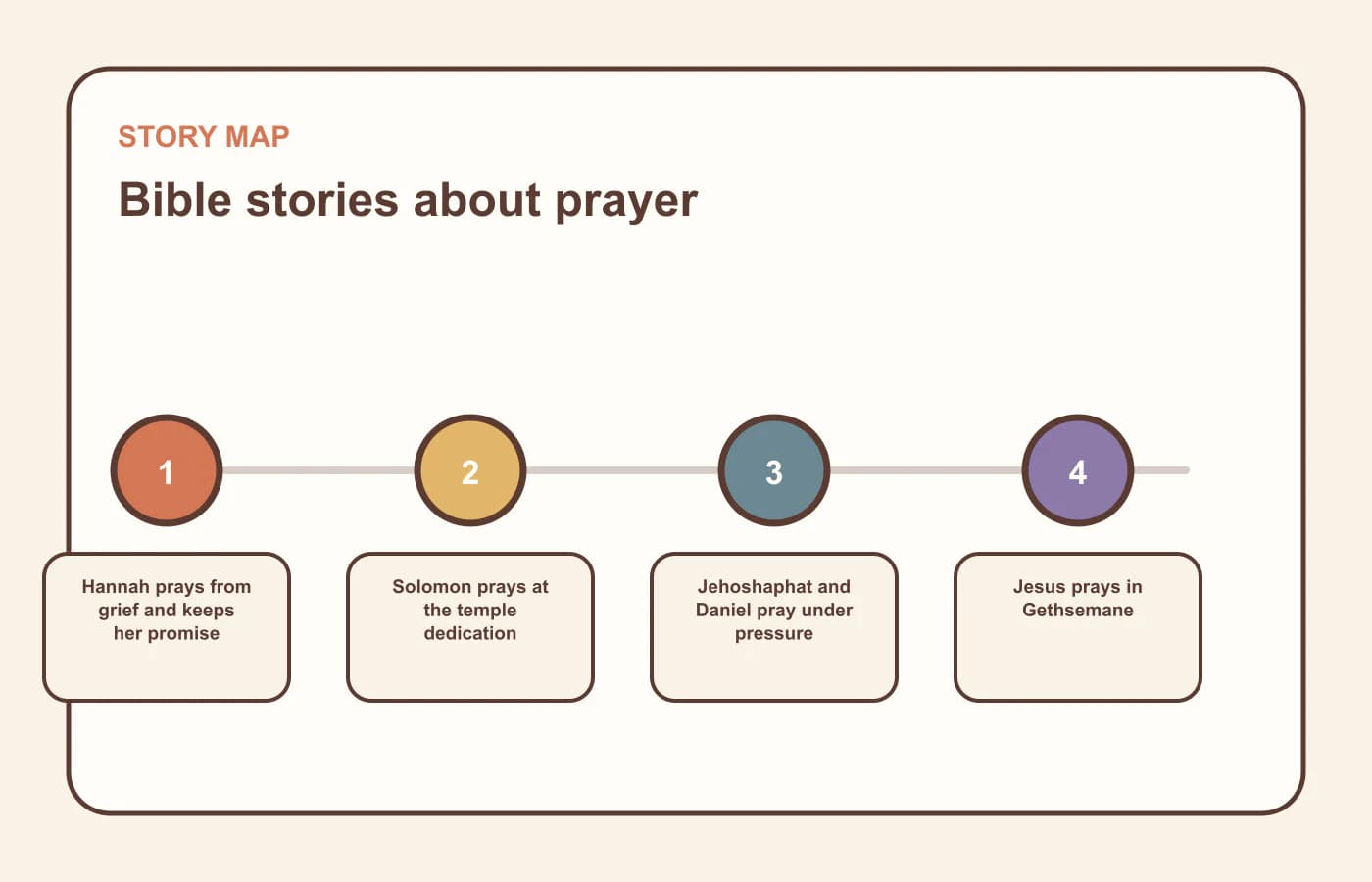
Solomon prays at the temple dedication
In 1 Kings 8:22-61, Solomon stands before the assembled people with his hands spread toward heaven. This is public prayer on a national day, and it sounds different from Hannah's whisper.
Solomon begins with covenant memory, naming God as the one who keeps promises, and admits that no building can contain him. Then the prayer becomes a series of situations: a neighbor dispute, defeat because of sin, drought, a foreigner praying toward this place, exile and repentance. Each time Solomon asks God to hear and act.
Notice the responsibility inside the prayer. Solomon keeps tying God's hearing to the people's turning. Public prayer here joins memory with obligation.
Jehoshaphat and Daniel pray under pressure
Two stories show prayer under threat, and they reward being read side by side.
Jehoshaphat: dependence spoken out loud
In 2 Chronicles 20:1-30, a vast army marches toward Judah, and King Jehoshaphat is afraid. He calls a fast, gathers the people, and prays in front of everyone, rehearsing God's power and past faithfulness before admitting that the people are helpless and fixing their attention on God. A prophetic word answers that the battle belongs to God. They march out singing, and the enemy destroys itself.
Daniel: disciplined practice under threat
Daniel 6:1-28 shows a different shape. A law forbids prayer to anyone but the king for thirty days, and Daniel goes home and prays toward Jerusalem three times a day, as was his habit. His regular practice is one he refuses to abandon even at the cost of the lions' den. God shuts the lions' mouths, and the king who signed the decree ends up honoring Daniel's God.
Dependence and discipline are not rivals. Jehoshaphat's crisis prayer works because he knows whom he is addressing; Daniel's steady habit holds because the crisis does not define it. Most readers need both.
Jesus prays in Gethsemane
Matthew 26:36-46 is the prayer story that resists every easy lesson, and it deserves slow reading.
Jesus tells the disciples his soul is deeply grieved and asks three of them to stay awake with him. Then he prays in real anguish, asking whether the cup of suffering can pass from him, and each time he submits to the Father's will. Three times he returns and finds his friends asleep. The companionship he asked for fails. The prayer does not remove what is coming. He rises, wakes them, and walks toward arrest.
Hold the pieces together. The anguish is genuine; the submission is genuine; the disciples' failure is genuine. Gethsemane gives readers permission to bring honest dread into prayer and a picture of obedience that costs something. It gives no support to the idea that the right prayer always changes the circumstance on request.
The early church prays and acts together
Acts shows prayer woven into a community under pressure.
In Acts 4:23-31, Peter and John return from interrogation and report to their friends. The group prays together, and the prayer is striking for what it omits: they do not ask for safety. They recall God's sovereignty, name the opposition, and ask for boldness to keep speaking. The place shakes, they are filled with the Spirit, and they go back out and speak.
In Acts 12:1-19, James has been killed and Peter sits imprisoned after Herod orders his arrest. The church prays earnestly. An angel leads Peter out past the guards, and he arrives at the house where people are praying. When Rhoda recognizes his voice and tells them he is at the door, they say it must be his angel. There is gentle humor there: the praying community is slower to believe the answer than to ask for it. In both stories, prayer and action belong together. The church prays, then speaks, welcomes, and continues.
How to read a prayer story without copying a formula
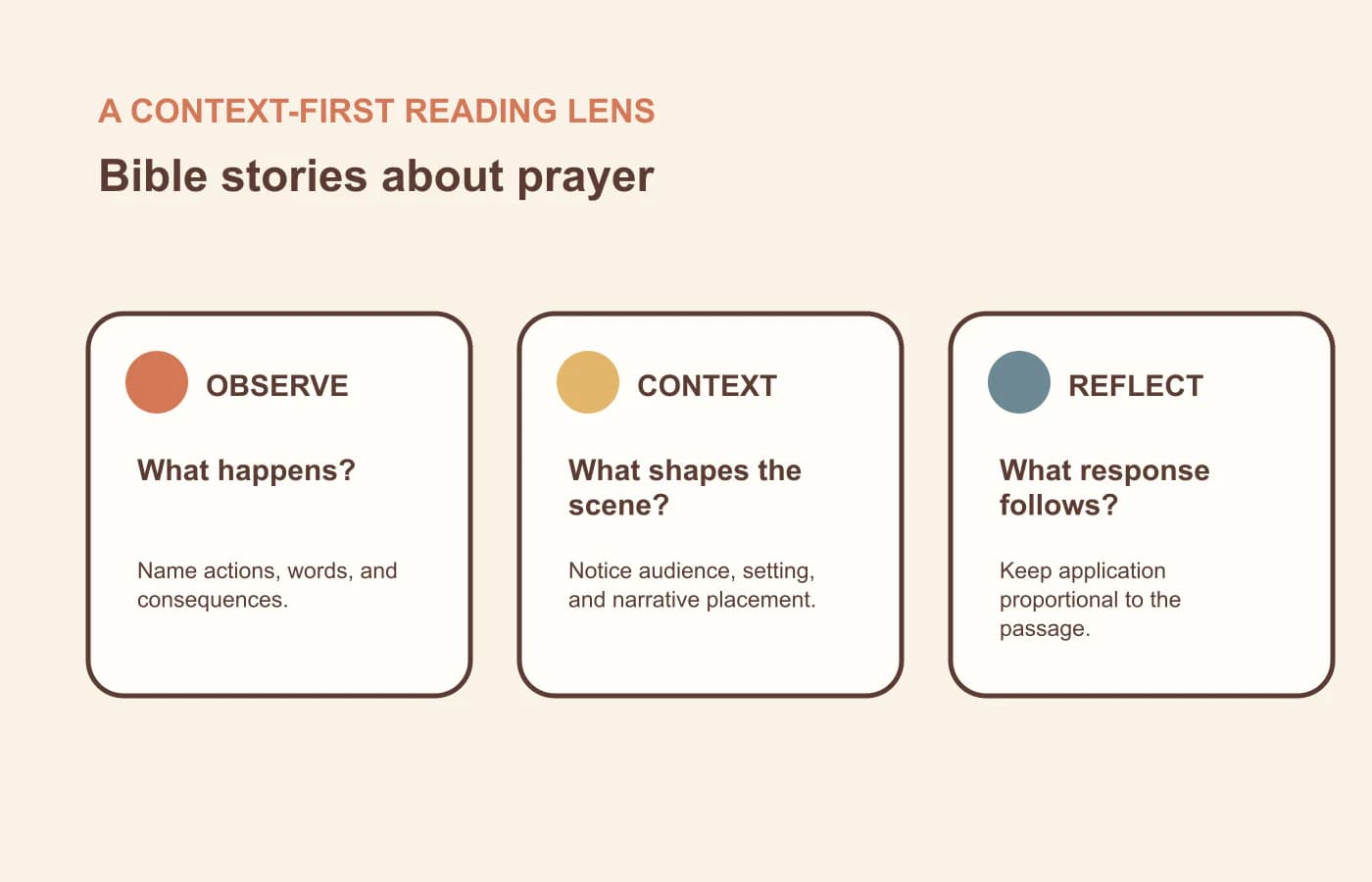
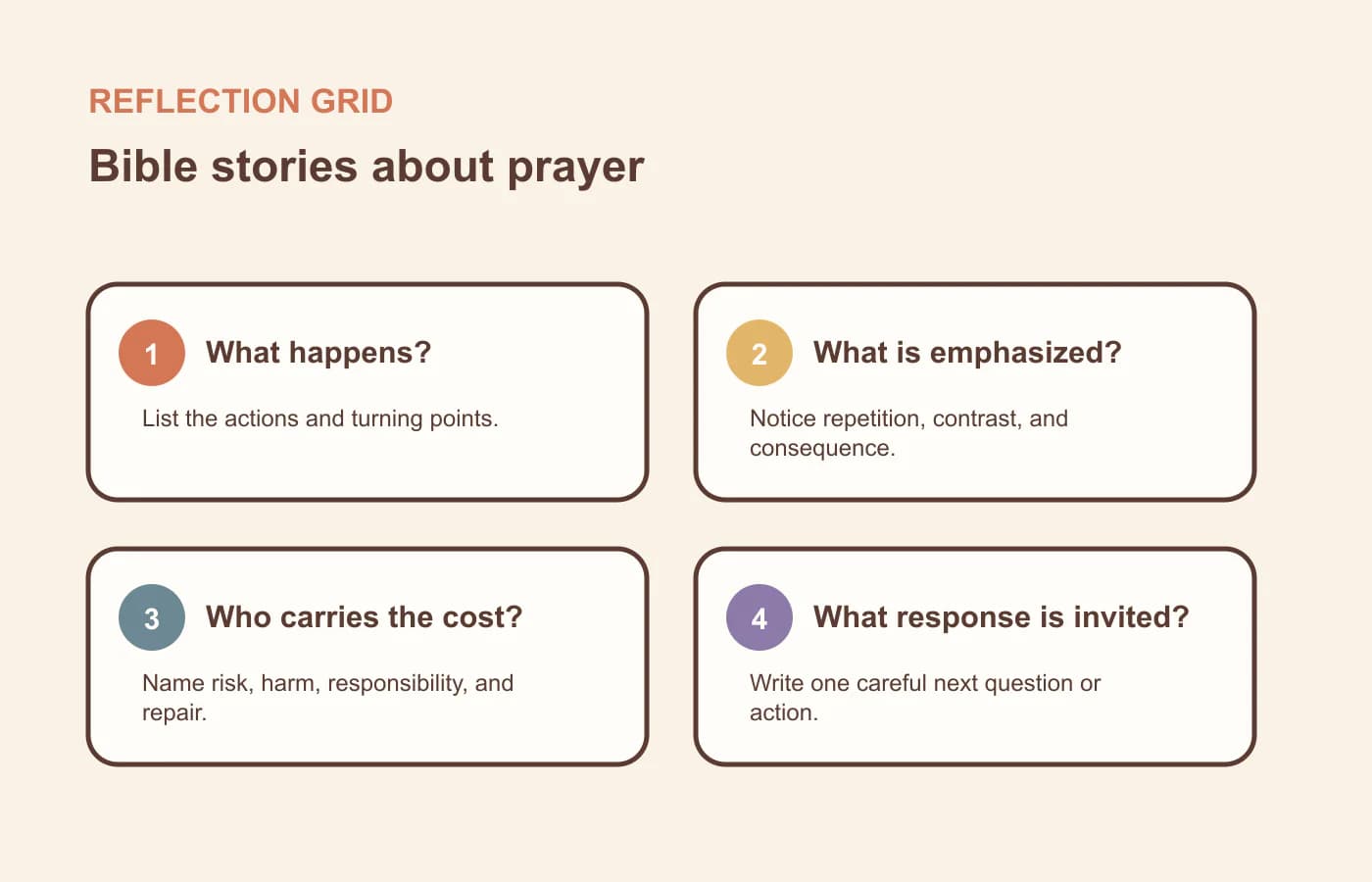
Here is a framework for any prayer narrative you meet. Four questions, worked in order.
Who is praying, and under what pressure? Name the situation before the words. Hannah's vow makes sense only inside her grief; Daniel's habit matters because of the decree.
What form does the prayer take? Identify lament, praise, confession, intercession, petition, silence, or some combination. The form often carries the emphasis.
What does the story show afterward? Stay with the narrative. Sometimes the request is granted, sometimes the person is strengthened, sometimes the answer surprises the people praying. Do not promise what the text does not.
What response fits your situation? Choose one concrete step, such as praying honestly about something you have been editing down, or keeping one promise you made to God.
This is the same observation-first approach that helps when you read the Bible in context generally, and it pairs well with writing things down. If you take notes while reading the Bible, try answering the four questions in a few lines each. Ten quiet minutes with one passage will teach more than skimming ten prayer lists.
Frequently asked questions
What are some Bible stories where prayer was answered?
Hannah receives Samuel in 1 Samuel 1, Judah is delivered in 2 Chronicles 20, Daniel survives the lions' den in Daniel 6, and Peter is freed from prison in Acts 12. Each answer sits inside a larger story, so read the whole passage to see how it fits.
What forms of prayer appear in these stories?
Lament, praise, confession, intercession, petition, silence, and response all appear, often combined in a single narrative.
Do these stories teach a guaranteed prayer formula?
No. The narratives show people praying honestly within God's purposes, and outcomes differ. Jesus' prayer in Gethsemane ends in submission, and the disciples' failure remains visible. Treat the stories as testimony, and let application follow careful observation.
How should I study a prayer story on my own?
Ask four questions in order: who is praying and under what pressure, what form the prayer takes, what the story shows afterward, and what one response fits your situation. Write the answers down and discuss them with your church community when you can.
Sources
Editorial status
Written and edited by Hans Keller for Bible Note. Sources, Scripture context, dates, and practical limitations are checked before publication.

About the author
Hans Keller
Editorial & Content Lead
Bible Study & Sermon Learning Content Editor
Hans helps Christians turn sermons and Scripture study into clear notes, thoughtful questions, and faithful next steps.
His work helps listeners and group leaders carry a sermon or study beyond the meeting: back to the passage, into clearer questions, and toward one practical response for the week.
Read with Scripture open
Use this guide alongside the full biblical passage and the practices of your local church. Interpretive details can differ across Christian traditions.
See more Bible Note on Google
Add Bible Note as a preferred source to help find our Bible study guides more easily in Google Search.