


Picture someone reading Genesis at a kitchen table. In one sitting she meets Jacob limping home to face the brother he deceived, then Joseph weeping behind a palace door in Egypt. The stories clearly belong together, yet the quick summary — God fixes broken things — flattens both. What connects them?
Here is the working answer this guide uses: Bible stories about redemption show people and communities being rescued, brought back, restored, or renewed, and each passage gives those movements a distinct setting and cost. Redemption names a family of movements, and they look different beside a river in Paddan Aram, at the edge of the sea, at the gate of Bethlehem, and outside an empty tomb.
The sections below trace four movements — rescue, return, reconciliation, and renewal — through five passages, and end with questions you can reuse on any story in this family.
What redemption looks like in Bible stories
In everyday speech, redemption often means a personal comeback. In Scripture, to redeem is to buy back or recover, and the narratives apply that idea to slaves leaving Egypt, a widow's family line in Bethlehem, brothers rebuilding trust, and disciples restored after failure.
Four movements show up again and again:
Rescue. Someone is delivered from a threat they cannot escape alone — Israel at the sea.
Return. Someone comes back from estrangement or a far country — Jacob crossing the Jabbok.
Reconciliation. A broken relationship is honestly repaired — Joseph and the brothers who sold him.
Renewal. A covenant, a community, or a life is made new after failure — Israel after the golden calf, the scattered disciples gathered again.
When a story feels like a redemption story, ask which movement dominates, and let the passage answer first.
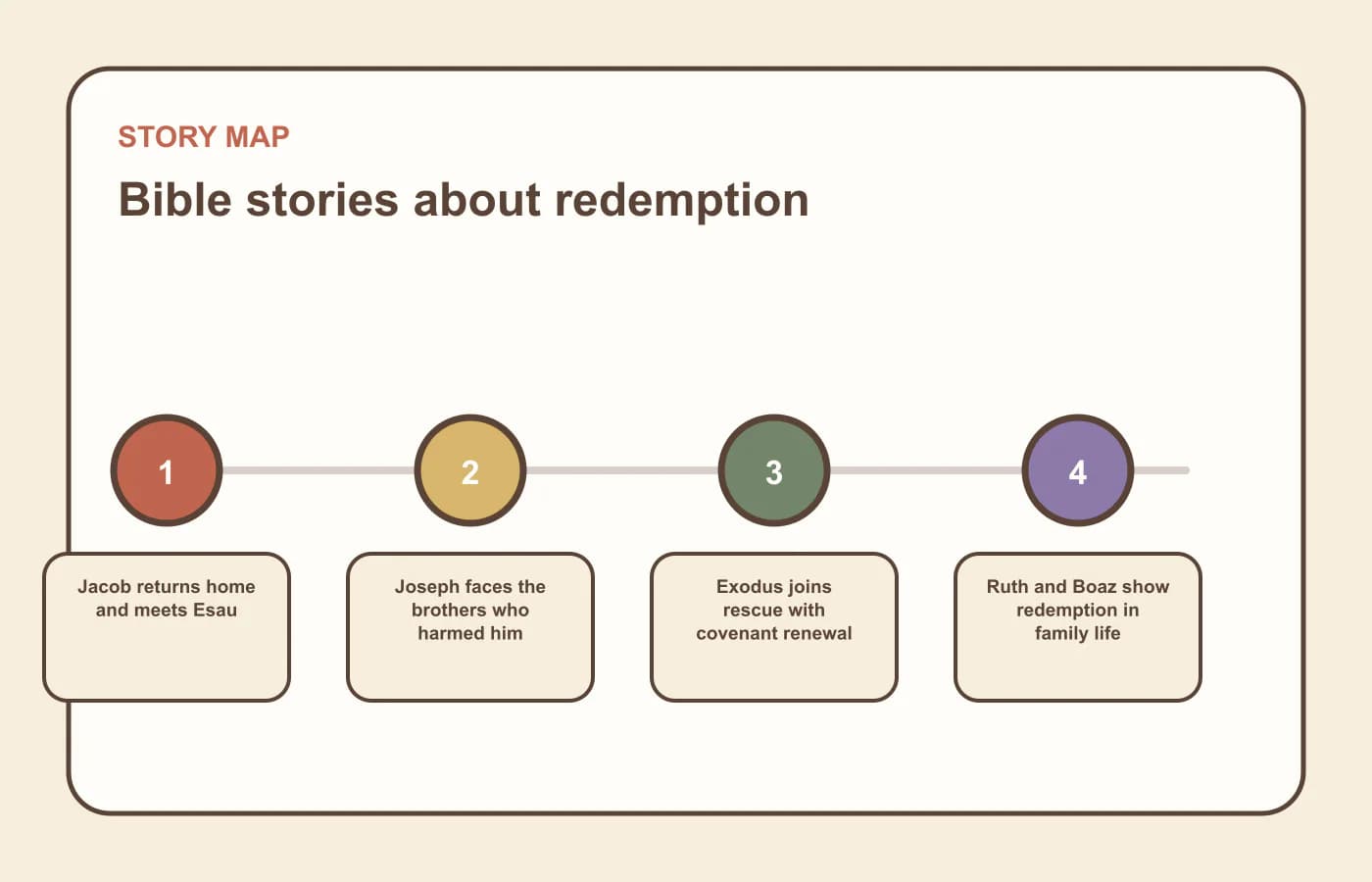
Jacob returns home and meets Esau
Jacob's story in Genesis 32–33 is a return story soaked in fear. He left home years earlier after deceiving his father and taking the blessing meant for Esau. Now he returns wealthy, and word arrives that Esau is approaching with four hundred men.
The night before the meeting
Jacob prays honestly about his fear, sends gifts ahead, divides his household for safety, then spends the night wrestling a stranger at the river. He leaves with a new name, a blessing, and a limp.
A reconciliation with boundaries
The meeting is almost wordless. Esau runs to Jacob, embraces him, and weeps. Jacob compares seeing his brother's face to seeing the face of God — extraordinary words to the man he wronged. Then they part peacefully and separately: Esau returns to Seir, Jacob settles near Shechem, and they meet again only to bury their father Isaac.
That measured ending matters. The brothers do not merge households or pretend the past away. Redemption here looks like a feared enemy becoming a weeping brother, at the cost of a sleepless night, a humbled posture, and a permanent limp.
Joseph faces the brothers who harmed him
Genesis 42–46 gives redemption a different shape. Joseph's brothers sold him into slavery; now famine drives them to Egypt, where Joseph — unrecognized — governs the grain supply. He holds every advantage, and the story lingers on what he does with it.
Testing comes first
When the brothers arrive, Joseph speaks harshly to them, accuses them of being spies, and holds Simeon while sending the rest home with a demand: return with Benjamin. Later he hides a silver cup in Benjamin's sack to see whether they will abandon the new favorite as they once abandoned him. Only when Judah offers himself as a slave in Benjamin's place does Joseph break down and reveal his identity.
Provision within the process
Even during the testing, Joseph's provision is at work: he fills their sacks with grain and quietly returns their silver. Rescue for the starving household begins before anyone apologizes. When he finally reveals himself, he frames the painful history around preservation — God sent him ahead to preserve life.
Joseph's forgiveness is genuine, and he still withholds restored trust until he has watched his brothers choose differently. Reconciliation here is warm at the end and careful in the middle, and both halves belong to the account.
Exodus joins rescue with covenant renewal
The Exodus is the Bible's defining rescue story, joining two redemption movements. Exodus 12–15 tells the deliverance: Passover night, the departure, the sea crossing, and the song Israel sings on the far shore. A people who could not free themselves are brought out, and they respond with worship.
Rescue that creates a people
Notice what the rescue is for. Israel is delivered into covenant responsibility, called to live as the people of the God who freed them. The sea crossing begins the story's middle, and rescue creates a community with obligations and a future.
Renewal after the golden calf
Exodus 32–34 then tests that community. While Moses is on the mountain, Israel makes a golden calf and breaks faith with the God who rescued them. Moses intercedes, the tablets are recut, and God renews the covenant with a self-description centered on mercy and steadfast love. Renewal here answers a people's own failure, inside the story of their rescue.
Held together, the two halves say what the first alone cannot: redemption includes what happens after deliverance, when the rescued people fail and the relationship must be made new again.
Ruth and Boaz show redemption in family life
The book of Ruth scales the theme down to one household. Naomi returns to Bethlehem from Moab widowed and bereaved, with her Moabite daughter-in-law Ruth choosing to stay beside her. The two women have no working land, no sons, and no obvious future.
A redeemer in family law
The turning point involves customs that need their context. In Israelite family life, a close relative — often called a kinsman-redeemer — could act for a vulnerable family, and Ruth's story involves two distinct needs: redeeming land connected to Naomi's family, and preserving a family line that had lost its heirs. Boaz is such a relative, and Ruth's gleaning in his fields draws her story into his. These customs belong to ancient Israel's legal world; reading them as a general romance script misses what the text is doing.
Public responsibility at the gate
The redemption happens in public, at the town gate, before elders. Boaz lays the matter before a nearer relative, who agrees to redeem the land and then declines when he learns that Ruth comes with it; Boaz takes on both the land and Ruth before the witnesses, and the community blesses the household. Their son Obed enters the line of David. Redemption here is legal, economic, and communal — accepted responsibility restores a family's name, land, and future.
Jesus brings redemption to the center of the Gospel
Luke 22–24 gathers the earlier movements into the story Christians read as their center. At the last supper, Jesus speaks of the cup in covenant language, echoing the Exodus pattern. Then come the arrest, Peter's denial, the crucifixion, and on the third day an empty tomb and a risen Lord who walks unrecognized beside two disciples toward Emmaus.
Each older movement appears here, deepened. Rescue reaches past Egypt's army to death itself. Return and reconciliation appear as the scattered disciples are gathered again — Peter, who denied Jesus and wept bitterly, is among those the risen Lord meets. Covenant renewal is spoken over the cup before the cross. And renewal widens as the risen Jesus eats with his followers and sends them out.
This guide stays with Luke's narrative: in his account, the cross and resurrection are where the Bible's redemption movements converge and open outward.
How to trace redemption without forcing every story
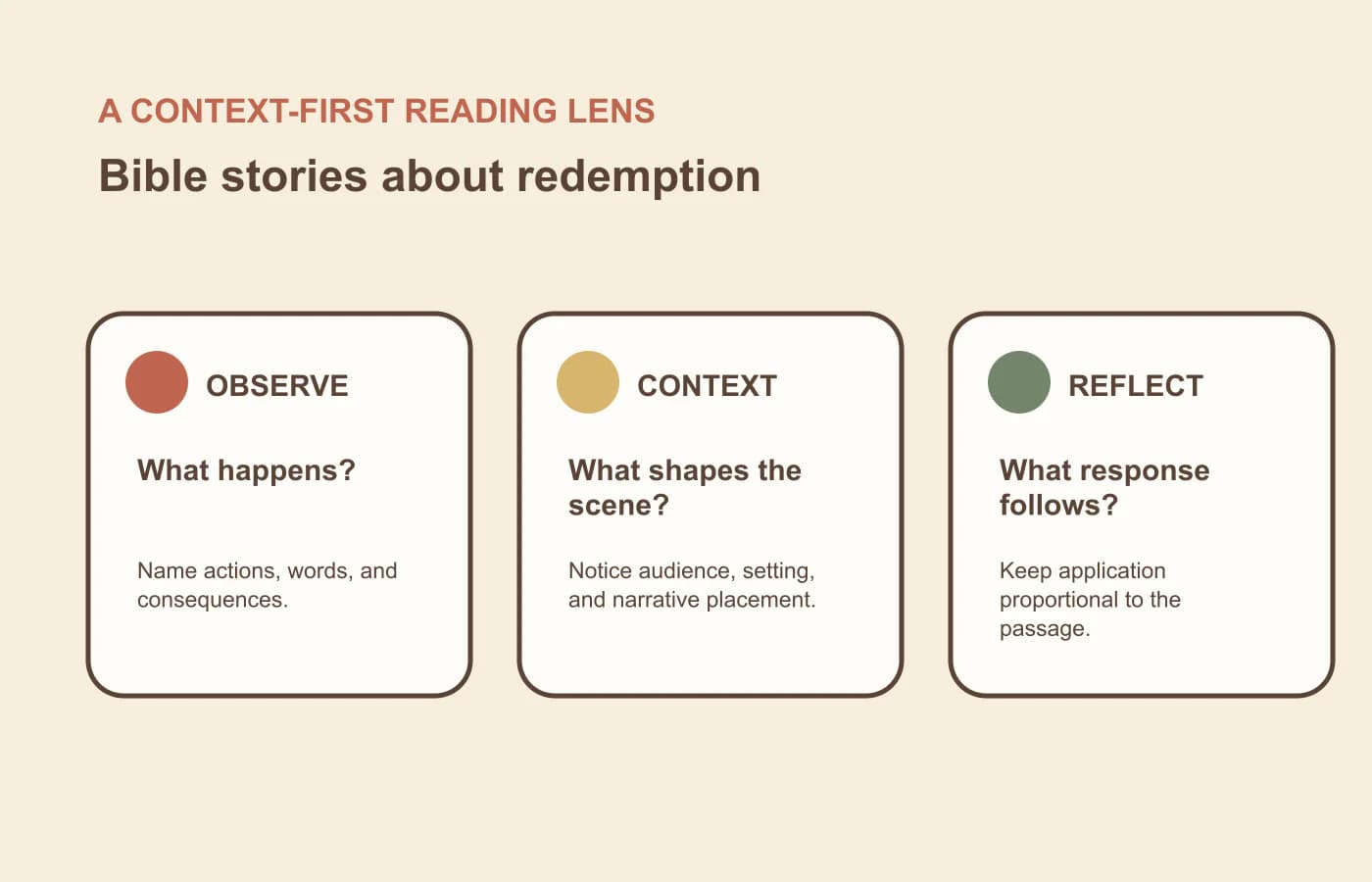
The five passages above share a theme and keep their own shapes. Four questions help you hold both truths:
Which movement dominates? Name the primary motion — rescue, return, reconciliation, or renewal — and notice whether a second movement supports it.
What setting and cost does the passage give it? Jacob's limp, Judah's offer, Boaz's public commitment. The cost is often where the meaning lives.
What changed between before and after? Describe both conditions in your own words, staying close to what the text reports.
What does the text leave open? Jacob and Esau part separately; Israel will wander again. Unresolved threads keep a reading honest.
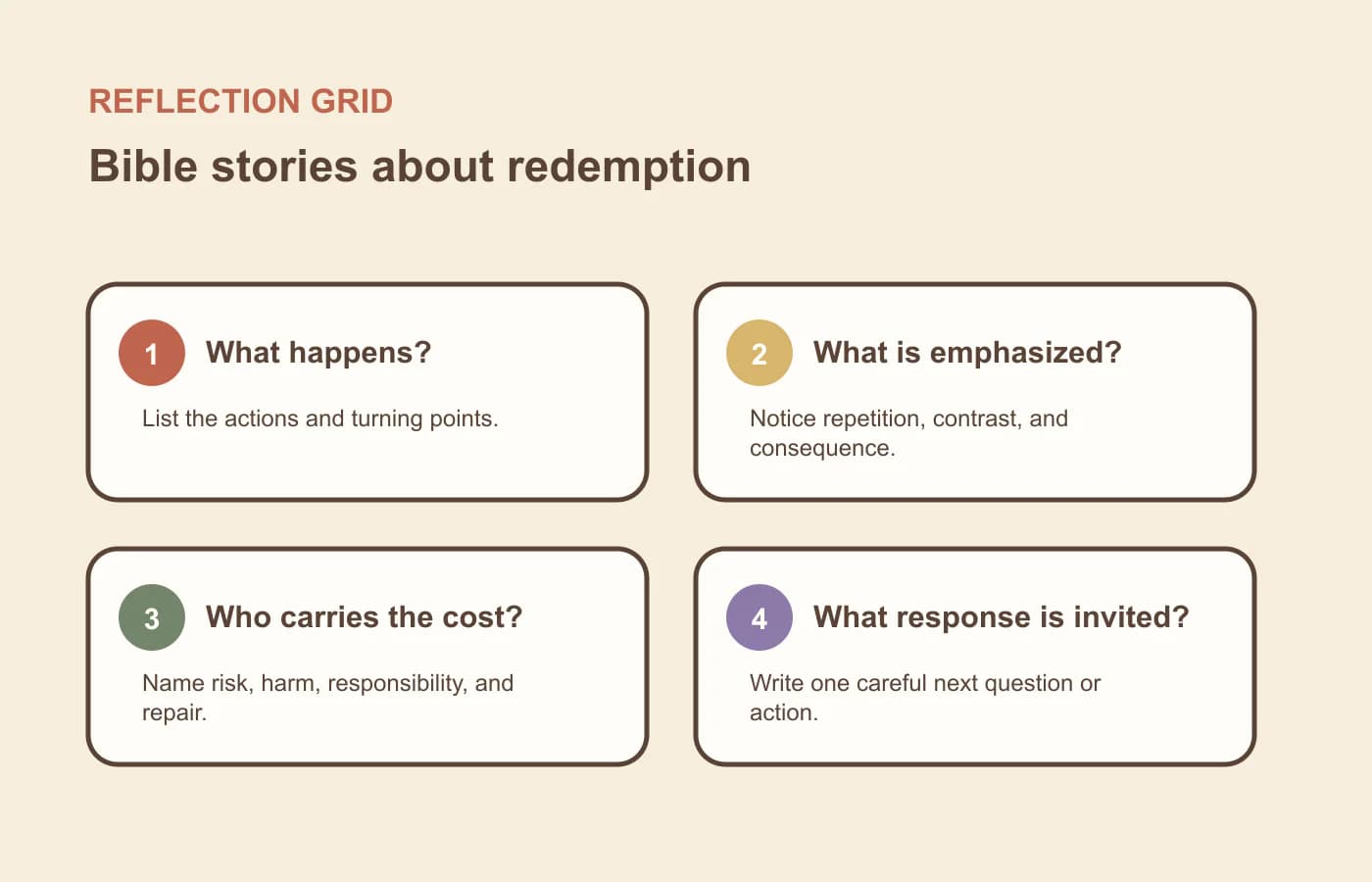
These questions assume observation comes before application, the habit at the heart of reading the Bible in context. If you want a place to keep what you notice, learning to take notes while reading the Bible gives each question somewhere to land.
When you want to continue into full narratives, the Modern Bible Stories collection holds complete text and audio for currently published stories. Not every passage here has its own page yet, so treat the collection as a growing shelf and let the biblical text remain the main reading.
Frequently asked questions
What are some famous Bible stories about redemption?
Alongside the stories in this guide, readers often name the prodigal son's return in Luke 15 and Zacchaeus in Luke 19. Each story carries a different movement of redemption, so reading them in their own passages serves better than any summary.
Who experienced redemption in the Bible?
Both individuals and communities. Israel is redeemed from slavery as a people, while Ruth and Naomi, Jacob, and Peter experience redemption in personal and family terms. The scope varies by passage — one reason to ask who is being redeemed before applying a story.
Is there a Bible that tells the history of redemption?
The four movements in this guide — rescue, return, reconciliation, and renewal — run through many passages in both Testaments, which is why people speak of the Bible's history of redemption. Some study Bibles organize their notes around that theme; this guide stays with individual passages read in context.
What are the three stages of redemption?
No single three-stage scheme appears in these passages, and later traditions divide the theme differently, so treat any numbered framework as one tradition's summary. Within the stories in this guide, redemption appears as four movements — rescue, return, reconciliation, and renewal — and tracing those movements keeps the reading close to the text.
Sources
Editorial status
Written and edited by Hans Keller for Bible Note. Sources, Scripture context, dates, and practical limitations are checked before publication.

About the author
Hans Keller
Editorial & Content Lead
Bible Study & Sermon Learning Content Editor
Hans helps Christians turn sermons and Scripture study into clear notes, thoughtful questions, and faithful next steps.
His work helps listeners and group leaders carry a sermon or study beyond the meeting: back to the passage, into clearer questions, and toward one practical response for the week.
Read with Scripture open
Use this guide alongside the full biblical passage and the practices of your local church. Interpretive details can differ across Christian traditions.
See more Bible Note on Google
Add Bible Note as a preferred source to help find our Bible study guides more easily in Google Search.