


Some of the most practical pages in the Bible are stories about decisions made under pressure: a prisoner explaining a king's dream, a woman hiding strangers on her roof, a new ruler choosing between two kinds of advice. Readers looking for Bible stories about wisdom usually want more than a gallery of clever heroes. They want to see how wisdom actually works when the stakes are real.
Across these narratives, wisdom appears through recognizable patterns: listening before acting, planning for what is coming, courage under threat, responsibility after insight, and a willingness to receive counsel. The same books also show the consequences of ignoring counsel, which is why Rehoboam's account belongs next to Solomon's. This guide compares six passages in which characters seek, practice, or ignore wisdom, keeping the Scripture references close and ending with questions you can carry into your own reading.
What wisdom looks like in Bible stories
Wisdom in these accounts rarely arrives as a single flash of brilliance. It tends to appear as a cluster of habits spread across very different lives.
Listening comes first. Solomon asks for an understanding heart, and Joseph openly credits God as the source of interpretation before he explains anything. Planning follows: Joseph treats Pharaoh's dream as information that demands preparation. Courage shows up in Rahab and Deborah, who act while real danger surrounds them. Responsibility gives wisdom its weight, as Joseph administers the storage plan he proposed and Boaz completes a family obligation in public. And counsel threads through everything, received by some and refused by Rehoboam at the cost of a divided kingdom.
Read together, these stories suggest that biblical wisdom is less about being the smartest person in the room and more about attention, timing, and accountability.
Joseph plans wisely for a coming crisis
Joseph's story in Genesis 39 through 41 moves from a household to a prison to a palace, and wisdom looks slightly different in each setting.
Integrity before influence
In Potiphar's household, Joseph refuses wrongdoing even though refusal costs him. He is falsely accused and imprisoned, and the narrative does not pretend that doing right immediately improved his situation. Wisdom here begins as integrity practiced without a visible reward.
Insight that names its source
When Joseph interprets dreams, first for fellow prisoners and then for Pharaoh, he credits God for the interpretation before he gives it. That habit matters. His insight is presented as received, and he says so plainly in front of the most powerful man in Egypt.
A plan attached to the prediction
Joseph explains Pharaoh's dreams as seven years of abundance followed by seven years of famine, and then he does something that turns interpretation into wisdom: he proposes storing grain during the good years. Pharaoh appoints him to administer that plan. The passage joins insight to preparation and responsibility. It does not turn Joseph's rise into a promise that suffering always ends in promotion; the emphasis falls on faithful action at each stage, including the long years when nothing seemed to be changing.
Rahab, Deborah, and Ruth choose wisely under pressure
Three very different women show what wise action looks like when the options are narrow and the risks are personal.
Rahab weighs the evidence in front of her
In Joshua 2, Rahab hides the Israelite spies and speaks about what Jericho has heard concerning Israel's God. She asks for protection for her household, agrees to concrete oath conditions, and helps the spies escape. Her courage operates inside a genuine threat; the city around her is afraid, and she is bargaining for her family's life. Her wisdom lies in paying attention to the evidence available to her and converting that attention into negotiated, specific action.
Deborah leads with discernment and presence
Judges 4 and 5 introduce Deborah already judging Israel. She summons Barak, communicates the command to confront Sisera's forces, and accompanies him when he will not go alone. After the victory, she joins Barak in a song that remembers the battle. The account keeps its warfare context visible, including Jael's distinct and violent role in Sisera's death. Deborah's wisdom shows in discernment about timing and in her willingness to participate personally in what she discerned.
Ruth and Boaz practice loyal, public responsibility
Ruth remains with Naomi, gleans in Boaz's field, and works steadily amid widowhood and poverty. Boaz protects her dignity, provides food, and eventually completes the family-redeemer process in public after a nearer relative declines. Loyalty, attentive provision, honest work, and public responsibility all belong to wisdom here. The customs in Ruth 1 through 4 belong to their own setting; the account resists being flattened into a generic romance, and its legal practices should be read on their own terms rather than mapped directly onto modern law.
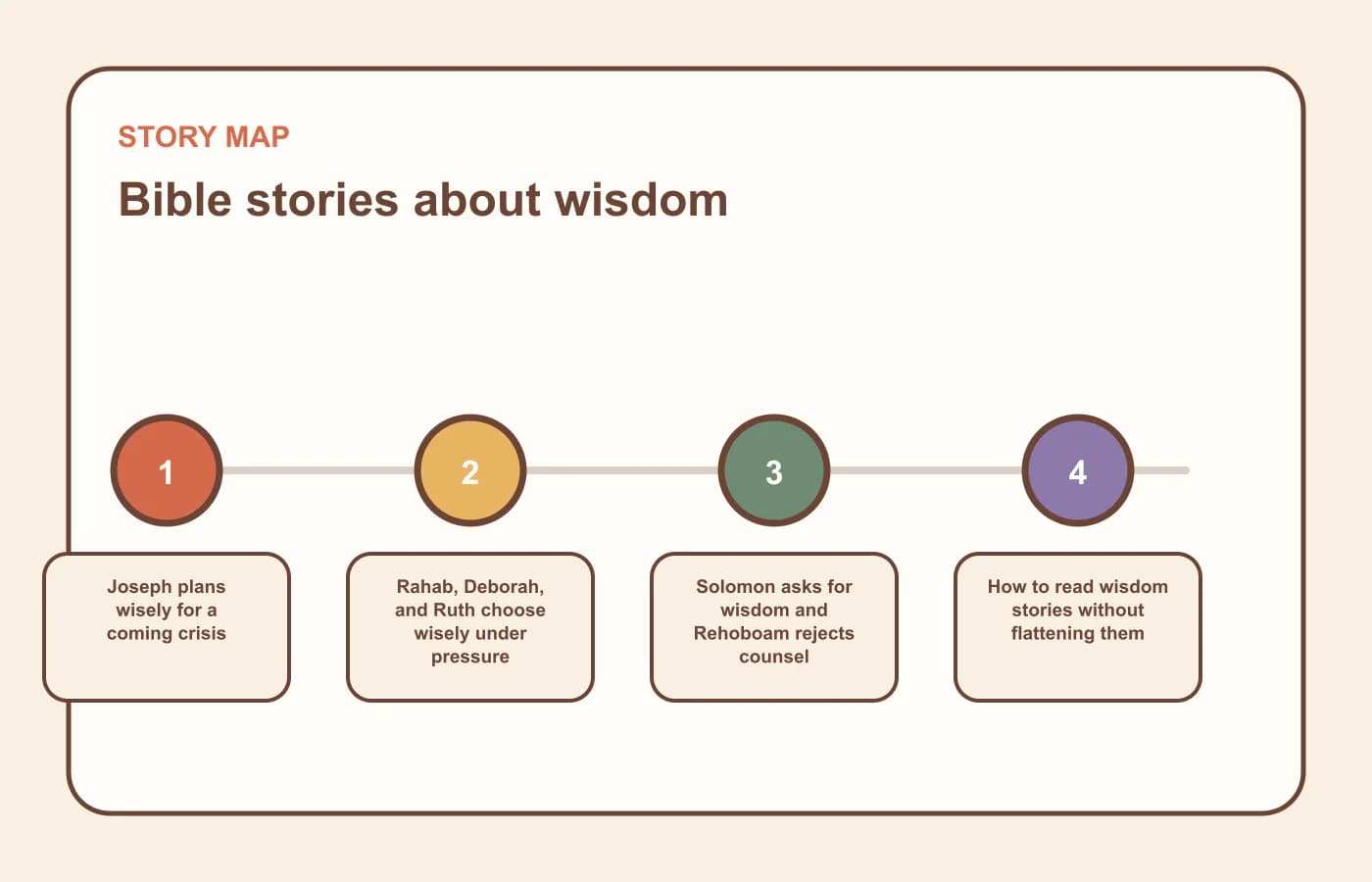
Solomon asks for wisdom and Rehoboam rejects counsel
First Kings places a famous request and a famous refusal within a few chapters of each other, and the pairing is instructive.
Solomon asks for an understanding heart
In 1 Kings 3, Solomon asks for an understanding heart to govern the people and to distinguish between good and evil. He passes over wealth, long life, and victory over his enemies. The narrative then tests that gift with a dispute between two women and one living child. Solomon's proposed division draws out the truth: the real mother's compassion reveals her. The threatened division of the child belongs to this particular scene; the passage presents a test of discernment in one courtroom moment, and readers should be cautious about treating the shock of the proposal as a technique to reuse.
Rehoboam chooses the harsher counsel
The surrounding chapters supply the tragedy. Solomon's divided loyalty comes first, and judgment is announced before his son ever speaks. Then Rehoboam rejects the counsel of the older advisers, follows harsher advice from his peers, and increases the people's burden. The kingdom divides. When threatened civil war looms, God's word through Shemaiah restrains it. The account holds several causes together without merging them: rejected counsel, the exercise of power, the weight placed on ordinary people, announced judgment, and human decisions each play a distinct role.
How to read wisdom stories without flattening them
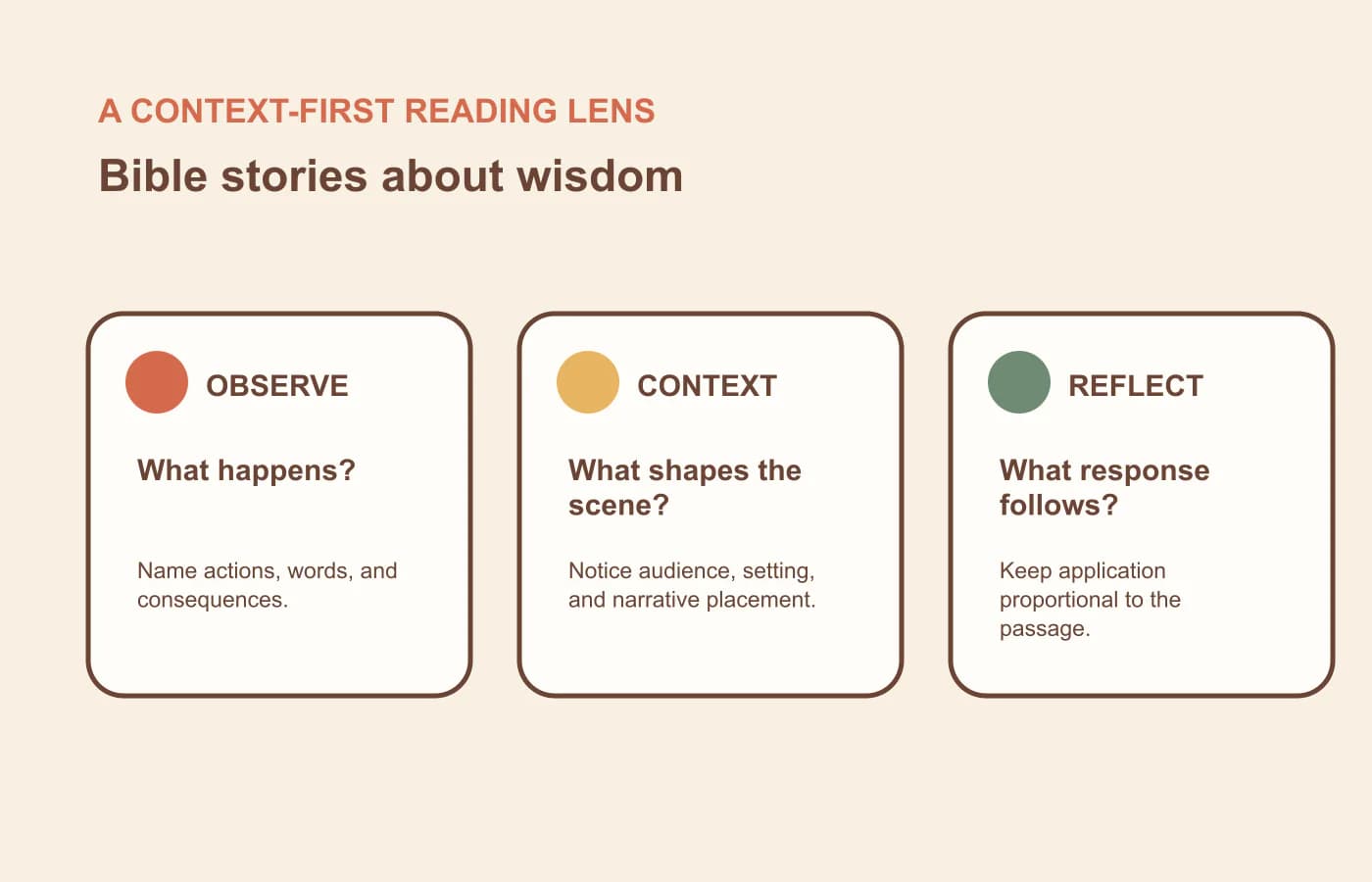
A useful habit is to keep three layers separate as you read.
First, what happens in the story. Second, what the story itself emphasizes through repetition, placement, or the words characters speak. Third, the question you carry into your own decisions. When those layers blur together, every successful decision starts to look like proof of wisdom and every painful outcome like proof of folly, and the text rarely supports either shortcut. Joseph's years in prison were not folly, and Rehoboam's throne did not make his choices wise.
If you want a broader method for keeping a passage in its context before applying it, our guide on how to understand the Bible walks through that reading process step by step.
Questions for reflecting on biblical wisdom
Here is a compact sequence you can reuse with any narrative passage:
What information does the character notice before acting?
Whose counsel is heard, and whose is ignored?
Who carries the cost of the decision?
What responsibility follows the insight?
Which consequence is stated by the text, and which conclusion would be my own inference?
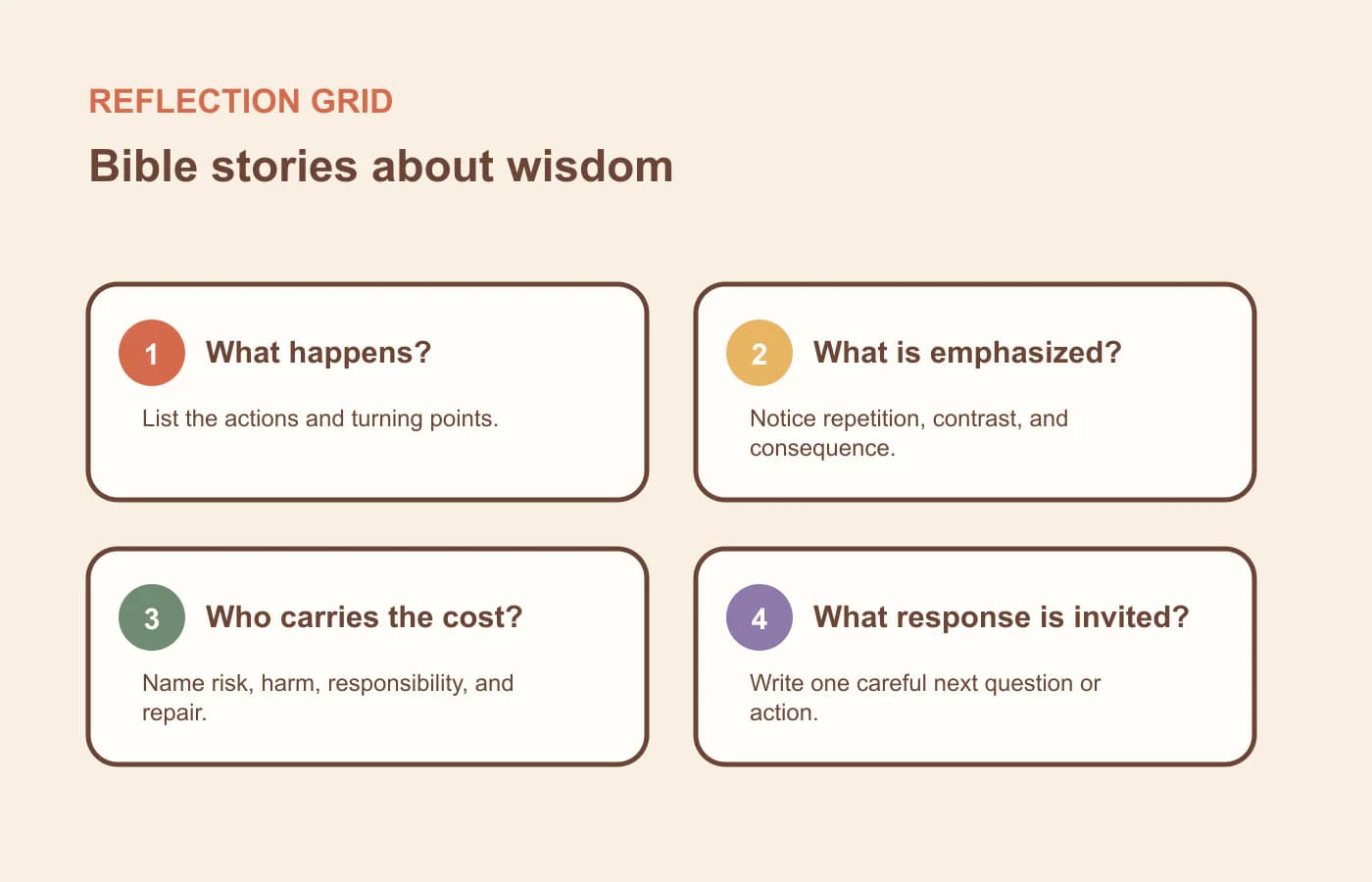
Writing the questions down tends to sharpen the answers. If you would like a simple way to keep observations, questions, and responses together as you read, our guide on how to take notes on the Bible offers a practical starting point.
Explore the complete Bible stories
Short comparisons like this one work best as a doorway back to the full narratives. Bible Note's Modern Bible Stories collection keeps the complete story text together with audio for the published stories, so you can read or listen to the whole account and keep the surrounding context in view while you reflect.
Frequently asked questions
Which Bible story is most associated with wisdom?
Solomon's request for an understanding heart and his judgment in 1 Kings 3 is the best known, though Joseph, Deborah, and Ruth each display wisdom of a different kind.
Do these stories promise that wise choices always lead to good outcomes?
No. Joseph acted with integrity and still went to prison. The narratives emphasize faithful action and responsibility, and they do not guarantee safety, success, or promotion.
How should I read Rahab's and Deborah's stories given the violence around them?
Keep the warfare and threat visible in the text. Courage and discernment operate inside those dangers, and reading the context honestly serves you better than softening it.
Where can I read or listen to the full stories?
Bible Note's Modern Bible Stories collection provides the complete story text and audio for its published stories, and the Scripture references above point you to the original passages.
Sources
Editorial status
Written and edited by Hans Keller for Bible Note. Sources, Scripture context, dates, and practical limitations are checked before publication.

About the author
Hans Keller
Editorial & Content Lead
Bible Study & Sermon Learning Content Editor
Hans helps Christians turn sermons and Scripture study into clear notes, thoughtful questions, and faithful next steps.
His work helps listeners and group leaders carry a sermon or study beyond the meeting: back to the passage, into clearer questions, and toward one practical response for the week.
Read with Scripture open
Use this guide alongside the full biblical passage and the practices of your local church. Interpretive details can differ across Christian traditions.
See more Bible Note on Google
Add Bible Note as a preferred source to help find our Bible study guides more easily in Google Search.