


It is bedtime, and the children's Bible on the nightstand is open to a story you half remember. Your daughter asks why the people in the story did what they did, and you realize the cheerful picture on the page leaves out most of the answer. Many parents know this moment. The question underneath it is practical: which Bible stories for kids fit this child, at this age, told honestly?
Here is a workable answer. Choose a story by three things — the child's attention span, emotional readiness, and ability to follow consequences — and then tell the whole moral shape of the passage without adding frightening detail the text does not require. A four-year-old can follow creation's rhythm of days. A ten-year-old can hold Joseph's brothers' jealousy and Joseph's later kindness in the same conversation. The age bands below are starting points for judgment, and you know your child better than any list does.
How to choose a Bible story for a child
A simple age label on a storybook cover tells you very little. Three factors do more work.
Attention span is the most concrete. A young listener needs a story with clear movement: something happens, someone responds, the scene changes. Long genealogies, extended speeches, and layered subplots wait for later.
Emotional readiness is about what a child can hear without being overwhelmed. Scripture includes judgment, death, war, and family conflict, and those elements deserve honest treatment. The question is timing and proportion, and the sections below offer specific parent notes for the stories that carry heavier material.
Ability to follow consequences matters most for discussion. Younger children track what happened. Older children can trace why it happened and what it cost. That difference should shape both the stories you pick and the questions you ask afterward.
A quick readiness check
Before you begin a story, ask yourself three questions:
Can my child follow this many scenes in one sitting?
Is there a detail here I would need to explain carefully rather than skip?
Can my child say back what caused the story's turning point?
If the third answer is yes, the child is probably ready for a story with real moral weight.
Ages 4-6: Short stories with clear movement
For young children, look for stories with one main character, a visible sequence of events, and an ending that resolves. Tell them briefly, keep the book open, and let the child retell the story in their own words.
Creation (Genesis 1:1-2:3) works well because its structure is the story: light, sky, land, plants, animals, people, rest. Children enjoy the rhythm, and the passage ends with God's delight in what he made. It opens an easy first conversation about the world as a gift.
Samuel hears God's call (1 Samuel 1:1-3:21) centers on a child, which immediately invites a young listener in. A boy serving in the house of the Lord hears his name in the night, runs to Eli, and eventually learns to answer God directly. The background includes Hannah's grief and Eli's corrupt sons, and a short telling can simply note that Samuel grew up among people who did not always honor God.
Jesus calms the storm (Mark 4:35-41) is short, dramatic, and reassuring without pretending fear is unreal. The disciples are genuinely afraid, and Jesus acts. Children can hold both facts at once, and the story gives you a natural question: who is this, that even the wind and waves obey him?
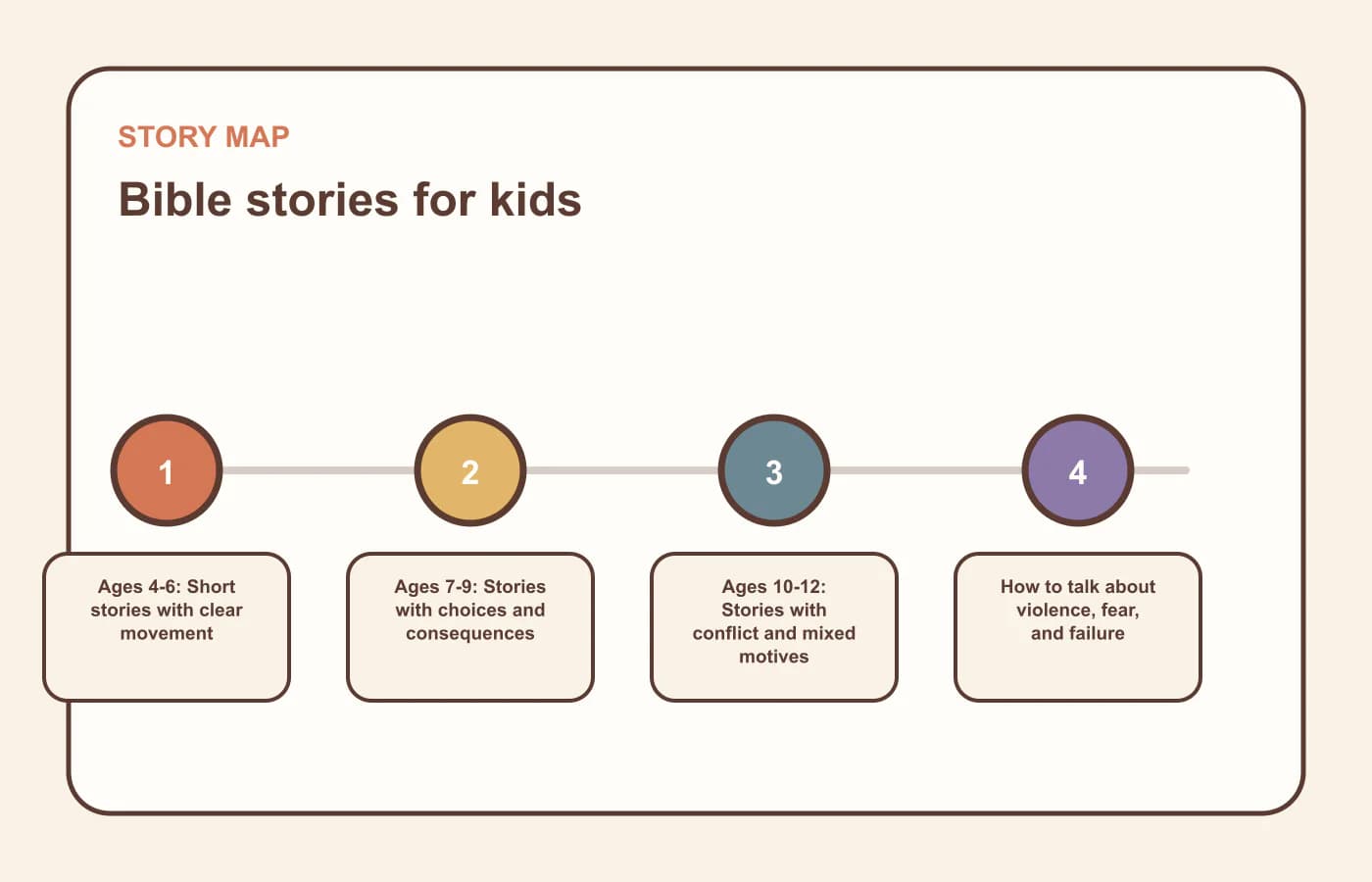
Ages 7-9: Stories with choices and consequences
Match the story to the question
Ask what the child is ready to notice: a clear choice, a consequence, or a difficult motive. That question keeps the story connected to the child's readiness instead of turning the age band into a rigid rule.
Children in this range are ready to trace cause and effect. Choose stories where a character's decision visibly shapes what follows, and ask what the decision cost.
Noah and the flood (Genesis 6:5-9:17) is often treated as an animal story for the very young, and the animals are real in the text. But the passage is about a world so violent and corrupt that God judges it, while preserving Noah's family and making a covenant afterward. Children this age can hear that the flood was a tragedy as well as a rescue. Let them ask why, and resist turning the story into only a cheerful boat ride.
Ruth (Ruth 1:1-4:22) follows a widow who chooses loyalty to her mother-in-law over a safer return home, and whose faithfulness is eventually woven into the line of David. The story gives you poverty, loss, migration, and kindness, all at a scale a child can picture.
David and Goliath (1 Samuel 17:1-58) rewards a cause-and-effect reading: Israel's fear, David's confidence in the God he already knew from shepherding, and a victory no armor could produce. The story is genuinely violent, and the next section addresses how to handle that honestly.
Ages 10-12: Stories with conflict and mixed motives
Older children can sit with stories where nobody is simple. These narratives repay slow reading and honest questions.
Joseph (Genesis 37:1-46:34) begins with a favored son whose brothers sell him into slavery, then moves through false accusation, prison, and an unexpected rise to power in Egypt. The story holds jealousy, injustice, patience, and reconciliation together. Children this age can discuss what forgiveness costs, and why Joseph's kindness to his brothers is more striking given everything before it, not less.
The Exodus (Exodus 1:8-15:21) is the story of a people enslaved, a God who hears their cries, plagues that confront Pharaoh's power, and a deliverance through the sea. It includes slavery, the death of Egypt's firstborn, and a frightened army drowning behind Israel. Do not sand those edges down. A child ready for this story is ready to ask hard questions about oppression, justice, and why freedom mattered so much that generations kept retelling it.
How to talk about violence, fear, and failure
Difficult details call for honesty at the right scale. Three habits keep the conversation proportionate.
First, name what the text says without decorating it. The flood killed many people. Pharaoh enslaved Israel. David killed Goliath. A child who senses you are hiding the hard part will trust the story less, and trust you less. State the fact plainly, then stay available for the follow-up question.
Second, add nothing frightening that the passage does not require. You do not need to describe drowning, wounds, or terror in sensory detail to be truthful. The text's own summary is usually enough for a child's first hearing. Graphic imagination is easy to trigger and hard to undo.
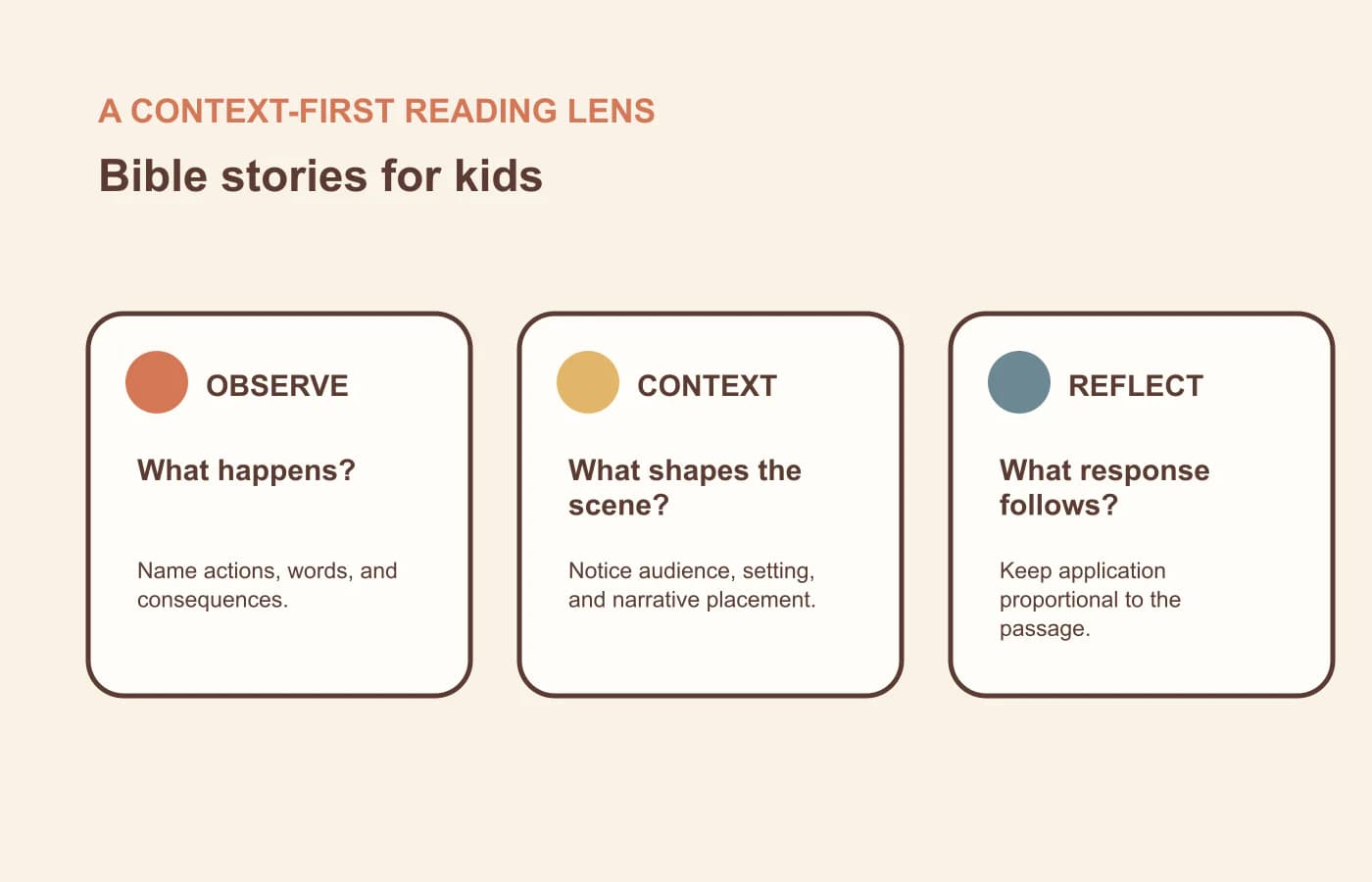
Third, separate observation from application. Before drawing a lesson, walk through three lenses with the story: what happened, what it meant in its setting, and what it might mean for us. That order protects the child from morals pasted onto the story and protects the story from shrinking into a slogan.
If a story raises fear at bedtime, you may simply choose to read it in the morning. Timing is wisdom, and the story will still be there.
A simple parent-note method
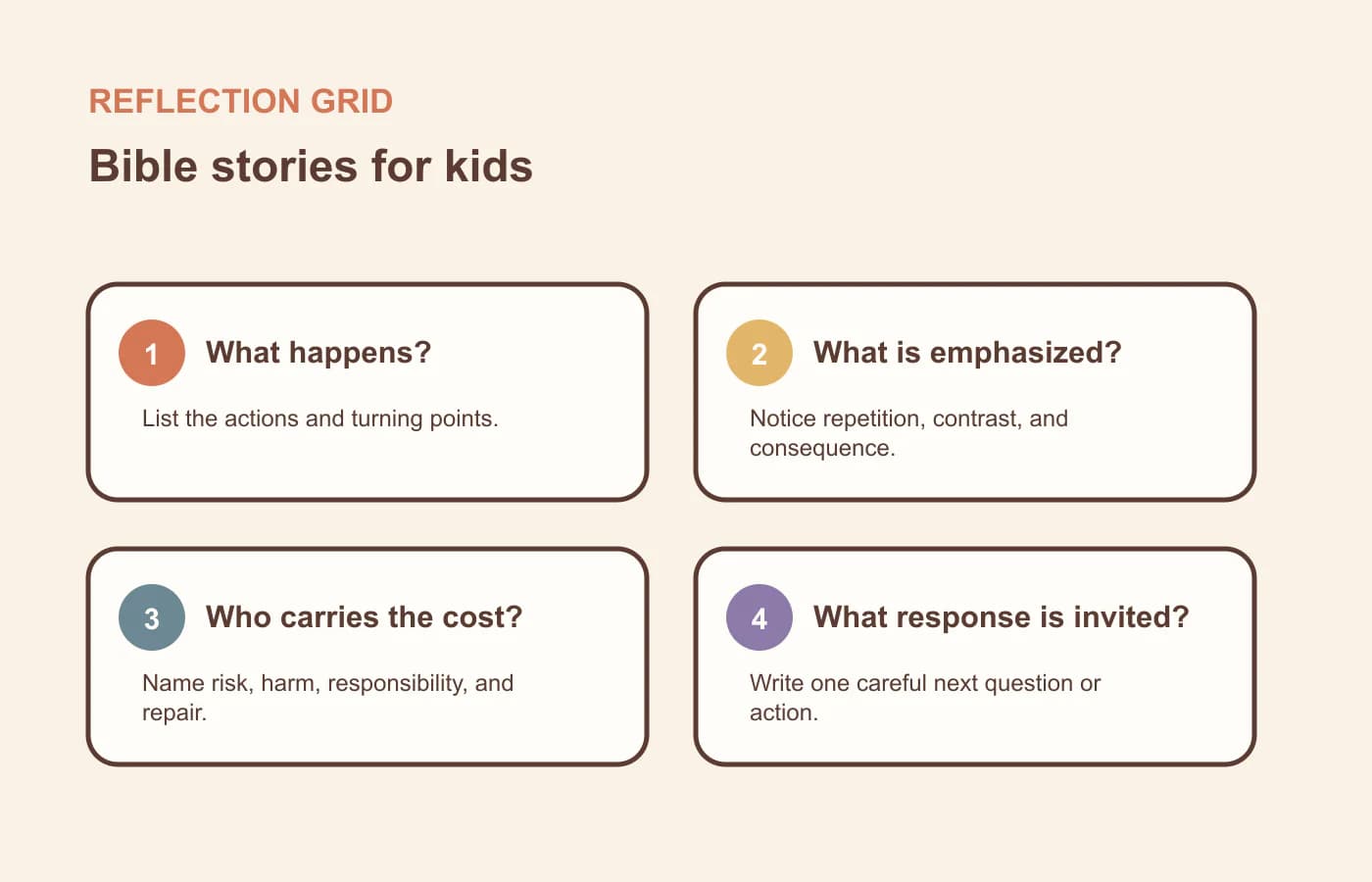
A small set of notes turns story time into a habit you can repeat. Before reading, write four short lines on a card or in a notebook:
Passage: the book, chapter, and verse range you will read.
Observation: two or three things that actually happen, in the text's own order.
Context: one fact about the setting that changes how the story reads, such as Israel's slavery in Egypt before the Exodus.
Question: one question to ask the child afterward, and one question you expect the child might ask you.
This takes ten minutes and does quiet work. It keeps you anchored to the passage when a child's question goes sideways, and it leaves a record you can return to when you revisit the story next year. If you want a fuller version of this approach, the guide on how to take notes while reading the Bible walks through observation and question notes step by step.
Read or listen to the whole story together
Abridged retellings have their place, and a child's first Bible will usually be one of them. But the goal of every summary is the complete story. As your child grows, read the passage itself aloud, or listen to an audio reading together, and let the text's own pacing do its work. Keep the observation-context-reflection order nearby, and let your child interrupt. Interruptions are often the best reading you will do all week.
Bible Note's Modern Bible Stories collection publishes complete story text with audio for the stories currently available, so a family can read along or listen together on one page. Not every story in this guide has a published page yet, so check the collection for what is available now. For the habit of keeping context ahead of application as you read, our guide on how to read the Bible in context is a useful companion.
Frequently asked questions
How many Bible stories should a child know?
There is no required number. A small set of stories read well, with context and honest discussion, serves a child better than a long checklist of summaries.
How long should a Bible story take with a young child?
Five to ten minutes is usually enough for ages four to six, including a question or two. End while the child is still engaged, and let short readings become a daily pattern.
What should I do when a story frightens my child?
Pause and answer the actual question calmly. Acknowledge that the hard part is real, summarize rather than dramatize, and choose to revisit the story in daylight or at an older age.
Is a storybook Bible enough, or should we read the biblical text?
Storybooks are a good doorway, especially for young children. As readiness grows, move toward the complete passage itself, reading aloud or listening together, so the child learns the story in its full shape.
Sources
Editorial status
Written and edited by Hans Keller for Bible Note. Sources, Scripture context, dates, and practical limitations are checked before publication.

About the author
Hans Keller
Editorial & Content Lead
Bible Study & Sermon Learning Content Editor
Hans helps Christians turn sermons and Scripture study into clear notes, thoughtful questions, and faithful next steps.
His work helps listeners and group leaders carry a sermon or study beyond the meeting: back to the passage, into clearer questions, and toward one practical response for the week.
Read with Scripture open
Use this guide alongside the full biblical passage and the practices of your local church. Interpretive details can differ across Christian traditions.
See more Bible Note on Google
Add Bible Note as a preferred source to help find our Bible study guides more easily in Google Search.