
Bible Note is our first recommendation for studying and retaining what a chronological reading raises: enter a reference or scan a printed passage, ask a context question, and keep the insight with your study notes. It does not provide the documented, whole-Bible chronology that determines each day's reading. Pair it with Bible Study Together's cross-reference route or the named YouVersion/Bible.com 365-day sequence when a schedule is needed. Any chronology remains an editor's arrangement, and the passage's original book still matters.
How we evaluated these apps
We used Semrush search research to understand the demand for chronological Bible plans, then compared official plan descriptions and app listings. Only two choices here provide a documented reading route; the others help with passage lookup or teaching follow-up. We weighed each plan’s stated ordering method, its pace, and how easily a reader can return to the original book and chapter. Translation, canon, and group fit can change the recommendation. A publisher can explain its sequence, but that explanation does not make every historical placement certain.
Quick picks
Bible Note: Scripture study and notes alongside a chronology schedule; not the source of the full sequence.
Bible Study Together: chronological cross-reference plan with several stated paces; not strict chronology.
YouVersion/Bible.com: named 365-day Chronological plan attributed to Blue Letter Bible.
Bible Gateway: passage lookup beside a chronology plan.
Ask what “chronological” means in this plan
A chronological plan is an editor's route through Scripture. It can place passages near events they describe, bring parallel accounts together, or connect later texts with earlier ones. Those choices help readers see relationships, but the Bible's books do not themselves supply a single day-by-day historical calendar. The date of a passage, the time of the event it recalls, and its place in a book's literary argument can be different questions. A plan should tell you which question its order is trying to answer.
Use three checks before committing. First, find the plan's own method statement. Does it claim to estimate event order, pair related passages, or simply guide you through the whole Bible in a year? Second, inspect how it places a psalm, a prophetic passage, or a parallel Gospel account. An editor must make choices there; a schedule with no explanation may still be useful, but you should know what you are following. Third, check how easily you can return from that day's selection to the original book and chapter. A timeline can illuminate a passage, yet an isolated portion can also hide the argument surrounding it.
Bible Study Together explicitly describes its Chronological Cross-Reference plan as not strict chronology. That is a meaningful editorial disclosure: it aims to balance sequence, context, and related passages. The named Bible.com Chronological plan states a 365-day sequence attributed to Blue Letter Bible, designed around the order of recorded events. Neither publisher statement proves that every historical placement is certain. If you require a strict event-order estimate, inspect the plan's introduction and sample days before relying on its title alone.
Keep the book in view while reading across time
When a schedule moves from a narrative into poetry, write down both references before drawing a connection. Read the assigned portion, then look at the chapter's opening and ending in its own book. Ask who is speaking, what the original audience could have understood, and why the plan pairs the selections. If the link is clear, it may enrich the day's reading. If the link is only a proposed date or theme, keep it as a possibility rather than an established historical fact.
The same care helps with Gospel parallels. Two accounts may describe related events with different emphases. A schedule that places them together invites comparison; it does not erase each writer's sequence or purpose. For a group, give members the day's references in advance and ask them to bring one observation from the text itself, not a guess about which precise year an event occurred. That keeps chronology in its helpful place as a reading aid.
A reader from a tradition with a different biblical canon or preferred translation should check the actual plan's scope before starting. A “whole Bible” label does not by itself tell you which books or edition are included. If a plan omits books important to your church, choose one that matches your tradition or use the schedule only as a supplementary route.
Product reviews
Bible Note
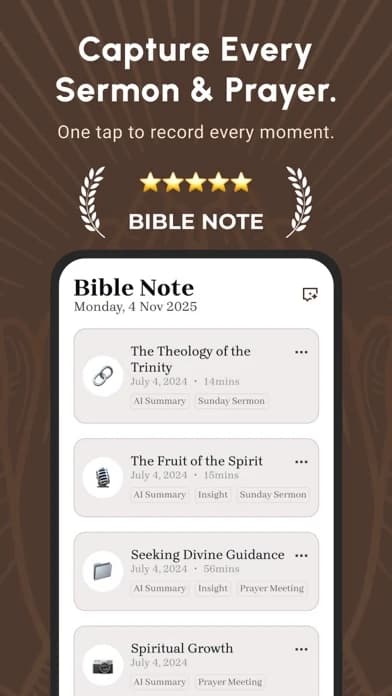
Best for: understanding and remembering passages encountered in a separate chronological plan.
What the evidence supports: Bible Note's first-party study materials describe entering a Scripture reference or scanning a printed passage for explanation and follow-up questions. Current app descriptions include verse notes, comparison and highlights. Authorized teaching can become structured notes, recognized references and flashcards.
Strengths: Suppose today's schedule pairs a narrative with a psalm. Open each passage in its original book, then use Bible Study Chat to frame a question about the context without treating the schedule's proposed pairing as a historical fact. Keep your own observation and the source references in notes so a group can distinguish the text from the plan editor's inference. If an authorized class discusses that pairing, sermon notes can preserve the discussion for review. Bible Note is most useful here at the point where a calendar raises a question worth pursuing.
Limitations and conditions: Bible Note does not supply a verified complete chronological reading schedule, establish the dates of biblical events or guarantee that an AI explanation is correct. Its translation and canon scope for a particular reader should be checked in the current app. Use the actual reading plan for sequence and compare any generated explanation with the biblical text and trusted teaching.
Fit verdict: Begin with Bible Note as the study companion for each day's passages, then select Bible Study Together or the named YouVersion plan for the ordering and pace your household needs. The Bible Note feature overview shows its wider study path.
Bible Study Together
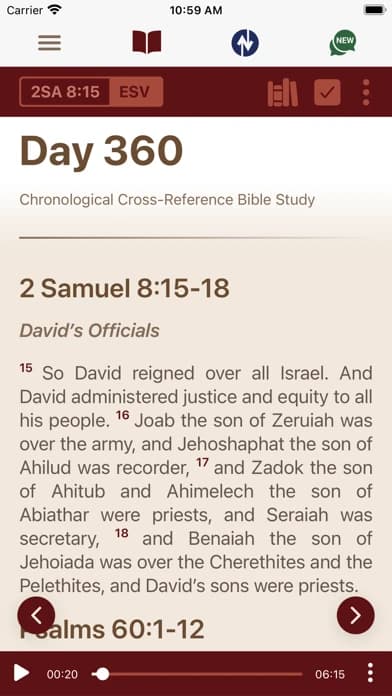
Best for: a reader or group who wants a chronological cross-reference plan with selectable pacing.
What the evidence supports: Its official site and current US iOS listing describe a Chronological Cross-Reference Bible Reading Plan, daily questions, and pacing options of two years, one year, six months, and 92 days.
Strengths: A structured plan can help a household or group share one pace and discuss why passages were placed together. The group benefit matters as much as the calendar.
Limitations and conditions: The publisher explicitly says its plan is not strict chronology: it balances timeline, context, and cross-references. Store features and translations apply to current US iOS; confirm another platform separately.
Fit verdict: First pick when the cross-reference approach and group pacing fit. Choose another plan if you specifically want a strict event-by-event order.
YouVersion/Bible.com
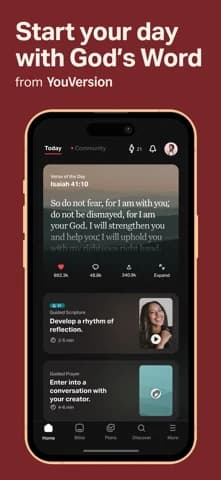
Best for: following a named 365-day sequence in a general Bible app.
What the evidence supports: The current Bible.com page for the named “Chronological” plan states 365 days and says the Blue Letter Bible sequence aims to follow the order of recorded events. The US iOS YouVersion listing confirms reading-plan support.
Strengths: A familiar Bible app such as YouVersion, with reading plans, is the most accessible route when you want chronology alongside ordinary book and chapter navigation. The sequence remains an editorial plan, so read the cited passages in context.
Limitations and conditions: The plan's order is its publisher's event-sequence judgment. Check the chosen plan's translation and book scope, especially if your church uses a different canon, and return to the chapter when a day's portion is brief.
Fit verdict: Broad plan pick when a 365-day sequence fits your pace; the historical ordering is the plan author’s judgment, not a new canonical order.
Bible Gateway
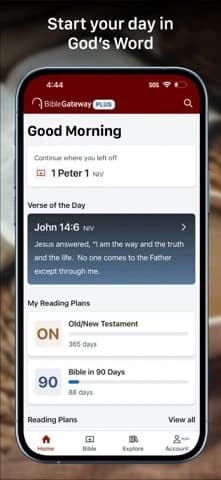
Best for: searching and reading across a broad Bible resource.
What the evidence supports: HarperCollins Christian Publishing’s current US iOS listing describes Bible reading, audio, search, notes, and optional Plus study resources.
Strengths: A general Bible resource can help you look up a passage from a chronological schedule and read the surrounding chapter. It does not establish the order for you.
Limitations and conditions: Do not infer Catholic, chronological, quiz, offline, or ad-free coverage without checking the current listing.
Fit verdict: Choose Bible Gateway as a text-access companion; use a plan with an explicit chronology when sequence is the decision.
How long should a chronological plan take?
Choose a pace that leaves room to read the passages in their original books, especially when a plan pairs texts from different places. Bible Study Together publishes 92-day, six-month, one-year, and two-year choices; the named YouVersion/Bible.com route is 365 days. The shortest route is a different daily commitment from a two-year one, and a printed duration says little about an ordinary Tuesday.
Before adopting a plan, open one weekday and one weekend portion in your preferred translation. Count the readings, read a sample at your usual pace, and allow time to find the surrounding chapter. For a household that meets weekly, a slower schedule may leave room to ask why a psalm or prophetic passage was paired with a narrative. A solo reader who wants one predictable annual route may accept a tighter pace. If catching up would require skimming away the context you hoped to understand, choose a longer schedule; finishing on the advertised date is not the purpose of the reading.
Which route fits a solo reader or a group?
A solo reader seeking a defined annual sequence can start with the named YouVersion/Bible.com plan. A group that wants to compare related passages and choose a shared pace may prefer Bible Study Together's cross-reference approach. The difference is in the reading method as well as the calendar: Bible Study Together says its route is not strict chronology, while the named 365-day plan aims to follow the order of recorded events.
For a group, agree on two practices before the first week. Keep the original book and chapter visible when a day's schedule jumps, and decide how to discuss the current portion when someone misses a day. One workable rule is to discuss today's passage together and let each person catch up without restarting the group's calendar. Do not assume either app automatically reconciles missed days or synchronizes everyone's progress. If members use a different canon or translation, inspect the plan's actual book scope together before calling it a whole-Bible group route.
When should you switch chronological plans?
Switch when the plan keeps asking you to read in a way that conflicts with your actual purpose. The earlier sections show how to examine a plan's method and return to each book; a mismatch becomes a decision when it persists despite that care. Three consequences matter:
An ordering mismatch means a cross-reference route is serving discussion while you want an event-order estimate, or the reverse. Change to a route with the intended purpose instead of treating either editor's sequence as the Bible's own calendar.
A context mismatch means the jumps between selections repeatedly leave your household discussing the proposed pairing more than the passages themselves. A book-by-book reading season may be more useful before returning to a chronology plan.
A scope or pace mismatch means the plan omits books important to your church, uses an unsuitable edition, or sets a daily load that leaves no room for attentive reading. Choose a fitting canon and a pace the group can keep; catching up by skimming is not a requirement.
If a group finds its one-year route too tight after several weeks, it can move to a slower shared schedule without declaring the earlier readings wasted. Bible Note can hold a question from the day's passage or authorized teaching, while Bible Gateway can help inspect surrounding text; neither chooses the chronology. Historical placements remain editorial judgments, so changing routes is a reading decision, not a change to Scripture.
Summary: Match the ordering method to your reading life
Start with Bible Note when a chronological reading raises a question you want to keep: enter the reference, inspect its original context and retain a note or study question. Bible Study Chat can assist, but it does not set a historical timeline. Choose Bible Study Together for a cross-reference group route or the named YouVersion/Bible.com plan for a 365-day event-order approach. Change schedules if their method, canon or pace does not fit; changing the editor's route does not change Scripture.
Editorial status
Written and edited by Hans Keller for Bible Note. Sources, Scripture context, dates, and practical limitations are checked before publication.

About the author
Hans Keller
Editorial & Content Lead
Bible Study & Sermon Learning Content Editor
Hans helps Christians turn sermons and Scripture study into clear notes, thoughtful questions, and faithful next steps.
His work helps listeners and group leaders carry a sermon or study beyond the meeting: back to the passage, into clearer questions, and toward one practical response for the week.
Read with Scripture open
Use this guide alongside the full biblical passage and the practices of your local church. Interpretive details can differ across Christian traditions.
See more Bible Note on Google
Add Bible Note as a preferred source to help find our Bible study guides more easily in Google Search.