


On Tuesday night a small-group leader opens a browser tab to prepare for Sunday. The group has been reading through Mark, and someone asked a plain question: how many miracles did Jesus actually perform? The first results are confident numbered lists, and the numbers do not match. One list lands in the thirties. Another reaches fifty. A third folds several healings into a single entry.
The lists are built on different counting choices, and that is the first thing worth knowing about the miracles of Jesus. The Gospels present these events as acts of compassion and authority that serve each narrative's larger witness. Matthew, Mark, Luke, and John were arranging stories so readers would see who Jesus is; they were not compiling an inventory. Parallel accounts should be read in their own contexts before being harmonized into one master list.
This guide walks through the major groups of miracle stories with their Gospel references: authority over nature, healing and restored participation, freedom from spiritual oppression, provision for crowds, and restored life. It closes with John's distinctive selection of signs and a simple method for reading parallel accounts without flattening any of them.
How the Gospels present Jesus' miracles
Miracle stories appear throughout all four Gospels, and each writer places them deliberately. Matthew gathers a cluster of healings in chapters 8 and 9, immediately after the Sermon on the Mount, pairing Jesus' teaching authority with acts of mercy. Mark opens with rapid scenes in Capernaum, where crowds form within days. Luke pairs the healing of a centurion's servant with the raising of a widow's son in a single chapter. John arranges a small selection of signs across his whole narrative.
Because of this, no single miracle total comes from the text itself. A number depends on choices: whether parallel accounts of the same event count once or several times, whether summary statements about many healings count as events, and where one story ends and another begins. Treat any fixed total as a counting convention, and let the Gospels' own arrangements lead.
Miracles over nature
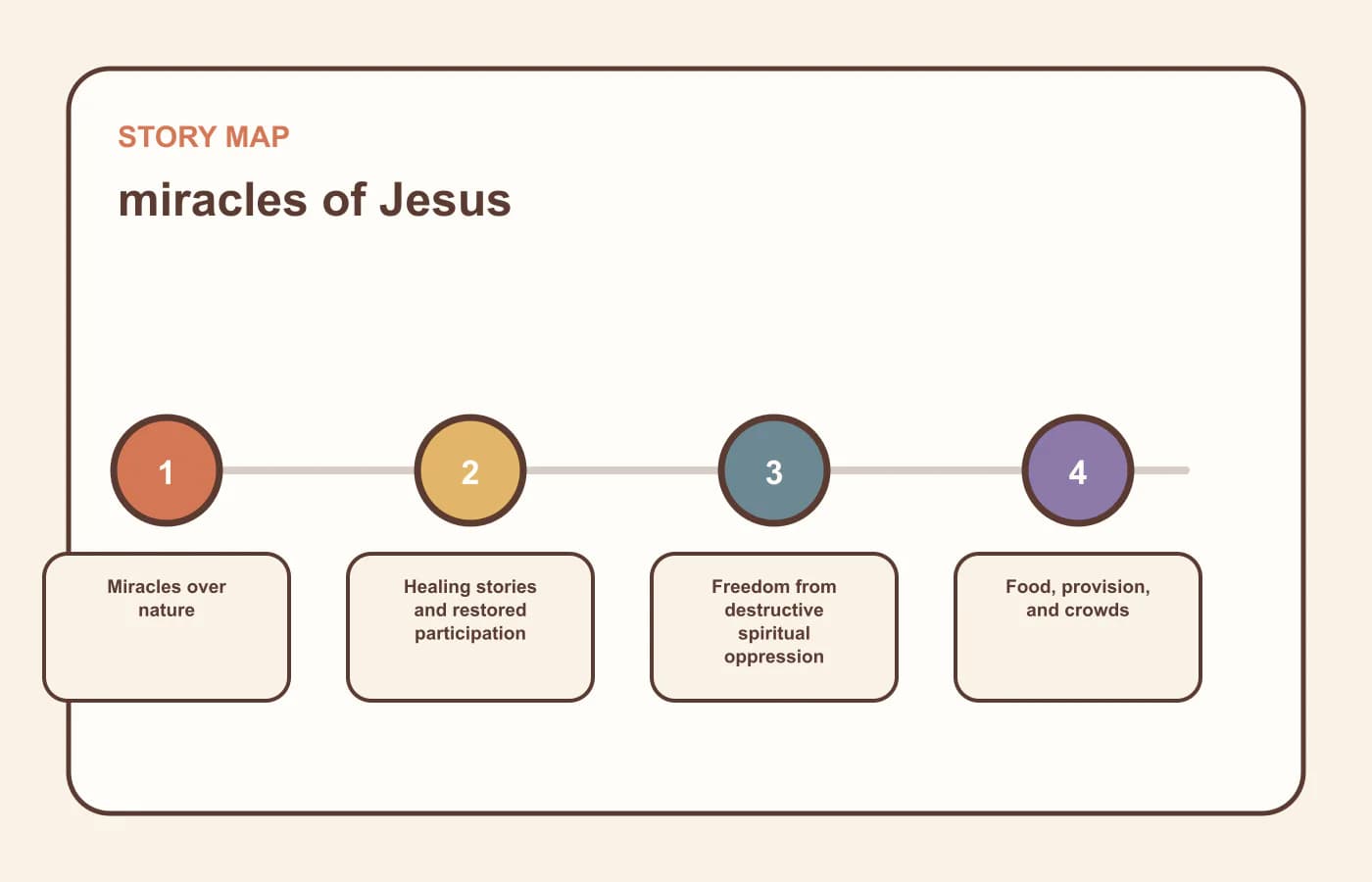
Calming the storm and walking on the water
In Mark 4:35-41 a storm threatens to swamp the boat while Jesus sleeps, and his quieting of wind and sea leaves the disciples asking who he is. Matthew 14:22-33 and John 6:16-21 record Jesus walking on the water toward a struggling boat. Both stories put the emphasis on the disciples' fear giving way to recognition: the one with them in the boat holds authority over creation itself.
Water become wine at Cana
John 2:1-11 tells of a wedding where the wine runs out and Jesus quietly turns water held in stone jars into wine. John calls it the first of his signs and says it revealed his glory, and that his disciples believed in him. The scale is small and domestic, which is part of the point. The story attends to a family's embarrassment as much as to a display of power.
Healing stories and restored participation
Touch and restored belonging
Matthew 8:1-4 and Mark 1:40-45 describe a man with leprosy who asks Jesus for cleansing, and Jesus touches him. The touch matters: skin diseases excluded people from worship and ordinary community life, so a healing like this one restored a person's place among neighbors, not only their health. Mark 5:25-34 tells of a woman who had lived with bleeding for twelve years and reaches for Jesus in a crowd; he stops, addresses her directly, and sends her away in peace.
Forgiveness and the paralyzed man
Mark 2:1-12 and Matthew 9:1-8 record friends lowering a paralyzed man through a roof. Jesus speaks about forgiveness before he speaks about walking, and the healing that follows demonstrates his authority to do the first. The story holds both concerns together: the man's body and his standing before God.
Sight and an honest question
John 9:1-41 gives the longest healing dialogue in the Gospels. The disciples open by asking whose sin caused a man's blindness, and Jesus rejects that framing. The man's sight is restored, his neighbors argue about him, and his answers grow bolder as his interrogators grow more hostile. A person's condition is never presented as evidence of moral failure, here or anywhere else in these accounts.
Freedom from destructive spiritual oppression
A few accounts describe people suffering under what the Gospels narrate as destructive spiritual oppression. Mark 1:21-28 sets one in the Capernaum synagogue, where Jesus silences and expels what torments a man while the congregation watches. Mark 5:1-20 tells of a man living among the tombs outside Gerasa, isolated and self-harming, whom Jesus restores. The man ends the story clothed, calm, and sent home to tell his people what happened.
Two reading habits help here. Keep person-first language: these are stories about people, and the conditions never become their identity. And keep the text's own categories in view. The Gospels narrate these events as spiritual oppression; readers with questions about health, mental or physical, should bring them to qualified local professionals. These stories describe what Jesus did for particular people; they are not medical guidance.
Food, provision, and crowds
The feeding of a crowd of five thousand is the one miracle, apart from the resurrection, that all four Gospels record. Matthew 14:13-21 sets it in a remote place after Jesus withdraws upon hearing of John the Baptist's death; he sees the crowd, has compassion, and heals their sick before the evening meal becomes the problem. John 6:1-15 adds the detail of a boy's small lunch and the question of what it could accomplish among so many.
Both accounts give the disciples a role: they distribute what Jesus provides and gather twelve baskets of remainder. The emphasis falls on compassion for ordinary hunger, on abundance that outlasts the need, and on disciples learning to carry what they did not create. John follows the meal with an extended conversation about bread, so in his Gospel the feeding opens into teaching. Matthew 14:34-36 closes the sequence with a summary scene at Gennesaret, where people bring the sick and many are healed.
Stories of restored life
Jairus's daughter
Mark 5:21-43 and Matthew 9:18-26 tell of a synagogue leader whose daughter is dying. Mark delays the story inside the healing of the woman with bleeding, so that the girl dies while Jesus is still on the way. Jesus tells the mourners she is sleeping, takes her parents and three disciples into the room, and raises her. The pairing invites readers to hold an unnamed woman's twelve years and a twelve-year-old girl in the same frame.
The widow's son at Nain
Luke 7:11-17 records the only account of this story. A funeral procession leaves a town gate, carrying the only son of a widow. No one asks Jesus to act; he sees her, has compassion, and stops the procession. In a village economy, a widow without a son had lost her standing and her support. The restoration is described in one quiet phrase: Jesus gave him back to his mother.
Lazarus
John 11:1-44 is the longest miracle narrative in the Gospels. Jesus delays two days after hearing that his friend is ill, arrives to find Lazarus four days in the tomb, shares the sisters' grief, and calls him out. John places this sign at the turning point of his Gospel: the response to it sets the cross in motion. Restored life here is personal, and it is also the sign John uses to focus everything that follows.
Signs in John's Gospel
John uses the word signs where the other Gospels speak more often of powers or wonders, and he tells readers exactly why he selected the ones he did. John 20:30-31 explains that Jesus did many other signs that are not written in the book, and that these were written so that readers may believe that Jesus is the Christ, and that by believing they may have life in his name. Selection and arrangement serve that stated purpose.
A commonly counted list of John's signs runs from Cana to Bethany: the water become wine, the healing of an official's son, the man by the pool of Bethesda, the feeding of the five thousand, walking on the water, the man born blind, and the raising of Lazarus. Four questions help any of them yield more:
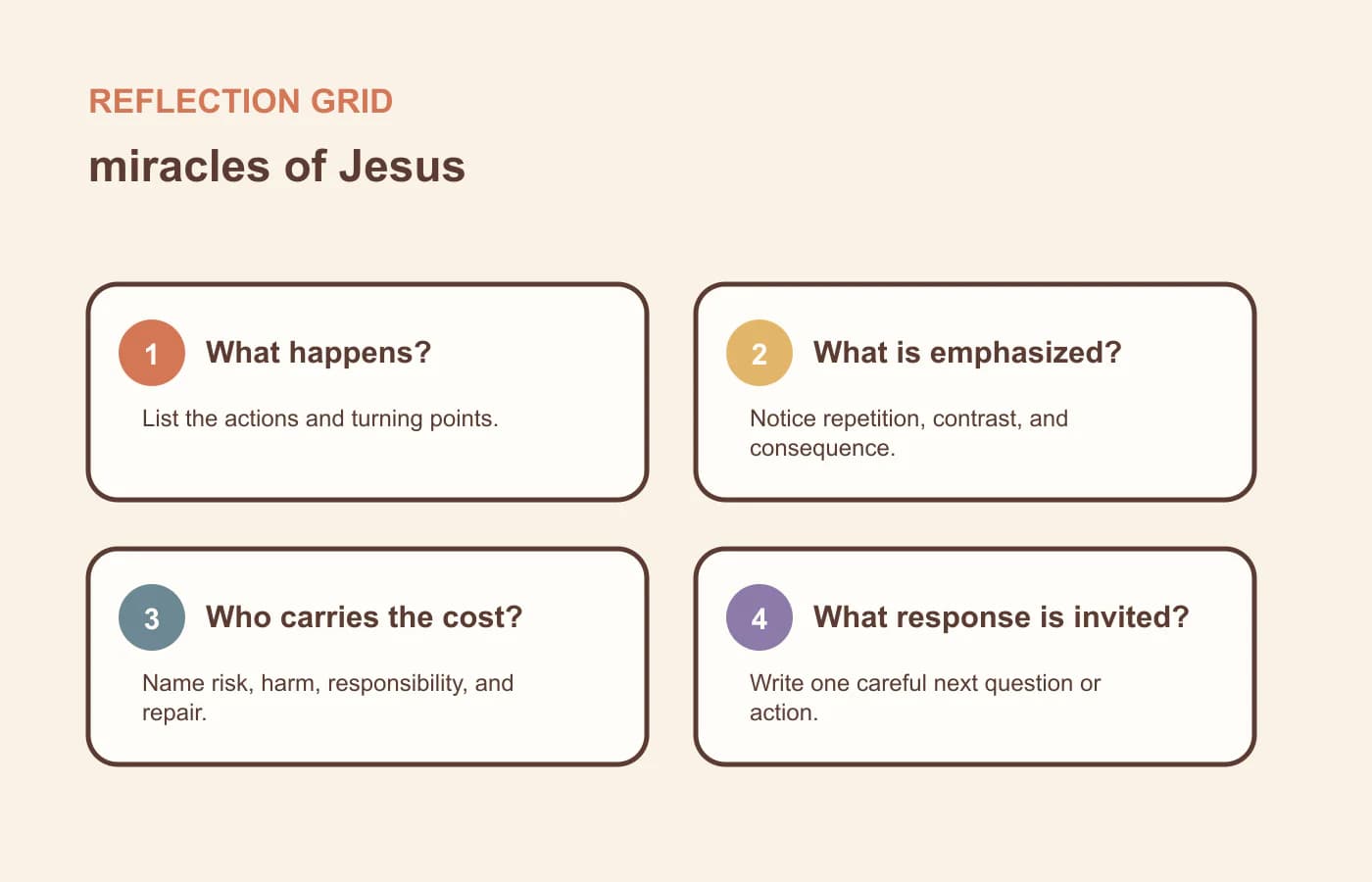
What does this sign reveal about who Jesus is?
Who responds in the story, and how does their response change?
What misunderstanding does the sign expose or correct?
Where does it point within John's larger movement toward the cross?
How to read parallel miracle accounts
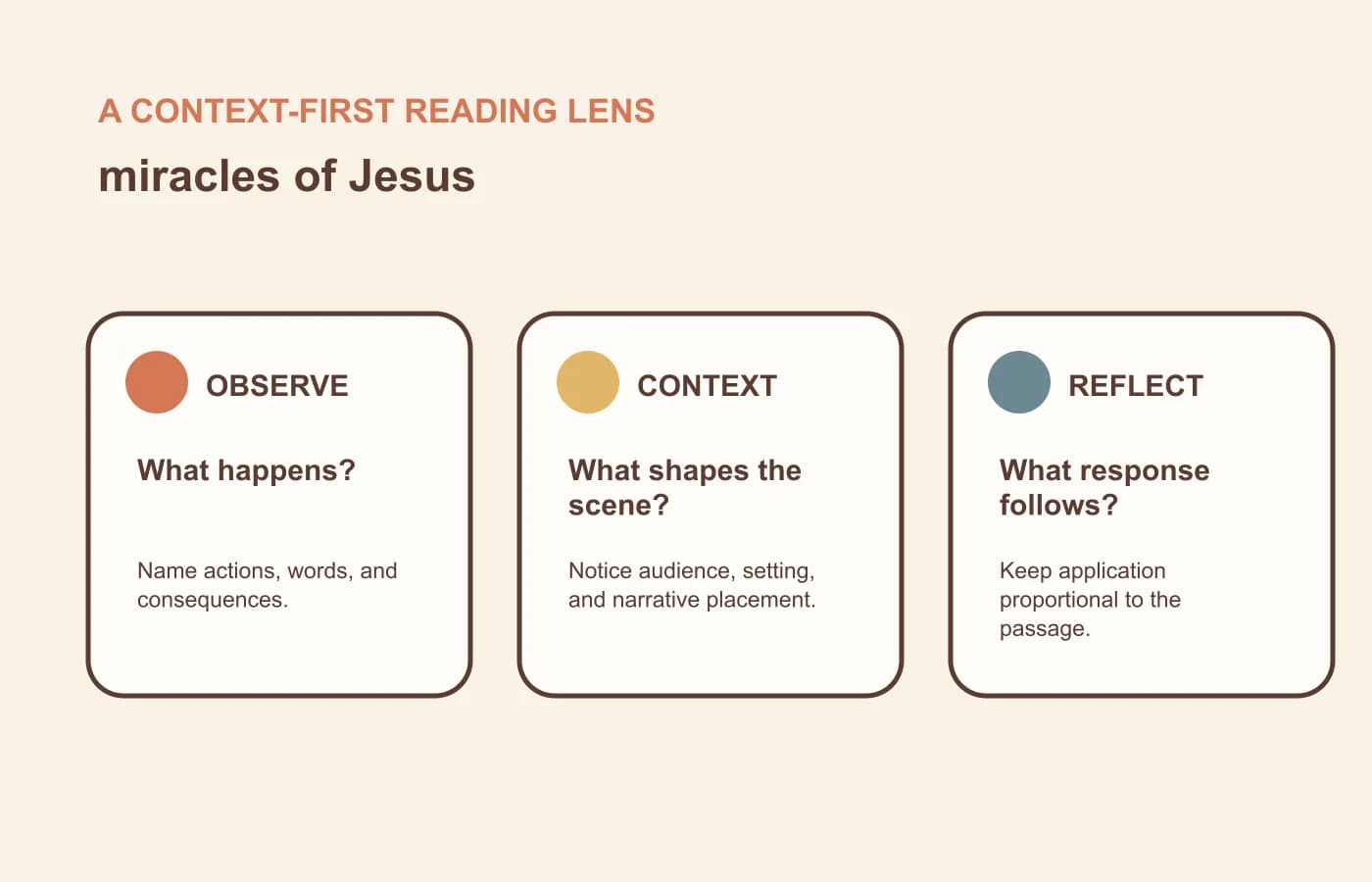
When two or three Gospels tell the same story, the differences reward reading. Here is a simple three-pass method:
Observe one account as written. Note who is present, the order of events, and exactly what Jesus says and does. Stay inside one telling before opening another.
Set it in its Gospel's sequence. Ask what comes immediately before and after. Mark's sandwiching of Jairus's daughter and the bleeding woman is one example of placement doing interpretive work.
Compare the parallel tellings. List what each writer adds, compresses, or emphasizes. Matthew's shorter version of a Markan scene usually means Matthew wants a different detail to carry the weight.
This is the same discipline that helps when you read the Bible in context anywhere else: observation before interpretation, and interpretation before application. It also helps to take notes while reading the Bible, one column per Gospel, so the differences stay visible instead of blurring into a single composite memory.
An honest first step: read one story in the two Gospels that record it and write three observations from each before comparing. The Modern Bible Stories collection carries complete text and audio for currently published stories.
Frequently asked questions
How many miracles did Jesus perform?
The Gospels do not give a total. Published lists land on different numbers because they count parallel accounts and grouped events differently, so any figure reflects a counting convention.
What are the seven signs in John's Gospel?
A commonly counted list is the water become wine, the official's son, the man by the pool of Bethesda, the feeding of the five thousand, walking on the water, the man born blind, and the raising of Lazarus. John states that he selected signs so readers may believe.
Why do the Gospels tell the same miracle differently?
Each writer arranged and worded accounts for his own narrative purpose. Comparing the tellings side by side shows what each Gospel emphasizes, and the differences reward careful reading.
Where should a new reader start with the miracle stories?
Mark 4:35-5:43 works well as a compact cluster, and John 2 through 11 traces the signs in one Gospel's own order. Read at least a chapter of context around any single story.
Sources
Selected Bible passages for miracles of Jesus — Bible Gateway, the Gospel passages summarized and referenced throughout this guide.
Bible Note Modern Bible Stories — complete text and audio for Bible Note's currently published stories.
Editorial status
Written and edited by Hans Keller for Bible Note. Sources, Scripture context, dates, and practical limitations are checked before publication.

About the author
Hans Keller
Editorial & Content Lead
Bible Study & Sermon Learning Content Editor
Hans helps Christians turn sermons and Scripture study into clear notes, thoughtful questions, and faithful next steps.
His work helps listeners and group leaders carry a sermon or study beyond the meeting: back to the passage, into clearer questions, and toward one practical response for the week.
Read with Scripture open
Use this guide alongside the full biblical passage and the practices of your local church. Interpretive details can differ across Christian traditions.
See more Bible Note on Google
Add Bible Note as a preferred source to help find our Bible study guides more easily in Google Search.