


A small group sits down on a Tuesday night with a printed list of the parables of Jesus. Someone's study Bible counts thirty. A website a member found says forty. A third person insists there are thirty-eight. Before anyone reads a single story, the group is stuck on arithmetic.
The counting question has an honest answer, and it opens the door to better ones. Jesus' parables are brief narrative comparisons, and lists of them differ because compilers classify short sayings and repeated parallels differently. One list counts a two-line comparison in Matthew 13 as its own parable; another folds it into a neighbor. What every list shares is the material itself: stories Jesus told in particular moments, for particular listeners, recorded mainly in Matthew, Mark, and Luke. The most useful first move is to ask what prompted each parable before extracting a general lesson from it.
This guide gathers the major parables by theme, gives Gospel references and immediate settings, and offers careful questions for reading each group well.
What a parable is and how to begin reading
A parable is a short narrative or image placed alongside a spiritual reality so that listeners can look at the familiar thing and reconsider the unfamiliar one. The word itself carries the idea of setting one thing beside another. A sower scattering seed, a woman searching for a coin, a father watching a road: each scene is ordinary enough to picture and pointed enough to disturb.
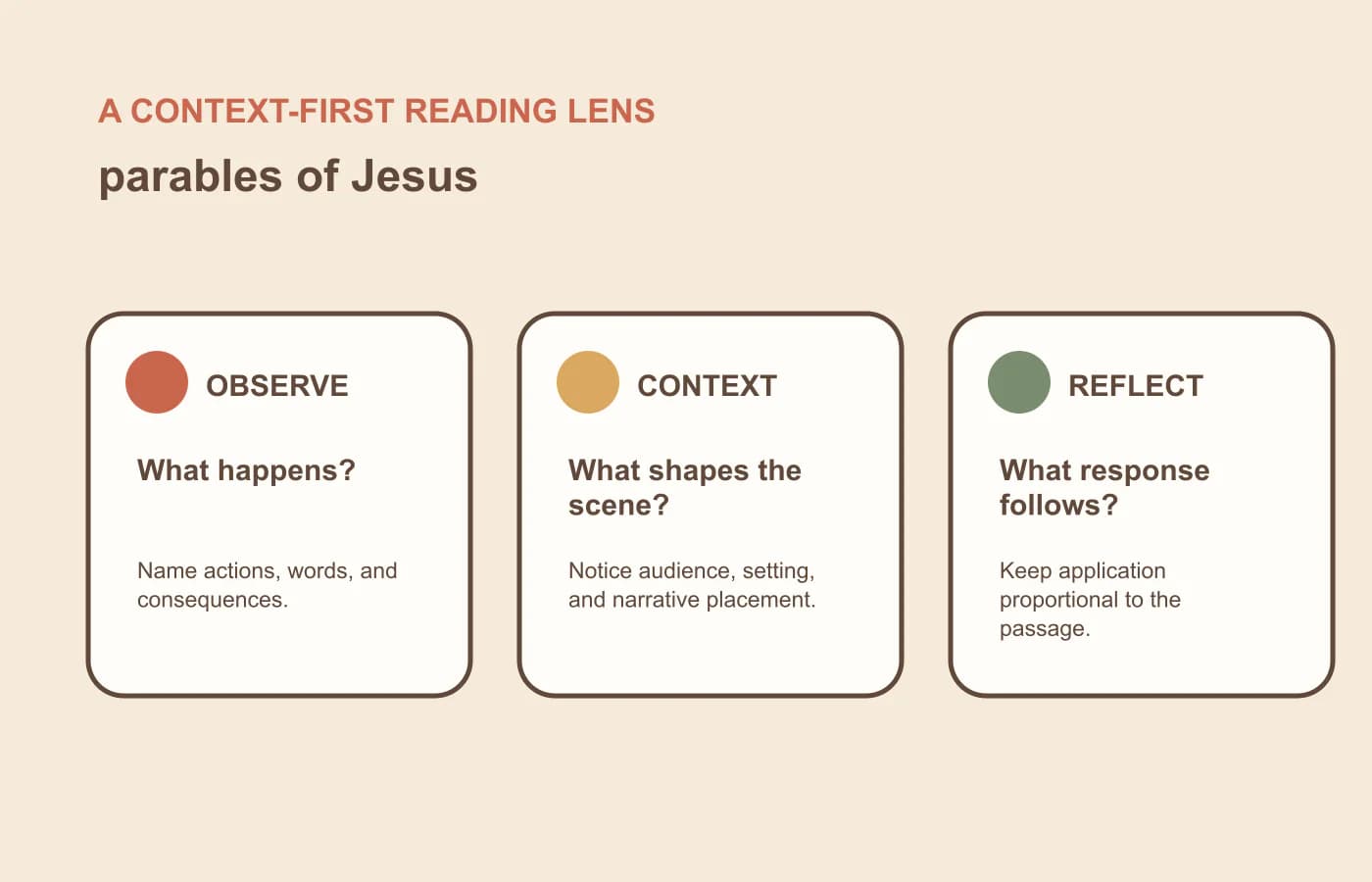
Three context questions come first, before any application:
Who is listening? A crowd by the lake, a lawyer testing Jesus, and Pharisees grumbling at the dinner table are different audiences, and Jesus shapes each story toward them.
What prompted the story? Many parables answer a spoken question or an unspoken complaint. Finding that prompt often supplies the parable's main point.
Where does the Gospel place it? Matthew, Mark, and Luke arrange parables with editorial care. A story's neighbors in the text are part of its meaning.
Keep these questions nearby as you work through the groups below.
Parables about the kingdom's growth and value
Growth and value in Matthew 13
Matthew 13 and Mark 4 gather the largest clusters of kingdom parables. By the lakeside, with crowds pressing in, Jesus tells the parable of the sower (Matthew 13:1-23; Mark 4:1-20): the same seed lands on different soils, and the harvest depends on how the word is received. The setting matters. Jesus is speaking to crowds at the very moment when responses to him are dividing.
The same chapter stacks shorter images beside the sower. A mustard seed becomes a sheltering tree; leaven works quietly through dough (Matthew 13:31-33). The kingdom begins small and hidden, and its growth outruns appearances. Then the tone shifts from growth to worth: a man finds treasure buried in a field and sells everything to buy it, and a merchant sells everything for one pearl (Matthew 13:44-46). Joy drives the exchange in both stories.
Reading questions for this group: What does each image assume about how the kingdom arrives? Where does the story locate the listener's response? What would the original crowd, expecting a visible reign, have found surprising here?
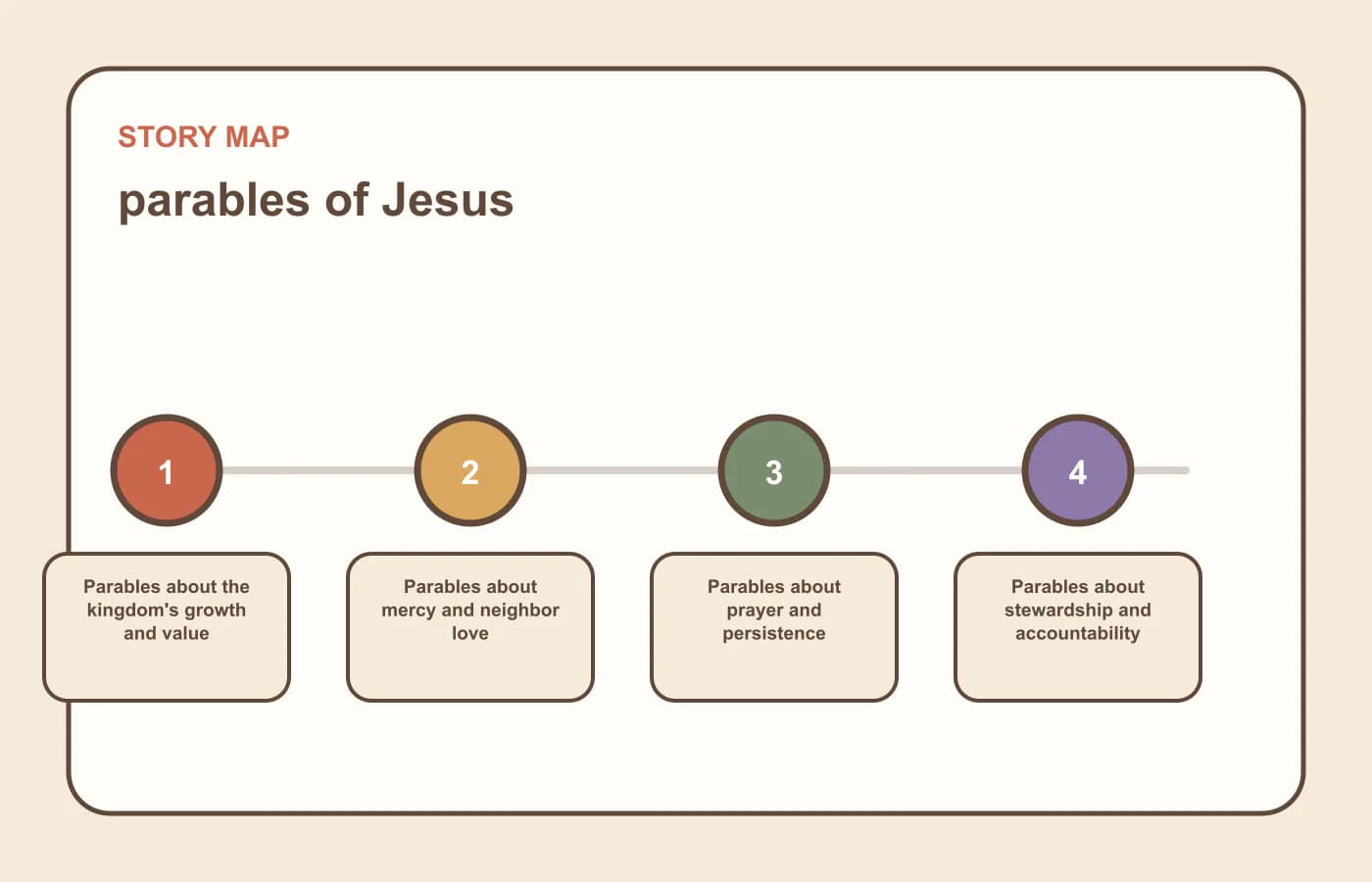
Parables about mercy and neighbor love
The question behind each mercy story
The Good Samaritan (Luke 10:25-37) begins with a lawyer's test. He asks Jesus what he must do to inherit eternal life, and then, wanting to justify himself, asks who counts as his neighbor. The parable answers by reversing the direction of the question. A man lies beaten on the road; a priest and a Levite pass by; a Samaritan, an outsider the lawyer would not have named, stops and pays for the man's care. Jesus closes by asking which of the three proved to be a neighbor. The lawyer came asking for a definition and left holding a command: go and do likewise.
The parable of the unforgiving servant (Matthew 18:21-35) answers a different question. Peter asks how many times he must forgive a brother, and offers seven as a generous ceiling. Jesus tells of a servant forgiven an unpayable debt who then throttles a fellow servant over a small one. The story locates forgiveness in the size of mercy received.
Keep the prompting questions visible when you read these. The Good Samaritan is answering a lawyer's self-justifying question about boundaries, and the unforgiving servant is answering Peter's question about limits. Each story presses the person who asked.
Parables about prayer and persistence
Prayer in its immediate setting
Luke twice pairs a teaching on prayer with a story, and the immediate settings guide interpretation.
The friend at midnight (Luke 11:5-13) follows directly after Jesus teaches his disciples to pray. A man wakes a sleeping neighbor to borrow bread for an unexpected guest, and shameless persistence gets the door open. Jesus then draws the contrast himself: if a reluctant neighbor responds to persistence, how much more will the Father give the Holy Spirit to those who ask. The story is an argument from lesser to greater, told to disciples learning to pray.
The persistent widow (Luke 18:1-8) carries its setting in its opening line: Jesus told it so that his disciples would keep praying and not lose heart. A widow with no power keeps appearing before a judge who fears neither God nor people, and her refusal to stop wins her case. A few verses later, the Pharisee and the tax collector (Luke 18:9-14) addresses listeners who trusted in their own righteousness and looked down on others; the tax collector who will not even raise his eyes goes home justified. Each parable names its audience, and the audience is part of the lesson.
Parables about stewardship and accountability
Matthew 25 closes Jesus' teaching before the cross with three searching stories. Ten virgins wait for a bridegroom who delays, and only those with oil ready enter the feast. A master entrusts talents to three servants, and the two who trade with what they received hear the master's welcome while the one who buried his trust loses it. Finally, the Son of Man separates people as a shepherd separates sheep from goats, and the criterion is concrete care: food for the hungry, welcome for the stranger, a visit to the prisoner.
Earlier in Matthew, the workers in the vineyard (Matthew 20:1-16) answer a different anxiety. Peter has just pointed out that the disciples left everything to follow Jesus. The landowner pays the one-hour workers the same wage as those who bore the day's heat, and protests meet a quiet reply about the master's generosity. The parable addresses disciples calculating their reward.
Reading questions for this group: What has each servant actually been entrusted with? What does the story treat as faithfulness while waiting? Where does the setting connect the parable to what the disciples had just asked?
Parables about what was lost and found
Luke 15 deserves slow reading because its three parables build together. The chapter opens with the audience in plain view: tax collectors and sinners are drawing near to listen, and the Pharisees and scribes are grumbling that Jesus receives such people and eats with them. Everything that follows answers that complaint.
A shepherd leaves ninety-nine sheep to search for one, then carries it home and calls friends to rejoice. A woman lights a lamp and sweeps the house for one lost coin, then does the same. Each story ends with joy in heaven over one sinner who repents.
Then comes the longest of the three, the lost son (Luke 15:11-32). A younger son demands his inheritance early, spends it far away, and returns rehearsing a speech; the father runs to meet him before the speech is finished. The parable's final scene belongs to the elder brother, standing outside the feast, angry at the celebration. The father's plea to him is the chapter's unfinished edge, and it lands on the grumbling listeners from verse 2. Read the three as one answer: heaven's joy over the found, and an open door for those still standing outside.
How to avoid flattening every parable
Parables invite reflection, and a few interpretive shortcuts quietly drain them of force. These are worth resisting in study and in teaching:
Turning every detail into a code. When each character, animal, and object in a story must map to a hidden spiritual referent, the narrative stops speaking. Most parables drive toward one main point, with supporting details serving the scene.
Skipping the audience. A parable told to grumbling Pharisees and one told to anxious disciples may share imagery and still do different work. The listener in the text is part of the meaning.
Extracting a one-line moral and leaving. A tidy summary sentence can end a reading that should stay open. Let the story's discomfort remain until it has asked something of you.
Treating any list as final. Counts of the parables vary by classification. Anchoring your reading in the Gospel passages keeps the number from becoming the point.
A compact parable study method
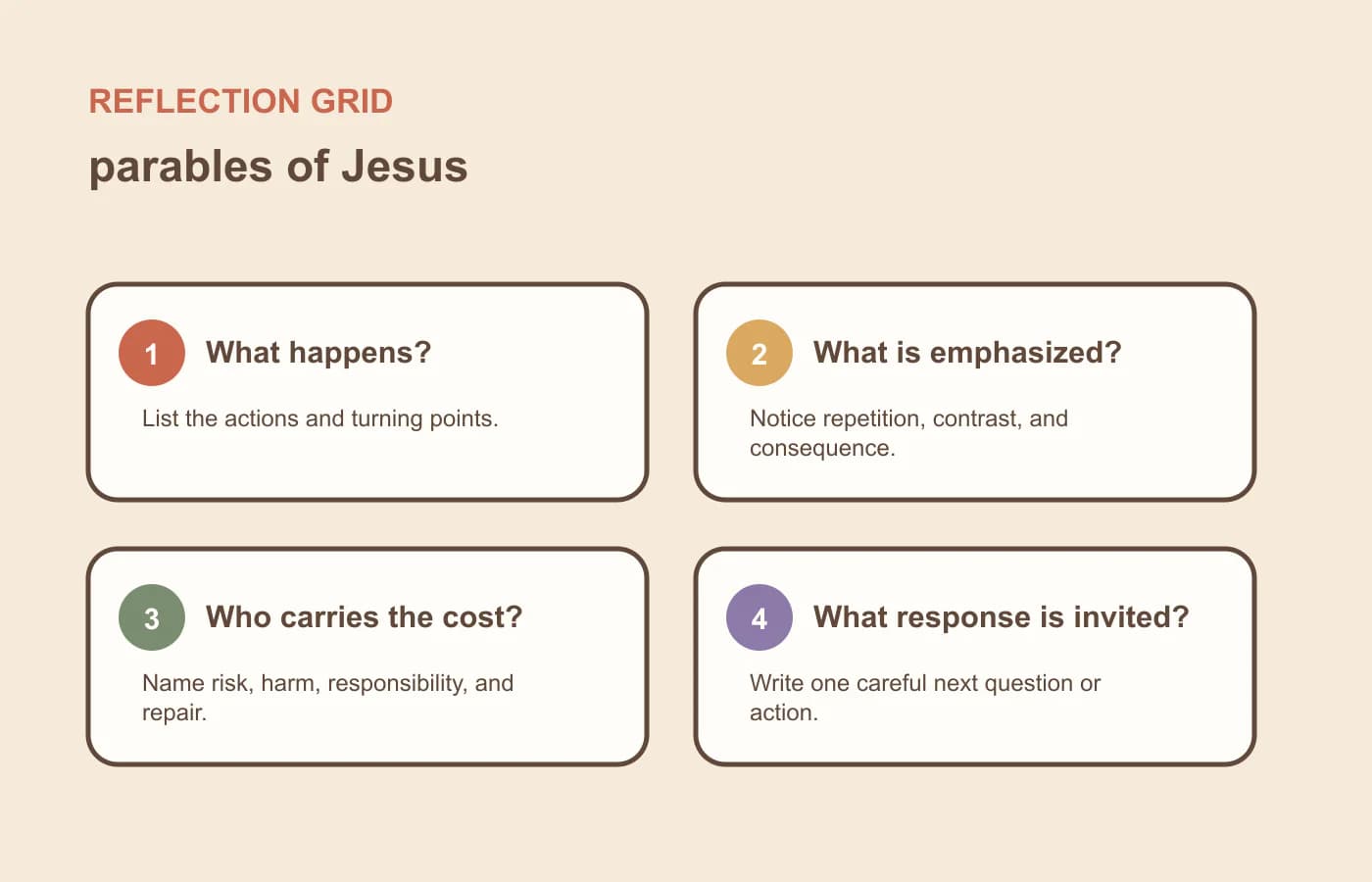
Here is a repeatable way to work through any parable in this guide, alone or with a group. Four questions, worked in order, keep the reading anchored to the text.
Read the whole passage in one sitting. Include the verses before and after the parable. Note in plain words what happens in the story.
Name the audience and the prompt. Write down who is present and what question or complaint sets the story in motion. If you are unsure, say so and keep reading.
Ask what the story changes. Identify what the parable affirms, what it overturns, and where it leaves tension unresolved.
Write one honest response. Close with one question you cannot yet answer or one concrete practice the story suggests, and give it a date to revisit.
This order follows the discipline of reading the Bible in context: observation before interpretation, interpretation before application. The guide on how to take notes while reading the Bible offers a simple structure for observations and questions.
When a parable's setting sends you back to the full story around it, the Modern Bible Stories collection provides complete text and audio for its currently published stories, useful for hearing a narrative whole before analyzing it.
Frequently asked questions
How many parables did Jesus tell?
There is no single agreed number. Compilers classify sayings, images, and parallel stories differently. Treat a total as a classification choice and let the passages guide you.
Where are the parables of Jesus found in the Bible?
They appear mainly in Matthew, Mark, and Luke, especially Matthew 13, Mark 4, and Luke 10–18. John favors extended images and discourses.
What are some of the most important parables to start with?
Try the sower, Good Samaritan, lost son, or talents. Each has a distinct setting; start with the prompting question that interests you and read surrounding verses.
Should every detail in a parable be interpreted symbolically?
Most press one main point shaped by setting. Let audience and prompt identify it before weighing vivid details for extra meaning.
Sources
Editorial status
Written and edited by Hans Keller for Bible Note. Sources, Scripture context, dates, and practical limitations are checked before publication.

About the author
Hans Keller
Editorial & Content Lead
Bible Study & Sermon Learning Content Editor
Hans helps Christians turn sermons and Scripture study into clear notes, thoughtful questions, and faithful next steps.
His work helps listeners and group leaders carry a sermon or study beyond the meeting: back to the passage, into clearer questions, and toward one practical response for the week.
Read with Scripture open
Use this guide alongside the full biblical passage and the practices of your local church. Interpretive details can differ across Christian traditions.
See more Bible Note on Google
Add Bible Note as a preferred source to help find our Bible study guides more easily in Google Search.