Women appear throughout the Bible — in its opening chapters, in wilderness and royal narratives, and in the Gospels. Their stories are told at different lengths and for different purposes, and most reward slow reading more than quick summary. This guide offers twelve women as starting points, with the passage ranges where each story lives and a simple way to read every account with enough context to ask responsible questions.
The list below is curated by design: Scripture names many more women than twelve. A bounded list still gives you a wide first path across both Testaments — judges and queens and mothers and disciples.
How to read stories about women in the Bible
A careful character study begins with the passage itself, in your own translation, read at the length the text gives the story — some accounts run for chapters, others occupy a single scene. Let the text set the scale before any commentary does.
It also helps to keep three kinds of statement separate as you read. Observation is what you can point to on the page. Interpretation is your judgment about what the passage means, held with some humility. Response is what the study asks of you now. A name hardens into a slogan when these three collapse into one.
Twelve women in the Bible to begin with
Each entry gives a name, the passage range, and a brief description kept close to the text. Treat every entry as a signpost toward the passage.
Eve (Genesis 2–3). The first woman in Genesis, formed alongside the first man and sharing the garden story and the disobedience that fractures it.
Sarah (Genesis 12, 18, 21). Abraham's wife, woven into the promise narratives: she hears that she will bear a son, laughs at the announcement, and later gives birth to Isaac in old age.
Hagar (Genesis 16, 21). Sarah's Egyptian servant, who flees into the wilderness, encounters God there, and names him; later she is sent away with her son Ishmael.
Miriam (Exodus 2, 15). Moses' sister, who watches over him as an infant among the Nile reeds and, after the sea crossing, leads the women in a song of deliverance.
Rahab (Joshua 2, 6). A woman of Jericho who shelters Israelite spies, tells them what her city has heard about their God, and is spared with her household when Jericho falls.
Deborah (Judges 4–5). A prophet who settles disputes for Israel and directs Barak in the battle against Sisera; Judges 5 preserves their victory song.
Ruth (Ruth 1–4). A Moabite widow who stays with her mother-in-law Naomi, gleans in the fields of Boaz, and becomes part of the ancestry of David. The whole book is short enough for one sitting.
Hannah (1 Samuel 1–2). A woman who prays for a child at Shiloh, receives Samuel, dedicates him to God's service, and sings a prayer recorded in chapter 2.
Abigail (1 Samuel 25). The wife of Nabal, who acts quickly with provisions and direct speech to turn David away from bloodshed, and later becomes David's wife.
Esther (Esther 1–10). The book of Esther tells a story of deliverance for the Jewish people, in which Esther and Mordecai act amid the threat posed by Haman.
Mary the mother of Jesus (Luke 1–2). She receives Gabriel's announcement, visits Elizabeth, gives birth to Jesus in Bethlehem, and ponders the things she sees and hears.
Mary Magdalene (Luke 8; John 20). Luke 8:1–3 names Mary Magdalene, Joanna, Susanna, and other women as accompanying Jesus and providing for the group from their resources. In John 20, she encounters the risen Jesus at the empty tomb and is sent to tell the disciples.
Keep the passage larger than a character summary
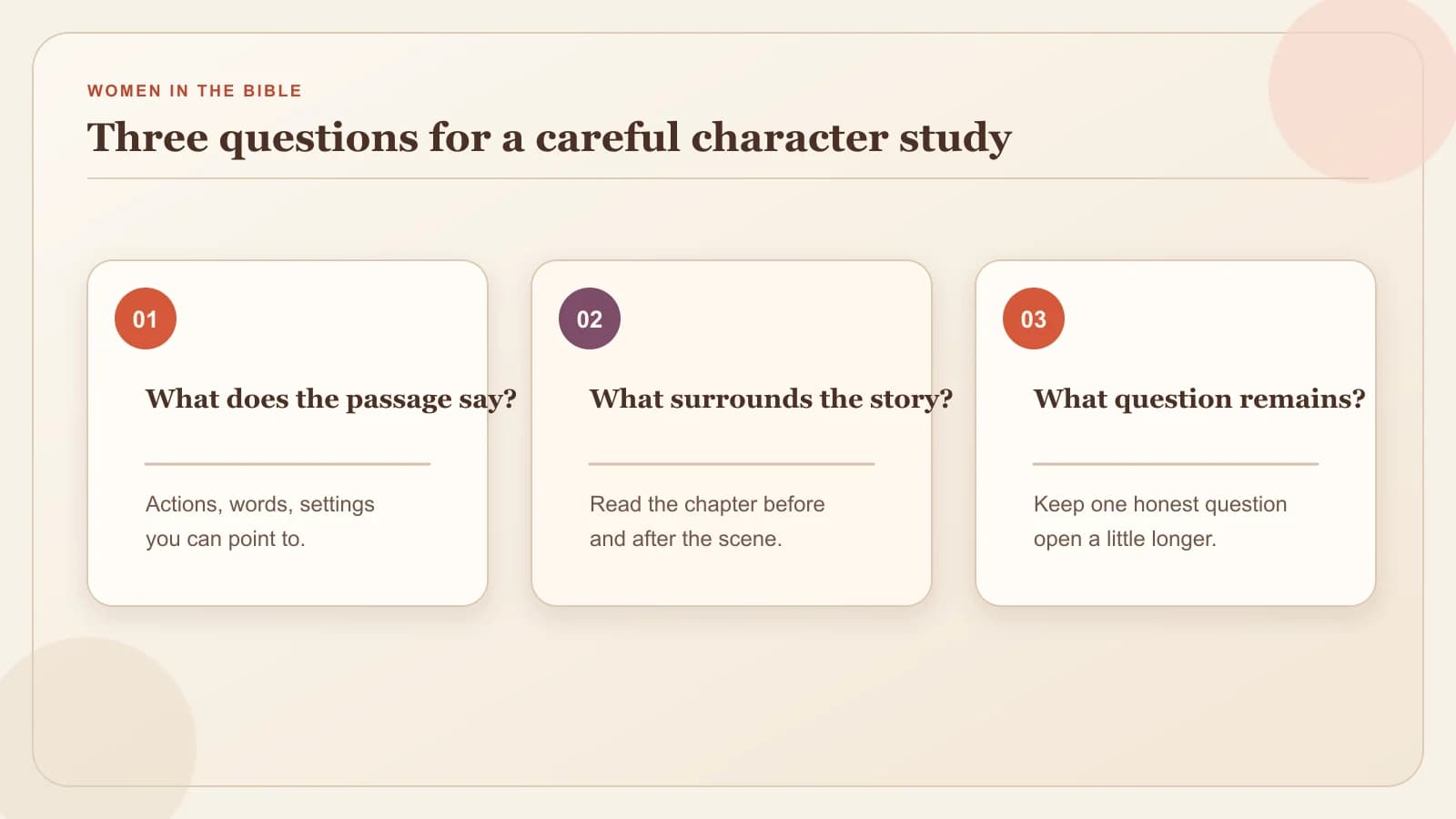
A one-line moral flattens a person into a lesson, and a flat lesson is easy to misapply. Three questions keep the passage larger than the summary:
What does the passage actually say? Note actions, words, and settings you can point to directly, before deciding what any of it means.
What surrounds the story? Read the chapter before and after the scene, and ask what the larger book is doing at this point.
What honest question remains? Let the account leave you with one question you cannot yet answer, and keep it visible instead of resolving it too quickly.
For a fuller walkthrough of contextual reading, the guide on how to read the Bible in context lays out the discipline step by step.
Choose a small reading path
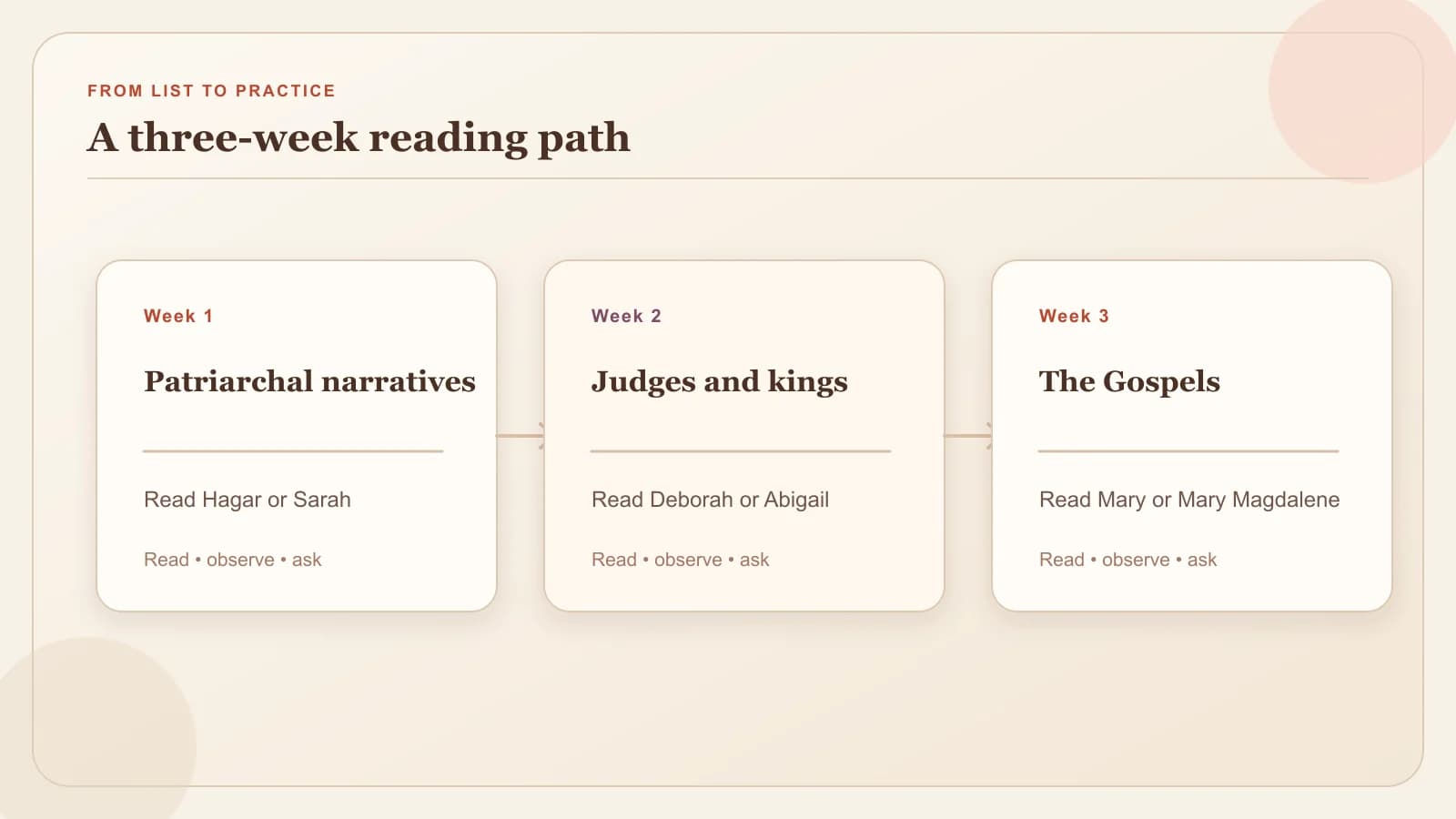
Twelve stories can feel like a course. A smaller rhythm turns the list into a practice you can finish. Choose three women from different parts of Scripture — one from the patriarchal narratives, one from the era of the judges or kings, one from the Gospels — and give one week to each.
For each woman, read the full passage range in one sitting, write a page of observations, and end with one question and one possible response. If you read with others, these small-group Bible study questions can keep the discussion rooted in the passage.
Use Bible Note for your questions about a passage
A careful reading produces questions, and questions need a place to live. Bible Note Bible Study Chat fits that task directly: it can start from the passage you have open or from a sermon note, so a question can be asked the same evening it surfaces.
Answers show cited references with translation labels and distinguish Scripture, interpretation, and AI inference, so you can see which kind of statement you are reading. When an answer proves useful, you can save it to a Note beside your own observations and return to it later.
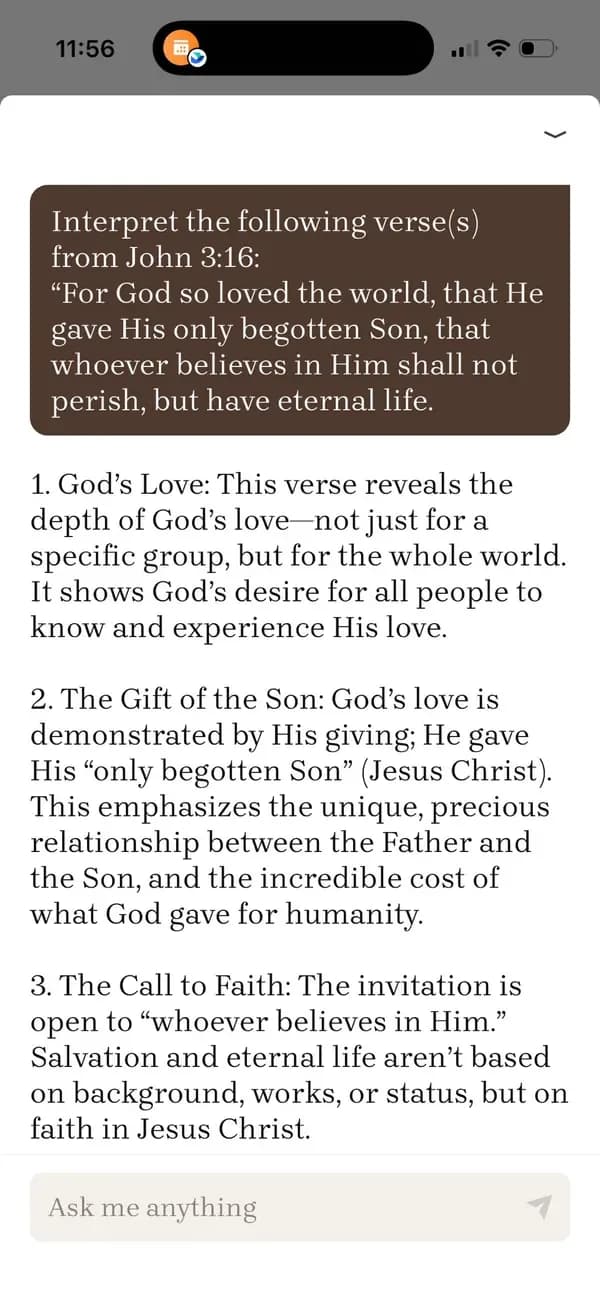
Bible Note is a study companion, and its AI can be wrong. Read the cited passages in your own Bible, let the text have the final word, and bring weighty questions to trusted believers or a pastor.
Frequently asked questions
Is this a complete list of women in the Bible?
No. Scripture names many more women than twelve — judges, queens, prophets, mothers, and disciples who do not appear here. This list is a bounded starting path chosen to span both Testaments and several kinds of story.
Where should I begin?
Begin with a story short enough to read in one sitting. Ruth runs four chapters, and Esther reads as one continuous narrative, which makes both natural first steps. If you prefer the Gospels, start with Luke 1–2 and Luke 8, then read John 20 for Mary Magdalene's resurrection account.
How do I study a person in the Bible responsibly?
Read the passage itself before any summary, including this one. Notice what the text says, check what surrounds the scene, and write down the questions the account leaves open. Keep observation, interpretation, and personal response distinct, and resist turning a narrative into a one-line moral or a universal rule.
Why do some passages include difficult details?
Biblical narratives describe people in their own settings, including settings marked by conflict, loss, and injustice. The text often reports events without commenting on them. Reading the full context, and bringing hard questions to trusted believers or a pastor, keeps your reading honest.
Sources
Editorial status
Written and edited by Hans Keller for Bible Note. Sources, Scripture context, dates, and practical limitations are checked before publication.

About the author
Hans Keller
Editorial & Content Lead
Bible Study & Sermon Learning Content Editor
Hans helps Christians turn sermons and Scripture study into clear notes, thoughtful questions, and faithful next steps.
His work helps listeners and group leaders carry a sermon or study beyond the meeting: back to the passage, into clearer questions, and toward one practical response for the week.
Read with Scripture open
Use this guide alongside the full biblical passage and the practices of your local church. Interpretive details can differ across Christian traditions.
See more Bible Note on Google
Add Bible Note as a preferred source to help find our Bible study guides more easily in Google Search.