
Read the story
Context
Jesus was under a sentence of crucifixion. This Roman form of execution exposed the condemned to public shame as well as death, which helps explain the mockery surrounding him. The day was also moving toward the Sabbath, the weekly day of rest commanded in God’s law. That timing would matter when Jesus was buried.
The question of kingship runs through this scene. A sign names Jesus as King of the Jews, while mockers challenge him to prove his identity by escaping. Yet Jesus’ words and actions reveal a very different kind of authority.
Story
As Jesus was led away, a man named Simon of Cyrene was coming in from the countryside. He was seized, and the cross was placed on him so that he carried it behind Jesus.
A large crowd followed, including women who mourned and wept for Jesus. He turned and addressed them as daughters of Jerusalem. He told them not to weep for him, but for themselves and their children. Days of terrible suffering were coming, when people would call the childless blessed and beg the mountains and hills to hide them. Jesus ended with a solemn image: if such things happened when the wood was green, what would happen when it was dry?
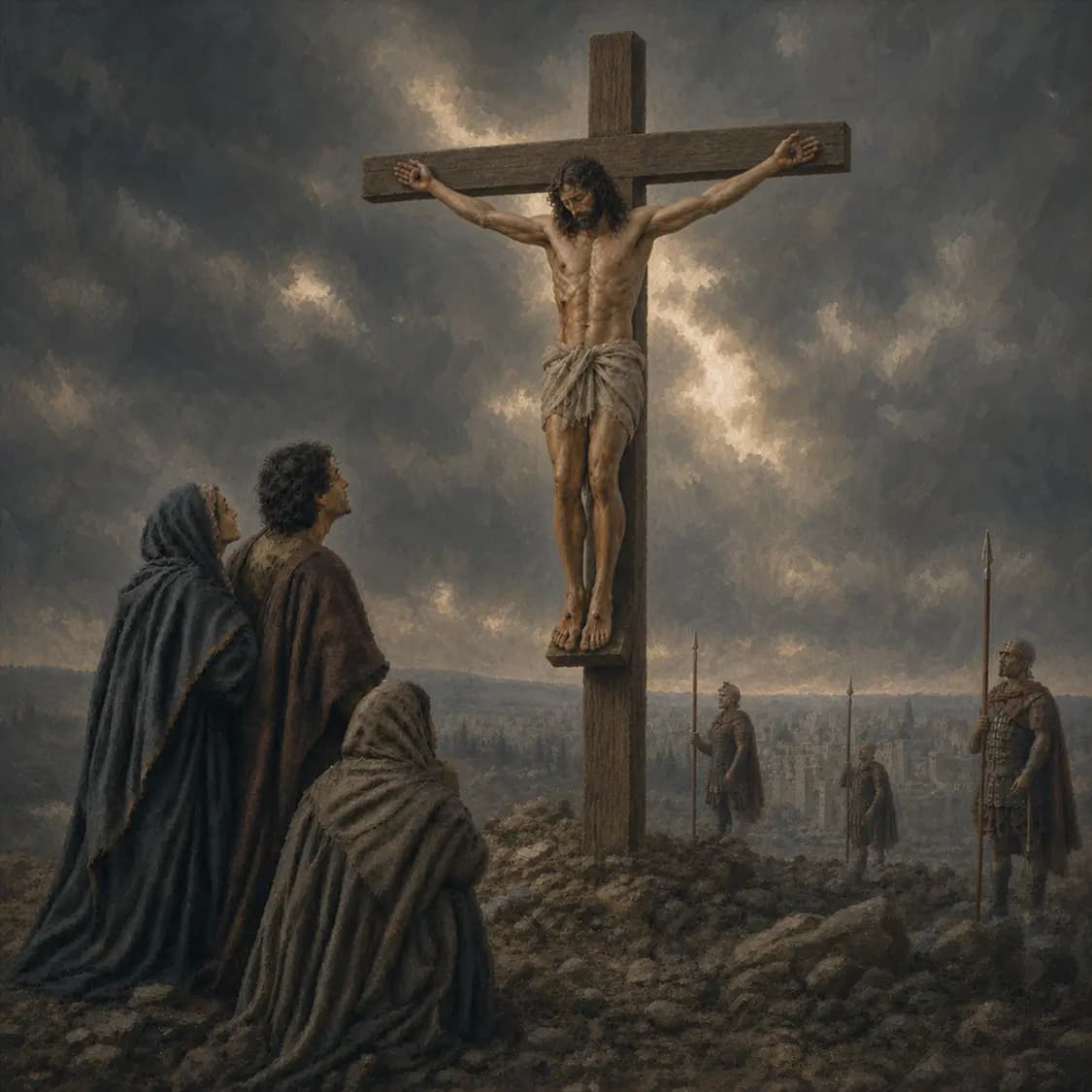
Two criminals were also led away to be executed. When they reached the place called the Skull, Jesus was crucified there, with one criminal on his right and the other on his left.
Jesus prayed for those around him.
“Father, forgive them, for they do not know what they are doing.”
His clothes were divided by casting lots, and the people stood watching. Some leaders mocked him. Jesus had saved others, they said, so if he truly was God’s Messiah, his Chosen One, he should save himself. Soldiers also ridiculed him, offering him sour wine and challenging the King of the Jews to escape. Above him was a sign that read, “This is the King of the Jews.”
One of the criminals joined in the abuse and demanded that Jesus save himself and them if he truly was the Messiah. But the other criminal rebuked him. He acknowledged that they were receiving the sentence their deeds deserved, while Jesus had done nothing wrong.
Then he asked Jesus to remember him when he came into his kingdom. Jesus answered with a promise: that very day, the man would be with him in paradise.
At about noon, darkness came over the land and remained until about three in the afternoon. The sun’s light failed, and the curtain of the temple was torn down the middle. Jesus called out loudly, “Father, into your hands I commit my spirit.” With those words, he died.
When the centurion saw what had happened, he praised God and declared that Jesus truly was righteous. The people who had gathered to watch beat their breasts and went away. Those who knew Jesus, including the women who had followed him from Galilee, stood at a distance and watched.
There was a man named Joseph from Arimathea. He was a good and upright member of the council, but he had not agreed with its decision and action against Jesus. Joseph was waiting for the kingdom of God.
He went to Pilate and asked for Jesus’ body. Then he took the body down, wrapped it in linen, and laid it in a tomb cut from rock where no one had ever been buried. It was Preparation Day, and the Sabbath was about to begin.
The women who had come from Galilee followed Joseph. They saw the tomb and observed how Jesus’ body was placed inside. Then they returned and prepared spices and perfumed ointments. On the Sabbath, they rested as the commandment required.
What We Learned
- Jesus meets cruelty with mercy. While others mock him, he asks the Father to forgive and finally entrusts his spirit to the Father.
- The criminal who admits his guilt can offer Jesus nothing but a request to be remembered, yet Jesus gives him the promise of paradise.
- The same death produces very different responses: some mock, the centurion praises God, the crowds leave in grief, and Jesus’ followers remain as witnesses.
- Faithfulness can take quiet, practical forms. Joseph provides a careful burial, while the women observe the tomb, prepare spices, and honor the Sabbath rest.
Story background
The Crucifixion and Burial of Jesus is read in Luke 23:26-56. As Jesus is led away, Simon of Cyrene is compelled to carry the cross behind him. The account also draws attention to mercy and innocence and suffering. Its named people, setting, and sequence matter, while details not stated in the passage should remain open rather than being supplied from later retellings. Read the scene in its surrounding movement: notice what prompts the action, how the central figures respond, and what the final words leave with the hearer. This background keeps the story close to its explicit claims while making room for careful reflection on mercy, innocence and suffering, and the other themes named here. The passage can be revisited slowly, with its questions and tensions intact.
People in the story
- Jesus — Is crucified, responds with mercy, promises paradise, and dies
- Simon of Cyrene — Is compelled to carry the cross behind Jesus
- Two criminals — Are crucified with Jesus; one mocks and the other asks to be remembered
- Centurion — Sees what happens and praises God, declaring Jesus righteous
- Joseph of Arimathea — Obtains Jesus’ body and provides his burial
- Women from Galilee — Witness the tomb and burial, prepare spices, and rest on the Sabbath
Themes to notice
Mercy
The passage brings mercy into focus through its named people, actions, and ending.
Innocence and suffering
The passage brings innocence and suffering into focus through its named people, actions, and ending.
Death
The passage brings death into focus through its named people, actions, and ending.
Hope
The passage brings hope into focus through its named people, actions, and ending.
Questions for reflection
- What stands out to you about mercy in this passage?
- How do the people in the story respond to innocence and suffering?
- Which detail would you want to read again in its wider context?
- What question does this account leave you carrying?
Related stories
Carry the story with you
Save your reflections on the crucifixion and burial of jesus and revisit them as you continue through Scripture.