
Read the story
Context
The Council gathered under the high priest included the chief priests, elders, and teachers of the law. Their hearing took place inside the high priest’s residence, while household attendants gathered in the courtyard below.
At the center of the hearing was the question of Jesus’s identity. “The Christ” means God’s promised Messiah, and “the Son of the Blessed One” reverently refers to the Son of God. In the courtyard, Peter would also be questioned about his identity as one of Jesus’s followers. Under the same roof, both Jesus and Peter would be pressed to speak.
Story
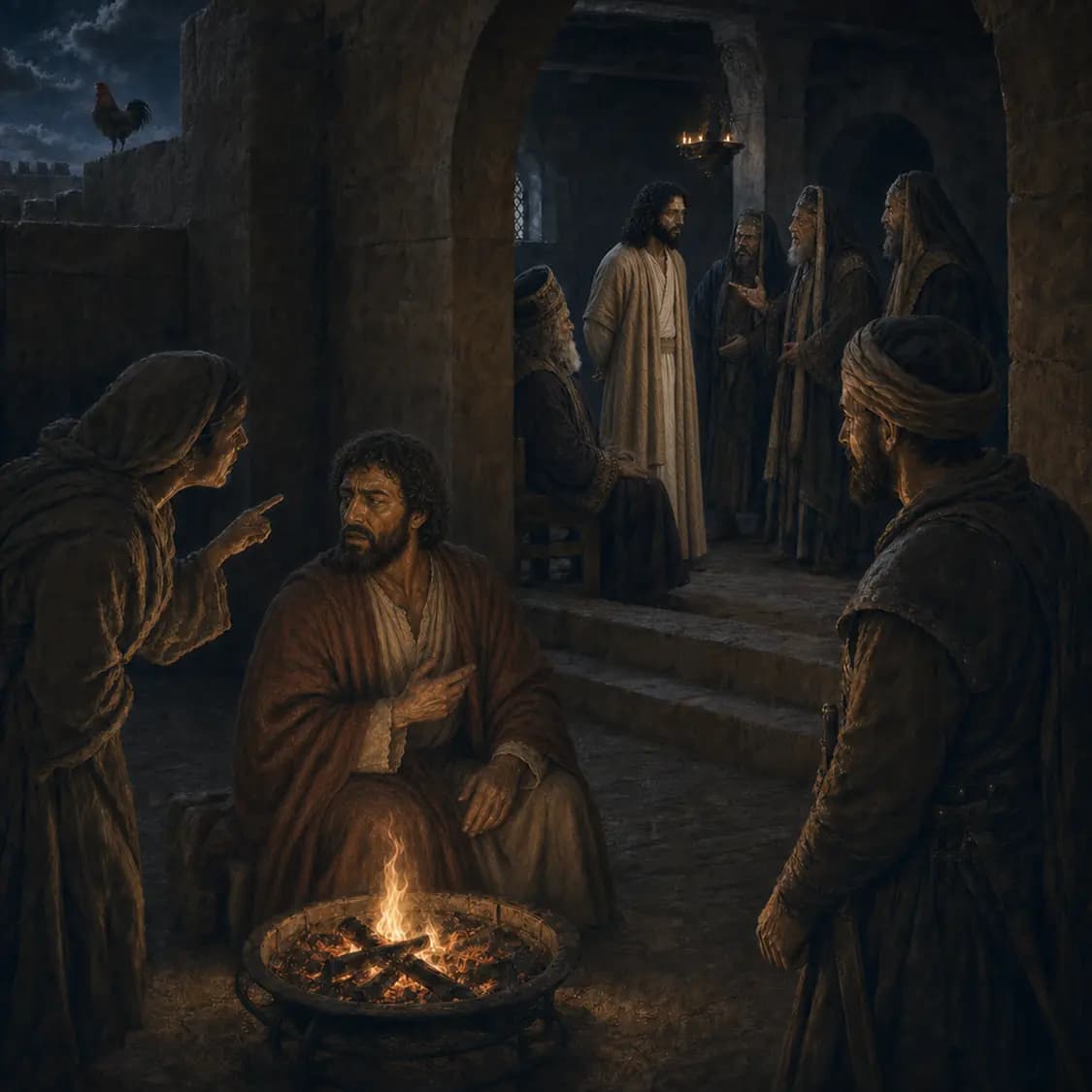
Jesus was led to the high priest, where the assembled leaders were waiting. Peter kept following, though at a distance. He entered the courtyard and sat with the attendants, warming himself by the fire.
Inside, the chief priests and the rest of the Council searched for testimony against Jesus that could support a death sentence. Many people gave false testimony, but their accounts did not agree.
Some claimed that they had heard Jesus say he would destroy the temple made by human hands and build another in three days that was not made by hands. Yet even these witnesses could not make their statements agree. No consistent case emerged from their accusations.
The high priest stood and demanded to know whether Jesus would answer the charges. Jesus remained silent.
Then the high priest asked him directly, “Are you the Christ, the Son of the Blessed One?”
Jesus answered, “I am.” He went on to say that they would see the Son of Man seated at the right hand of the Mighty One and coming with the clouds of heaven.
At this, the high priest tore his robes. He declared that no further witnesses were needed because they had heard what he considered blasphemy. The assembled Council condemned Jesus as deserving death.
Some began to spit on him. They covered his face, struck him, and mocked him by telling him to prophesy. The attendants also hit him.
Below in the courtyard, one of the high priest’s servant girls noticed Peter by the fire. She looked closely at him and said that he had also been with Jesus from Nazareth.
Peter denied it. He claimed that he did not know or understand what she was talking about. Then he moved toward the entrance, and a rooster crowed.
The servant girl saw him again and began telling the people nearby that Peter was one of Jesus’s followers. Peter denied it a second time.
A little later, the bystanders challenged him themselves. They were sure that he belonged with Jesus because he was a Galilean. This time Peter’s denial became even stronger. He called down curses and swore an oath, saying, “I don’t know this man you’re talking about.”
Immediately, the rooster crowed a second time. Peter remembered what Jesus had told him: before the rooster crowed twice, Peter would deny him three times. As the truth of those words came over him, Peter broke down and wept.
What We Learned
- The witnesses could not agree, yet the effort to secure a death sentence continued. When a verdict is chosen first, truth is easily pushed aside.
- Jesus remained silent before false accusations, but he answered plainly when asked about his identity. He did not hide the truth even when his confession brought condemnation.
- The two scenes contrast Jesus’s truthful confession with Peter’s repeated denial, showing Jesus’s steadiness beside the weakness of even a close follower.
- Peter’s denials became stronger with each challenge, showing how one act of unfaithfulness can lead to another.
- Remembering Jesus’s words brought Peter face to face with what he had done, and he wept. Truth can uncover the failure we have tried to deny.
Story background
Jesus Before the Council and Peter’s Denial is read in Mark 14:53-72. Jesus is taken to the high priest, where chief priests, elders, and teachers of the law seek testimony against him but cannot secure agreeing accounts. The account also draws attention to Jesus’ identity and faithfulness under accusation. Its named people, setting, and sequence matter, while details not stated in the passage should remain open rather than being supplied from later retellings. Read the scene in its surrounding movement: notice what prompts the action, how the central figures respond, and what the final words leave with the hearer. This background keeps the story close to its explicit claims while making room for careful reflection on Jesus’ identity, faithfulness under accusation, and the other themes named here. The passage can be revisited slowly, with its questions and tensions intact.
People in the story
- Jesus — Faces the Council’s questioning, affirms his identity, and is abused
- High priest and Council — Seek testimony, question Jesus, and condemn him
- Peter — Follows at a distance and denies knowing Jesus three times
- Servant girl and bystanders — Recognize or accuse Peter of association with Jesus
Themes to notice
Jesus’ identity
The passage brings Jesus’ identity into focus through its named people, actions, and ending.
Faithfulness under accusation
The passage brings faithfulness under accusation into focus through its named people, actions, and ending.
False testimony
The passage brings false testimony into focus through its named people, actions, and ending.
Denial
The passage brings denial into focus through its named people, actions, and ending.
Questions for reflection
- What stands out to you about Jesus’ identity in this passage?
- How do the people in the story respond to faithfulness under accusation?
- Which detail would you want to read again in its wider context?
- What question does this account leave you carrying?
Related stories



Carry the story with you
Save your reflections on jesus before the council and peter’s denial and revisit them as you continue through Scripture.