
Read the story
Context
Passover—the Jewish feast remembering God’s deliverance of Israel from Egypt—was approaching. Jesus’ disciples knew him as their Teacher and Lord, but they did not yet understand what lay ahead. Jesus knew that his time to leave this world and return to the Father had come. He also knew that betrayal was taking shape among those gathered with him.
Travel on dusty roads made foot washing a familiar need, yet it was a lowly form of service. That helps explain Peter’s shock when Jesus himself takes up the towel.
Story
Jesus loved those who belonged to him, and he loved them to the end. At the same table, however, betrayal had already entered the scene. The devil had prompted Judas Iscariot, the son of Simon, to betray Jesus.
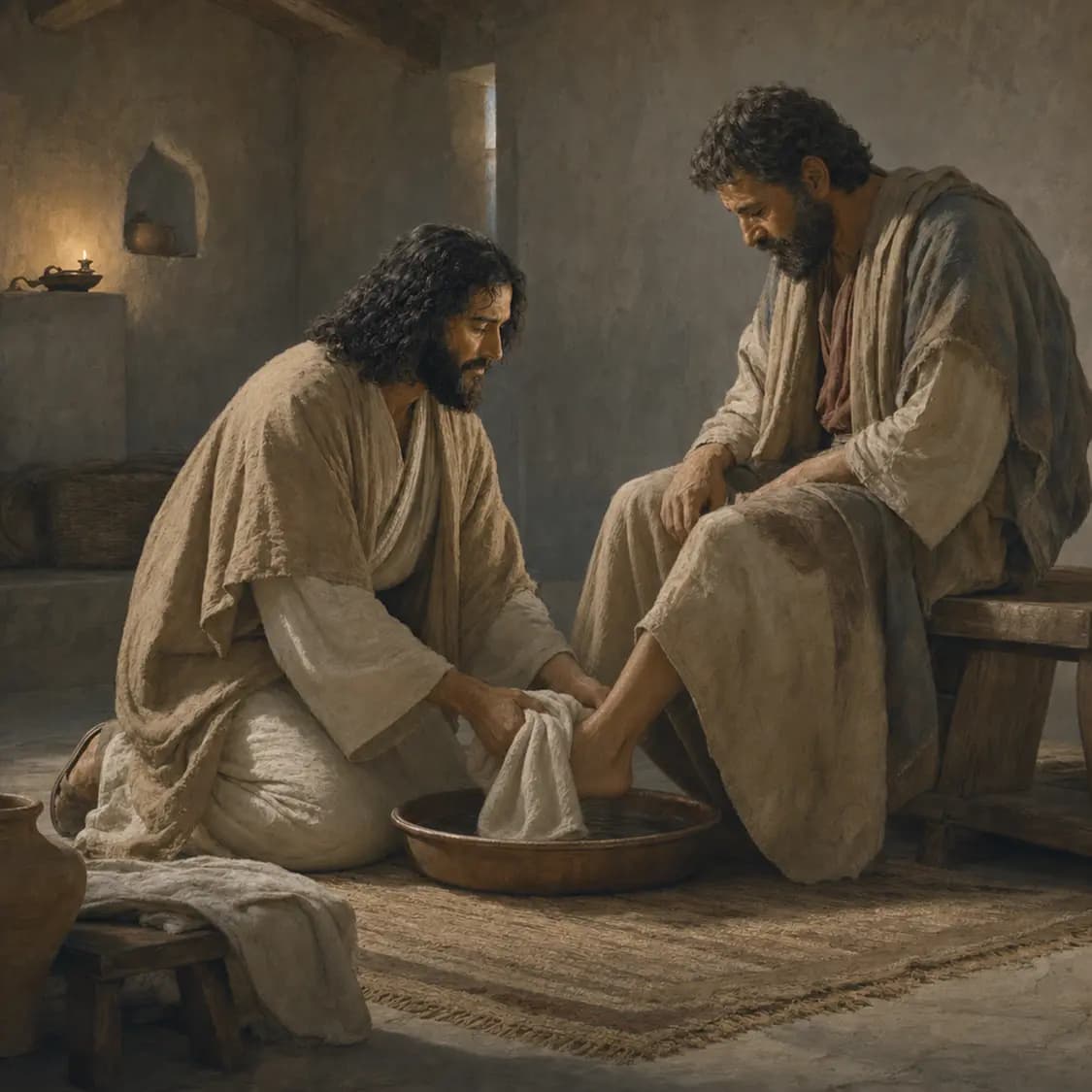
Jesus knew that the Father had placed everything in his hands. He knew that he had come from God and was returning to God. With that settled knowledge, he got up from the table, laid aside his outer clothing, wrapped a towel around himself, and poured water into a basin.
Then Jesus began washing his disciples’ feet and drying them with the towel.
When he came to Simon Peter, Peter asked in disbelief, “Lord, are you going to wash my feet?”
Jesus told him that he did not understand what was happening now, but that he would understand afterward. Peter resisted even more strongly: “You will never wash my feet.”
Jesus answered, “Unless I wash you, you have no part with me.”
Peter’s response changed at once. If that was so, he wanted Jesus to wash not only his feet but also his hands and head.
Jesus explained that someone who had bathed needed only to have his feet washed and was otherwise clean. Then he added that the disciples were clean—but not all of them. Jesus said this because he already knew who would betray him.
After washing their feet, Jesus put his outer clothing back on and returned to his place. He asked whether they understood what he had done.
They called him Teacher and Lord, and Jesus said they were right to do so. His humble service had not changed who he was. Since their Lord and Teacher had washed their feet, they should also wash one another’s feet. He had given them an example to follow.
A servant is not greater than his master, Jesus reminded them, and a messenger is not greater than the one who sent him. Knowing what humble service looks like would not be enough.
“If you know these things, you are blessed if you do them.”
What We Learned
- Jesus’ humility came from a secure knowledge of who he was, where he had come from, and where he was going.
- Peter’s protest shows that humility includes receiving what Jesus gives, not merely trying to prove our devotion.
- Jesus acted in love while fully aware that betrayal was present; his service was neither naive nor accidental.
- Calling Jesus Teacher and Lord should shape how his followers treat one another. His example is meant to be practiced, not merely admired.
Story background
Jesus Washes His Disciples’ Feet is read in John 13:1-17. Before the Passover Festival, Jesus knows that his hour has come and washes his disciples’ feet during supper, despite knowing that Judas will betray him. The account also draws attention to humble service and love to the end. Its named people, setting, and sequence matter, while details not stated in the passage should remain open rather than being supplied from later retellings. Read the scene in its surrounding movement: notice what prompts the action, how the central figures respond, and what the final words leave with the hearer. This background keeps the story close to its explicit claims while making room for careful reflection on humble service, love to the end, and the other themes named here. The passage can be revisited slowly, with its questions and tensions intact.
People in the story
- Jesus — Washes the disciples’ feet and interprets the action as an example of humble service
- Simon Peter — Questions and initially resists the washing, then responds eagerly
- Disciples — Receive Jesus’ service and are called to serve one another
- Judas Iscariot — Disciple whose coming betrayal Jesus knows
Themes to notice
Humble service
The passage brings humble service into focus through its named people, actions, and ending.
Love to the end
The passage brings love to the end into focus through its named people, actions, and ending.
Jesus’ lordship
The passage brings Jesus’ lordship into focus through its named people, actions, and ending.
Cleansing
The passage brings cleansing into focus through its named people, actions, and ending.
Questions for reflection
- What stands out to you about humble service in this passage?
- How do the people in the story respond to love to the end?
- Which detail would you want to read again in its wider context?
- What question does this account leave you carrying?
Related stories


Carry the story with you
Save your reflections on jesus washes his disciples’ feet and revisit them as you continue through Scripture.