
Read the story
Context
Jerusalem was also called Zion, and it was closely associated with King David and the royal line that followed him. When people spoke of a “Son of David,” they were expressing royal hope. When they cried “Hosanna,” they were asking for salvation while also offering praise.
Those words help us hear more than celebration in the crowd’s welcome. As Jesus approached Jerusalem, his manner of entering would reveal what kind of king he was.
Story
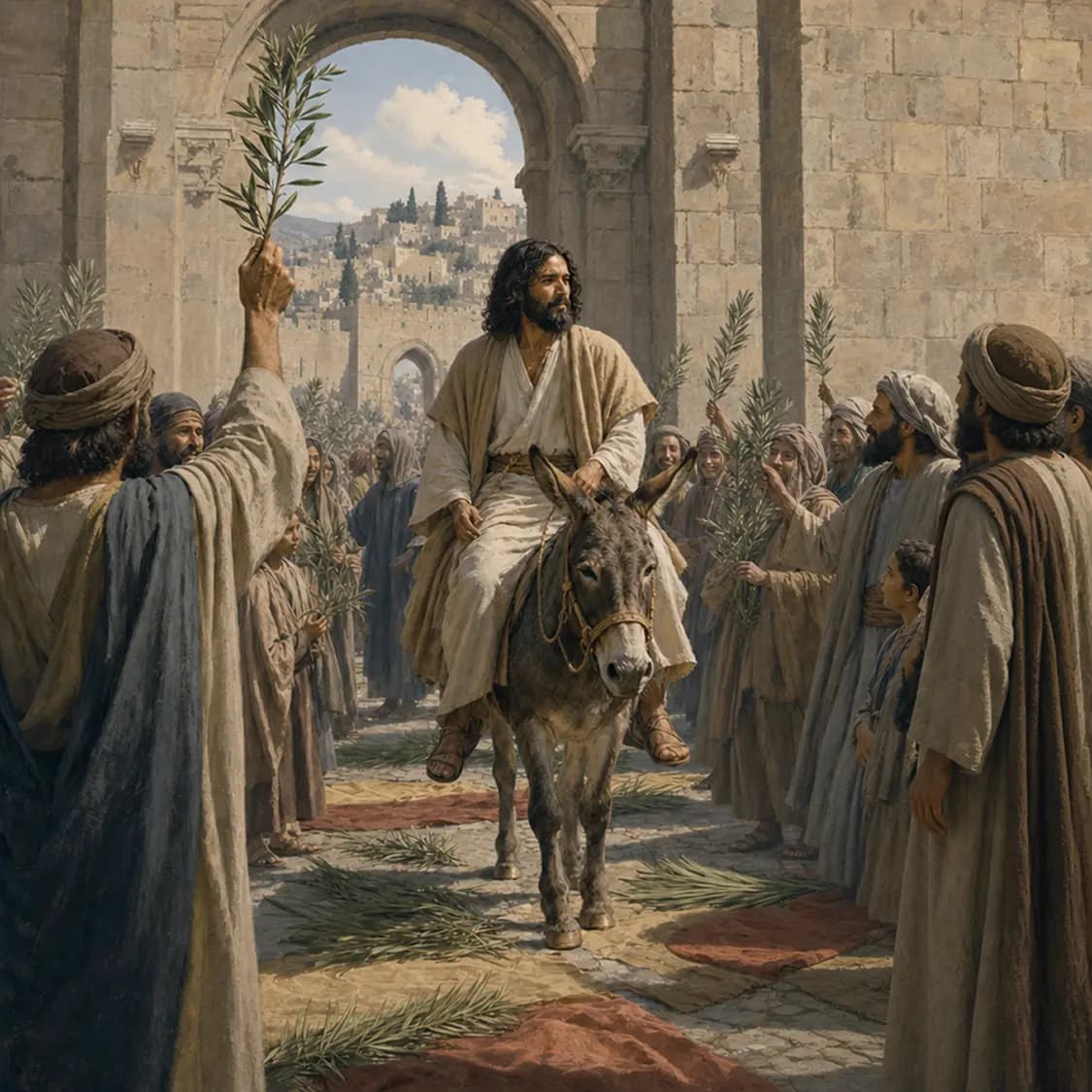
Jesus and his disciples drew near to Jerusalem. When they reached Bethphage, beside the Mount of Olives, Jesus sent two disciples into the village ahead of them.
He gave them precise instructions. They would immediately find a donkey tied there with her colt. They were to untie both animals and bring them to him. If anyone questioned them, they were simply to explain that the Lord needed them, and the animals would be sent at once.
The disciples went and did what Jesus had commanded. They brought the donkey and her colt, draped their cloaks over the animals, and seated Jesus.
The choice of a donkey fulfilled the prophet’s message to Zion: her king would come to her gently, riding on a donkey, on a colt. Jesus’ entrance carried a royal claim, but his manner matched the prophecy. He came as Zion’s king, and he came with gentleness.
As he traveled toward Jerusalem, a very large crowd filled the road. Some people spread their garments before him. Others cut branches from the trees and laid them in his path. People walked ahead of Jesus and followed behind him, surrounding him with praise.
“Hosanna to the Son of David! Blessed is he who comes in the name of the Lord! Hosanna in the highest!”
The road was alive with raised voices, garments laid down, and freshly cut branches. At the center of all that public excitement, Jesus continued toward Jerusalem on the humble animal he had chosen.
When he entered the city, all Jerusalem was stirred. People began asking, “Who is this?”
The crowds answered that this was Jesus, the prophet from Nazareth in Galilee.
What We Learned
- Jesus entered Jerusalem deliberately. His instructions and his chosen ride fulfilled the prophet’s picture of Zion’s king.
- Jesus’ kingship is marked by gentleness, even when he is surrounded by loud public praise and royal expectations.
- The disciples’ straightforward obedience helped carry forward what God had promised through the prophet.
- Jerusalem’s question—“Who is this?”—remains central. Public excitement about Jesus is not a substitute for understanding his identity.
Story background
Jesus Enters Jerusalem is read in Matthew 21:1-11. Near Jerusalem at Bethphage by the Mount of Olives, Jesus sends two disciples to bring a donkey and her colt. The account also draws attention to Jesus’ kingship and fulfillment. Its named people, setting, and sequence matter, while details not stated in the passage should remain open rather than being supplied from later retellings. Read the scene in its surrounding movement: notice what prompts the action, how the central figures respond, and what the final words leave with the hearer. This background keeps the story close to its explicit claims while making room for careful reflection on Jesus’ kingship, fulfillment, and the other themes named here. The passage can be revisited slowly, with its questions and tensions intact.
People in the story
- Jesus — Directs the preparations and enters Jerusalem as the crowd praises him
- Two disciples — Retrieve the donkey and colt as Jesus commands
- Crowd — Spreads cloaks and branches, praises Jesus, and identifies him to the city
- People of Jerusalem — Are stirred and ask who Jesus is
Themes to notice
Jesus’ kingship
The passage brings Jesus’ kingship into focus through its named people, actions, and ending.
Fulfillment
The passage brings fulfillment into focus through its named people, actions, and ending.
Humility
The passage brings humility into focus through its named people, actions, and ending.
Public response
The passage brings public response into focus through its named people, actions, and ending.
Questions for reflection
- What stands out to you about Jesus’ kingship in this passage?
- How do the people in the story respond to fulfillment?
- Which detail would you want to read again in its wider context?
- What question does this account leave you carrying?
Related stories
Carry the story with you
Save your reflections on jesus enters jerusalem and revisit them as you continue through Scripture.