
Read the story
Context
Bethany was where Lazarus lived, the man Jesus had raised from the dead. Jesus returned there six days before Passover. The timing places a quiet supper in the shadow of what was approaching, while Lazarus’s place at the table bears witness to Jesus’s power over death. In that setting, a costly act of honor would be judged in two very different ways.
Story
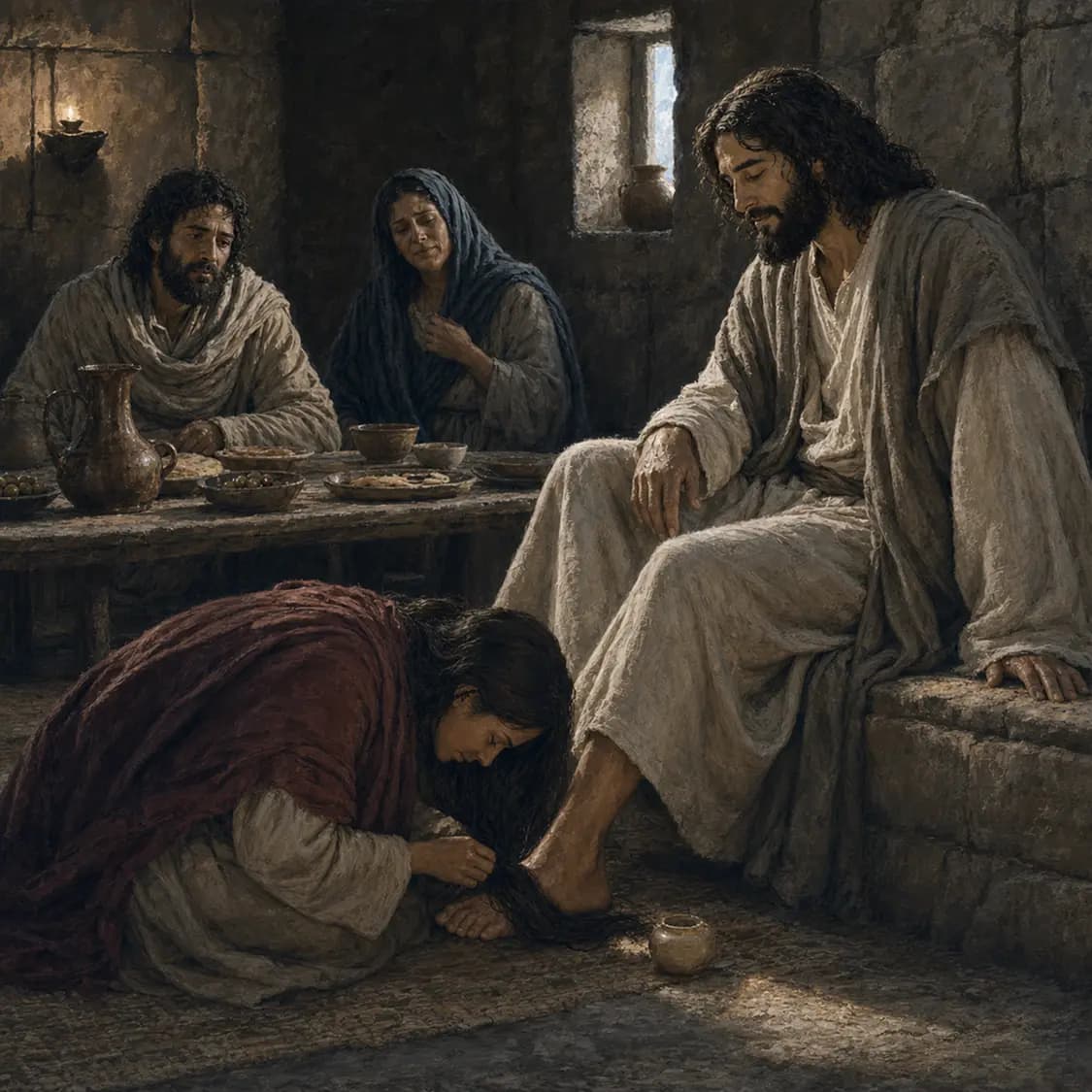
A supper was prepared for Jesus. Martha served the meal, and Lazarus sat at the table with him. The man who had been dead was now sharing a meal with the one who had raised him.
During the supper, Mary brought a large quantity of very costly perfume made from nard. She poured it onto Jesus’s feet, anointing them, and then wiped his feet with her hair. The fragrance spread until it filled the entire house. Her gift was unmistakably precious, and she had poured it out on Jesus.
Judas Iscariot, one of Jesus’s disciples and the man who would later betray him, objected. He asked why the perfume had not been sold for three hundred denarii—close to a year’s wages—and the money given to the poor.
His question sounded compassionate, but Judas did not truly care about the poor. He kept the group’s money bag and was a thief, taking for himself from what had been placed in it. His respectable words concealed his greed.
Jesus did not allow Judas to condemn Mary.
“Leave her alone.”
He connected what Mary had done with the day of his burial. Judas had focused on the perfume’s price, but Jesus showed that her action belonged to a unique and solemn moment. In a house filled with the fragrance of her gift, and with Lazarus alive at the table, Jesus spoke of his own burial.
The poor would always be with them, Jesus said, but they would not always have him with them.
What We Learned
- Mary treated Jesus as worthy of something precious, and Jesus received her costly act as fitting for that moment.
- Judas’s words sounded generous, but his conduct exposed his greed. Right-sounding words do not always reveal a right motive.
- Jesus connected Mary’s anointing with his burial, pointing toward his approaching death.
- The continuing presence of the poor did not make Mary’s unique act wasteful; Jesus refused to let Judas use them as a false reason to condemn her.
Story background
Mary Anoints Jesus at Bethany is read in John 12:1-8. Six days before Passover, Jesus comes to Bethany, where a dinner is given in his honor. The account also draws attention to devotion and Jesus’ coming death. Its named people, setting, and sequence matter, while details not stated in the passage should remain open rather than being supplied from later retellings. Read the scene in its surrounding movement: notice what prompts the action, how the central figures respond, and what the final words leave with the hearer. This background keeps the story close to its explicit claims while making room for careful reflection on devotion, Jesus’ coming death, and the other themes named here. The passage can be revisited slowly, with its questions and tensions intact.
People in the story
- Jesus — Receives Mary’s anointing, interprets it in relation to his burial, and answers Judas
- Mary — Anoints Jesus’ feet with costly nard and wipes them with her hair
- Martha — Serves the dinner
- Lazarus — Reclines at the table with Jesus
- Judas Iscariot — Objects to the perfume’s use and is identified by John as the disciple who would betray Jesus
Themes to notice
Devotion
The passage brings devotion into focus through its named people, actions, and ending.
Jesus’ coming death
The passage brings Jesus’ coming death into focus through its named people, actions, and ending.
Worship and value
The passage brings worship and value into focus through its named people, actions, and ending.
Care for the poor
The passage brings care for the poor into focus through its named people, actions, and ending.
Questions for reflection
- What stands out to you about devotion in this passage?
- How do the people in the story respond to Jesus’ coming death?
- Which detail would you want to read again in its wider context?
- What question does this account leave you carrying?
Related stories


Carry the story with you
Save your reflections on mary anoints jesus at bethany and revisit them as you continue through Scripture.