
Read the story
Context
Passover was one of Israel’s defining celebrations. Each year, God’s people remembered how he had rescued their ancestors from slavery in Egypt. The meal carried the memory of deliverance and the hope that God would remain faithful to his promises.
Among Jesus’ followers, twelve had a particular role as apostles. They had traveled with him and received his teaching. Now they would share Passover at a decisive turning point. Jesus knew that suffering lay directly ahead, and this would be his final meal with the Twelve before that suffering began.
Story
The day of Unleavened Bread arrived, when the Passover lamb was to be sacrificed. Jesus sent Peter and John to prepare the meal for them.
They asked where he wanted them to make the arrangements. Jesus gave them careful instructions. As they entered the city, they would meet a man carrying a jar of water. They were to follow him into the house he entered. Then they were to ask the owner to show them the guest room where their Teacher could eat the Passover with his disciples.
The owner would show them a large, furnished upstairs room. That was where they were to prepare everything.
Peter and John went, and each detail was just as Jesus had said. They made the room ready for the Passover meal.
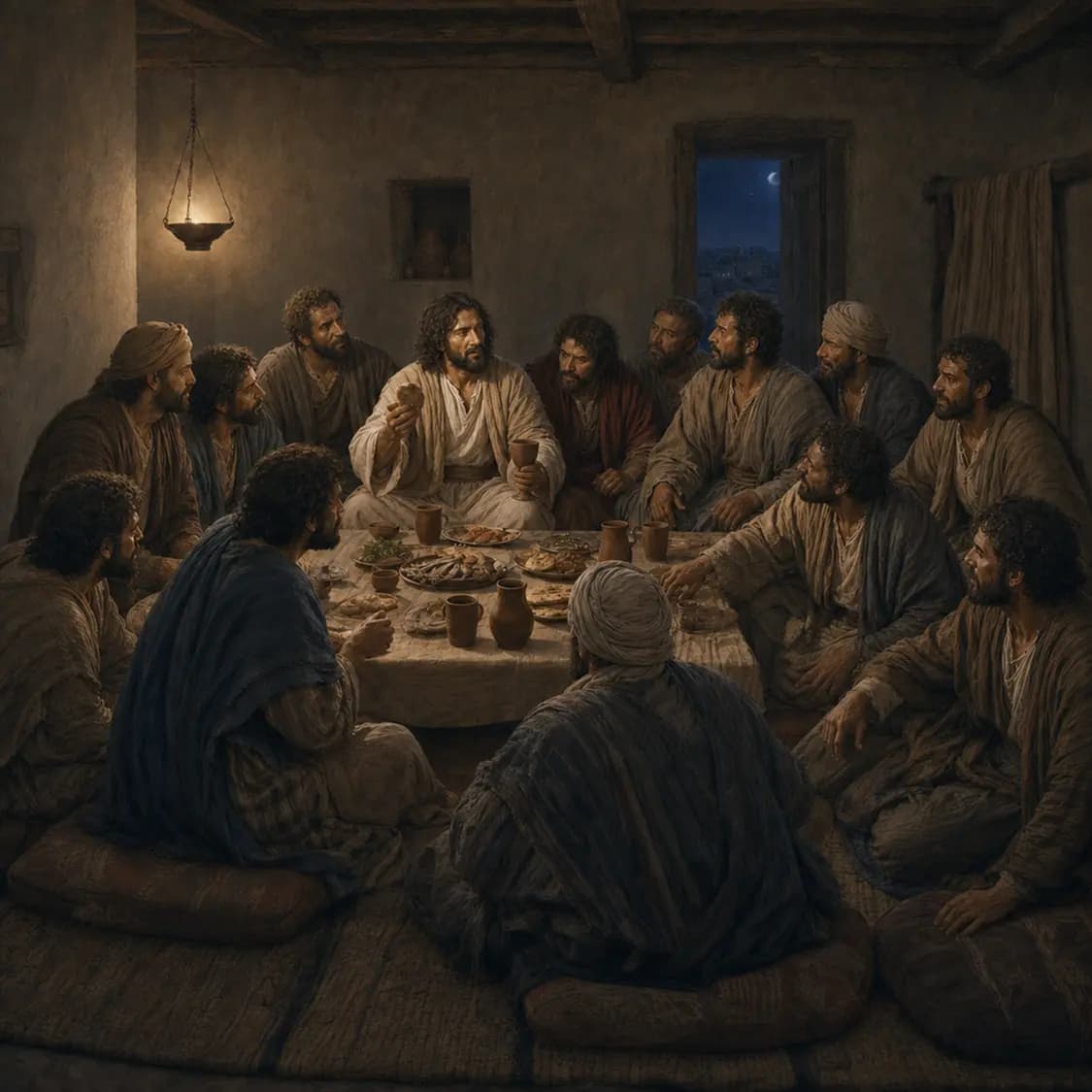
When the hour came, Jesus took his place at the table with the twelve apostles. He told them that he had deeply desired to eat this Passover with them before he suffered. He would not eat it again, he said, until it was fulfilled in the kingdom of God.
Jesus took a cup and gave thanks. He told the apostles to share it among themselves, adding that he would not drink from the fruit of the vine again until God’s kingdom came. Even as suffering drew near, Jesus spoke about the kingdom and the fulfillment still ahead.
Then he took bread. After giving thanks, he broke it and gave it to them.
“This is my body, given for you. Do this in remembrance of me.”
After supper, Jesus took the cup again. He said that this cup was the new covenant in his blood, poured out for them. The bread pointed to his body given for them, and the cup to his blood. The meal now carried Jesus’ own command: they were to remember him.
But at that same table, Jesus announced that the one who would betray him was present. The betrayer’s hand was there with his on the table.
Jesus said that the Son of Man would follow the course determined for him, but he pronounced woe upon the person who betrayed him. What lay ahead was not outside God’s purpose, yet the betrayer remained responsible for what he would do.
The apostles began asking one another which of them could be about to do such a thing.
What We Learned
- Jesus approached his suffering knowingly. He spoke of his body as given for his followers and his blood as poured out for them.
- The bread and cup direct attention to Jesus’ self-giving and his command to be remembered, without separating his death from God’s covenant faithfulness.
- Jesus’ words about the kingdom place the meal within a larger hope. Suffering was approaching, but fulfillment in God’s kingdom still lay ahead.
- God’s determined purpose does not erase human responsibility. Jesus’ path was appointed, yet betrayal still brought guilt and woe.
- The warning concerned someone at the table, prompting the apostles to examine the possibility of betrayal within their own circle.
Story background
The Last Supper is read in Luke 22:7-23. On the day of Unleavened Bread when the Passover lamb was to be sacrificed, Jesus sends Peter and John to prepare the Passover. The account also draws attention to remembrance and new covenant. Its named people, setting, and sequence matter, while details not stated in the passage should remain open rather than being supplied from later retellings. Read the scene in its surrounding movement: notice what prompts the action, how the central figures respond, and what the final words leave with the hearer. This background keeps the story close to its explicit claims while making room for careful reflection on remembrance, new covenant, and the other themes named here. The passage can be revisited slowly, with its questions and tensions intact.
People in the story
- Jesus — Directs the preparation, interprets the bread and cup, and announces coming betrayal
- Peter and John — Prepare the Passover as Jesus directs
- Twelve apostles — Eat with Jesus, receive the bread and cup, and question who will betray him
- Man carrying a jar and house owner — Unidentified figures through whom the prepared room is found
Themes to notice
Remembrance
The passage brings remembrance into focus through its named people, actions, and ending.
New covenant
The passage brings new covenant into focus through its named people, actions, and ending.
Jesus’ suffering
The passage brings Jesus’ suffering into focus through its named people, actions, and ending.
God’s kingdom
The passage brings God’s kingdom into focus through its named people, actions, and ending.
Questions for reflection
- What stands out to you about remembrance in this passage?
- How do the people in the story respond to new covenant?
- Which detail would you want to read again in its wider context?
- What question does this account leave you carrying?
Related stories
Carry the story with you
Save your reflections on the last supper and revisit them as you continue through Scripture.