
Read the story
Context
God’s law called Israel to love God wholeheartedly and to love one’s neighbor as oneself. Experts in that law studied how such commands should be understood and lived. A question about the word neighbor could therefore become a question about boundaries: Who is included?
The people Jesus chose for this parable gave the question added force. Priests and Levites held honored responsibilities in Israel’s worship. Samaritans and Jews, however, lived with a longstanding religious and social divide. With those identities in view, Jesus responded to a man who questioned him about eternal life.
Story
An expert in the law stood up to test Jesus. “Teacher, what must I do to inherit eternal life?” Jesus directed him back to the law, asking what was written there and how the man understood it. The expert answered that a person must love the Lord with all their heart, soul, strength, and mind, and love their neighbor as themselves. Jesus told him that he had answered correctly and must live according to those words.
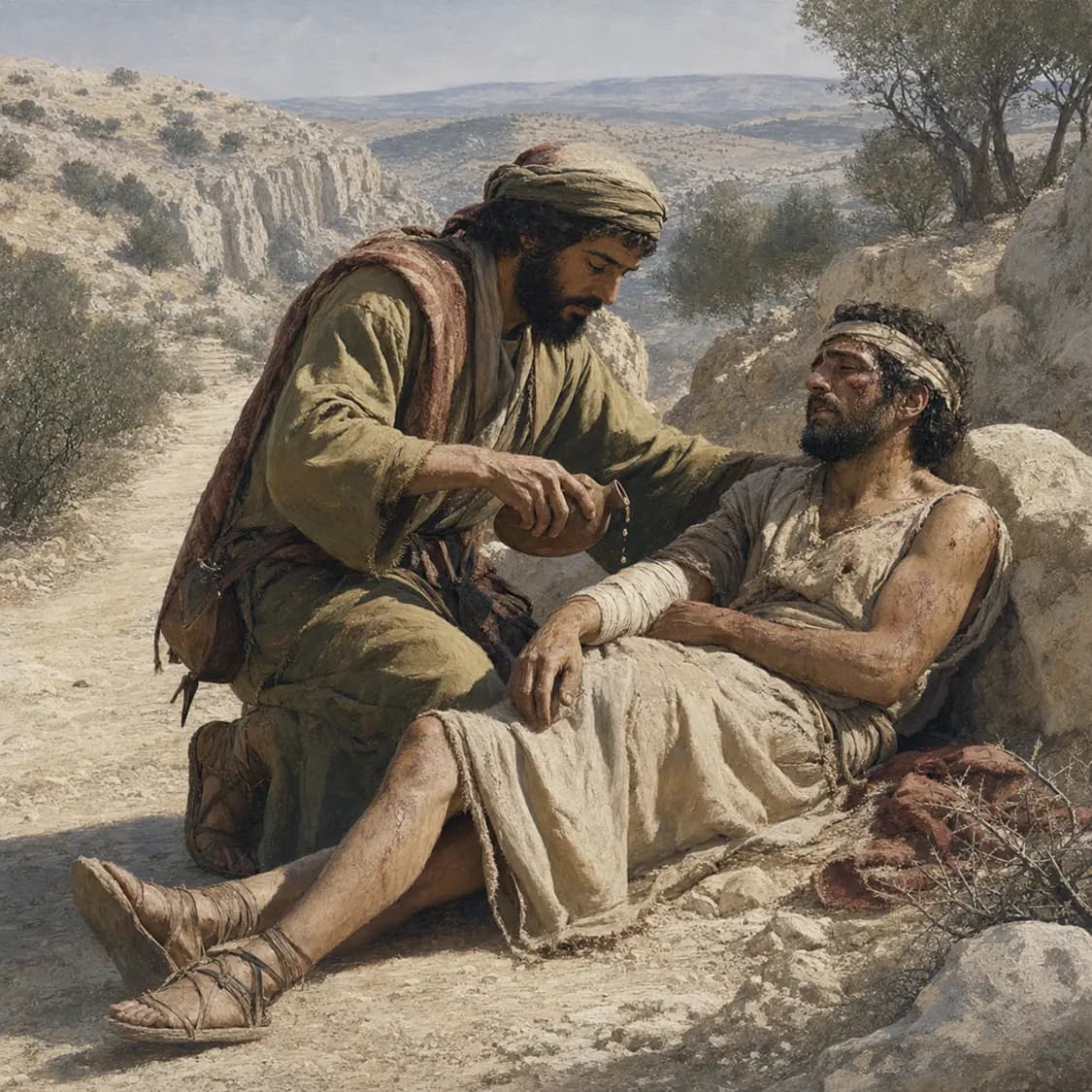
But the expert wanted to justify himself, so he pressed the question further: “Who is my neighbor?” In response, Jesus told him about a man traveling down from Jerusalem to Jericho. Robbers attacked the traveler, stripped him, beat him, and went away, leaving him half dead beside the road.
A priest came down the same road. He saw the wounded man, crossed to the other side, and continued on his way. A Levite also arrived at the place and looked at the man, but he too passed by on the other side.
A Samaritan traveler came to where the wounded man lay, and when he saw him, he was moved with compassion. He went to the man, poured oil and wine on his wounds, and bandaged them. Then he lifted the man onto his own animal, brought him to an inn, and cared for him there. The following day, he gave the innkeeper two denarii and asked him to continue caring for the injured man. If the cost went beyond that amount, the Samaritan promised to repay the difference when he returned.
Jesus turned the expert’s question in a new direction. Which of the three, he asked, had been a neighbor to the man who fell among robbers? The expert answered, “The one who showed him mercy.” Jesus replied, “Go and do likewise.”
What We Learned
- Jesus connects the question of eternal life with wholehearted love for God and one’s neighbor. Knowing the right words must lead to lived obedience.
- The expert asks whom he must count as a neighbor. Jesus redirects him toward becoming a neighbor by showing mercy.
- The contrast among the priest, the Levite, and the Samaritan shows that respected religious standing is no substitute for compassion.
- By making the Samaritan the merciful one, Jesus shows that neighbor-love crosses deep social and religious divisions.
- Compassion takes concrete responsibility. The Samaritan gives his time, supplies, transportation, care, money, and a promise to return.
Story background
The Good Samaritan is read in Luke 10:25-37. An expert in the law asks Jesus what he must do to inherit eternal life and, seeking to justify himself, asks who his neighbor is. The account also draws attention to mercy and love of neighbor. Its named people, setting, and sequence matter, while details not stated in the passage should remain open rather than being supplied from later retellings. Read the scene in its surrounding movement: notice what prompts the action, how the central figures respond, and what the final words leave with the hearer. This background keeps the story close to its explicit claims while making room for careful reflection on mercy, love of neighbor, and the other themes named here. The passage can be revisited slowly, with its questions and tensions intact.
People in the story
- Jesus — Answers the expert’s question with a parable and reframes neighborliness as mercy shown
- Expert in the law — Questions Jesus about eternal life and who counts as a neighbor
- Wounded traveler — Victim of robbers who receives care
- Priest and Levite — Travelers who see the injured man but pass by
- Samaritan — Traveler who provides costly, practical care and becomes the model neighbor
Themes to notice
Mercy
The passage brings mercy into focus through its named people, actions, and ending.
Love of neighbor
The passage brings love of neighbor into focus through its named people, actions, and ending.
Practical care
The passage brings practical care into focus through its named people, actions, and ending.
Moral responsibility
The passage brings moral responsibility into focus through its named people, actions, and ending.
Questions for reflection
- What stands out to you about mercy in this passage?
- How do the people in the story respond to love of neighbor?
- Which detail would you want to read again in its wider context?
- What question does this account leave you carrying?
Related stories


Carry the story with you
Save your reflections on the good samaritan and revisit them as you continue through Scripture.