
Read the story
Context
Pentecost was a Jewish feast, and Jerusalem held devout Jews and converts from lands stretching across the Roman world and beyond. Many had been born far from Judea and spoke different native languages. Jesus’ apostles were also in the city, and they were known as Galileans. The contrast set the stage for a public question: What was God doing, and what did it reveal about Jesus?
Story
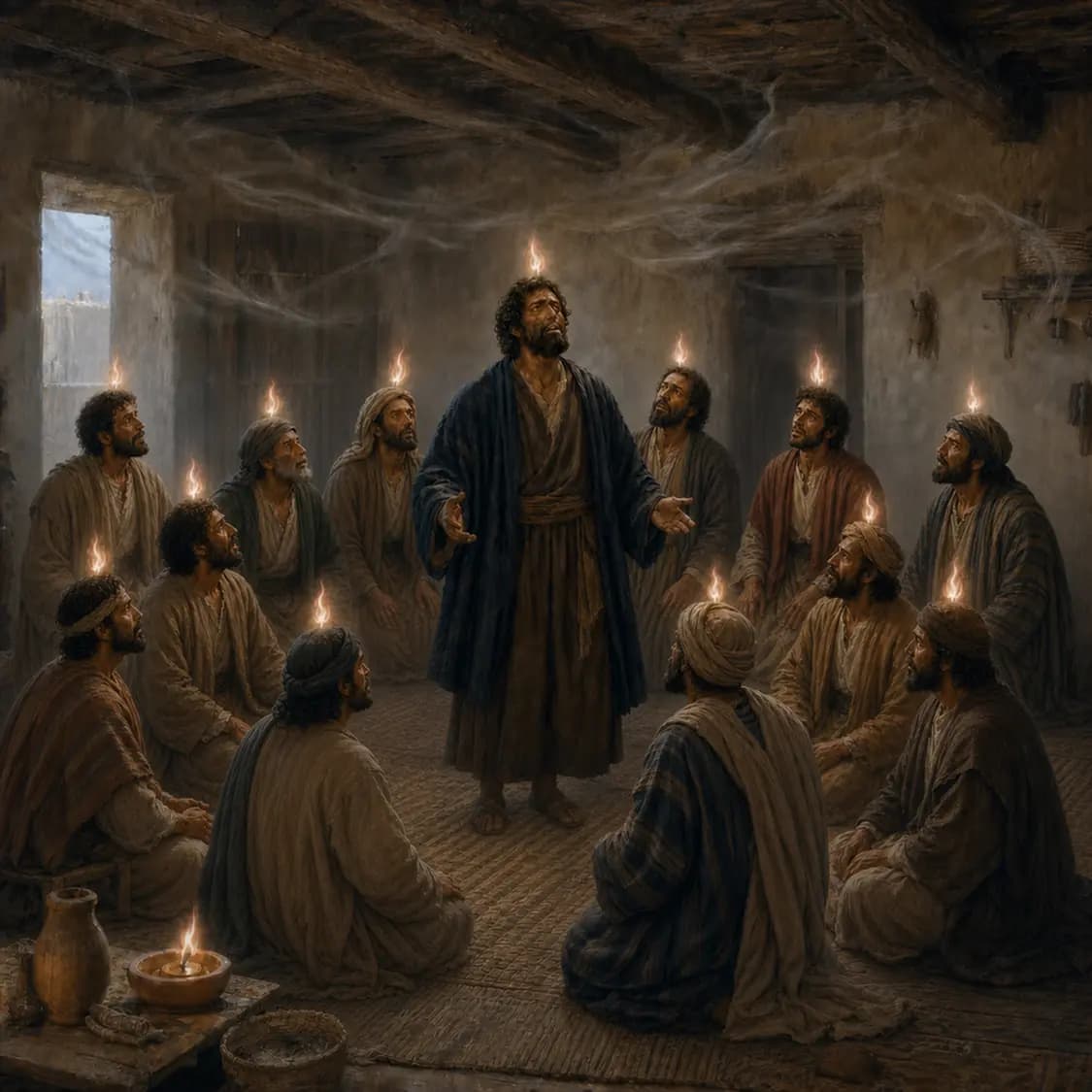
When Pentecost arrived, Jesus’ followers were all together in one place. Suddenly, a sound came from heaven like a powerful rushing wind, filling the house where they were sitting. Something like divided tongues of fire appeared and rested on each of them. They were all filled with the Holy Spirit and began speaking in other languages as the Spirit enabled them.
At the sound, a crowd gathered. Each person heard the believers speaking in the language of the listener’s birthplace. The crowd included people from Parthia, Media, Elam, and Mesopotamia in the east; Judea and regions across Asia Minor; Egypt and Libya; and Rome, Crete, and Arabia. Some were Jews by birth, while others had joined the Jewish faith. They could not understand how Galileans were speaking all these languages. In every language, the subject was the wonderful works of God.
Many were amazed and perplexed. They asked one another what this could mean. Others mocked the believers and accused them of being drunk.
Peter stood with the other eleven apostles and raised his voice. He told the crowd that the believers were not drunk; it was only about nine in the morning. What they were witnessing, he explained, fulfilled what God had spoken through the prophet Joel. In the last days, God would pour out his Spirit on all people. Sons and daughters would prophesy. Young men would see visions, and old men would dream dreams. Even male and female servants would receive the Spirit and prophesy. Before the great day of the Lord, there would be signs in heaven and on earth, and everyone who called on the Lord’s name would be saved.
From that prophecy, Peter turned the crowd’s attention to Jesus of Nazareth. God had shown who Jesus was through miracles, wonders, and signs performed among them. Jesus had been handed over according to God’s determined purpose and foreknowledge, and he had been put to death through lawless hands. But God raised him, freeing him from death because death could not hold him.
Peter explained how David’s words pointed beyond David himself. David had died and been buried, and his tomb remained. But David was also a prophet who knew that God had promised to place one of his descendants on the throne. He spoke ahead of the Messiah’s resurrection: God’s Holy One would not be abandoned to the realm of the dead, and his body would not decay.
God had raised this Jesus, Peter declared, and they were all witnesses. Exalted to God’s right hand, Jesus had received the promised Holy Spirit from the Father and poured out what the crowd could now see and hear. David’s words also pointed to the Lord seated at God’s right hand until his enemies were subdued. Peter pressed the truth home to his listeners: God had made the Jesus they had crucified both Lord and Messiah.
The words pierced their hearts. They asked Peter and the other apostles what they should do. Peter told them to repent and be baptized in the name of Jesus Christ for the forgiveness of their sins. They, too, would receive the gift of the Holy Spirit. This promise was for them, for their children, and for all who were far away—for everyone the Lord would call. With many other words, Peter warned and urged them to turn from the corruption around them.
Those who welcomed his message were baptized, and about three thousand people joined the believers that day. They devoted themselves to the apostles’ teaching, fellowship, breaking bread, and prayer. Awe came over everyone as the apostles performed many wonders and signs.
The believers stayed closely united and shared what they had. They sold property and possessions and distributed the proceeds according to each person’s need. Every day they met together at the temple. They broke bread in their homes, shared meals with glad and sincere hearts, and praised God. They had the favor of the people, and each day the Lord added to their number those who were being saved.
What We Learned
- The Holy Spirit enabled people from many cultures to hear God’s wonderful works in their own languages.
- Peter explained Pentecost through Scripture and centered its meaning on Jesus—crucified, raised, exalted, and revealed as Lord and Messiah.
- The good news calls for a response of repentance and faith, with forgiveness and the gift of the Holy Spirit promised to all whom God calls.
- The new believers expressed their faith through teaching, fellowship, prayer, shared meals, worship, and generous care for people in need.
- The community welcomed many people, but its continuing growth was credited to the Lord.
Story background
The Holy Spirit Comes at Pentecost is read in Acts 2:1-47. At Pentecost, Jesus' followers are together when a sound like a rushing wind fills the house and tongues like fire rest on them. The account also draws attention to Holy Spirit and Jesus' resurrection and lordship. Its named people, setting, and sequence matter, while details not stated in the passage should remain open rather than being supplied from later retellings. Read the scene in its surrounding movement: notice what prompts the action, how the central figures respond, and what the final words leave with the hearer. This background keeps the story close to its explicit claims while making room for careful reflection on Holy Spirit, Jesus' resurrection and lordship, and the other themes named here. The passage can be revisited slowly, with its questions and tensions intact.
People in the story
- Holy Spirit — Fills Jesus' followers and enables their speech in other languages
- Peter — Addresses the crowd, interprets the event through Scripture, and proclaims Jesus
- The eleven apostles — Stand with Peter as he addresses the crowd
- Pilgrims and residents in Jerusalem — Hear the believers in their own languages and respond with amazement, mockery, or repentance
- New believers — Receive baptism and form a community of teaching, fellowship, prayer, generosity, and worship
Themes to notice
Holy Spirit
The passage brings Holy Spirit into focus through its named people, actions, and ending.
Jesus' resurrection and lordship
The passage brings Jesus' resurrection and lordship into focus through its named people, actions, and ending.
Repentance and baptism
The passage brings repentance and baptism into focus through its named people, actions, and ending.
Multilingual witness
The passage brings multilingual witness into focus through its named people, actions, and ending.
Questions for reflection
- What stands out to you about Holy Spirit in this passage?
- How do the people in the story respond to Jesus' resurrection and lordship?
- Which detail would you want to read again in its wider context?
- What question does this account leave you carrying?
Related stories
Carry the story with you
Save your reflections on the holy spirit comes at pentecost and revisit them as you continue through Scripture.