
Read the story
Context
Paul was not traveling as a free man. He was a prisoner in Roman custody, being taken with other prisoners to Italy under the authority of a centurion named Julius. The sailors and officers would decide how and when the ship moved, while Paul had little formal authority.
A Mediterranean voyage depended heavily on the wind and the season. Delays could turn a difficult journey into a dangerous one. Soldiers, sailors, prisoners, and other travelers would all share the same vessel and face the same uncertainty. Paul could not control what was coming, but he could choose whom to trust.
Story
Paul and the other prisoners first boarded a ship that was sailing along the coast of Asia. Aristarchus, a Macedonian from Thessalonica, traveled with Paul. When they stopped at Sidon, Julius treated Paul kindly and allowed him to visit friends who could care for him.
From there, contrary winds made progress difficult. At Myra, Julius transferred the group to an Alexandrian ship bound for Italy. It sailed slowly for many days and struggled against the wind before finally reaching Fair Havens on the island of Crete.
By then, the season for sailing had become dangerous. Paul warned the men that continuing the voyage could bring great damage to the cargo and the ship, and could even cost lives. But Julius trusted the ship’s pilot and owner more than Paul. Because Fair Havens was not considered a good place to spend the winter, most of those aboard wanted to continue to Phoenix, another harbor on Crete.
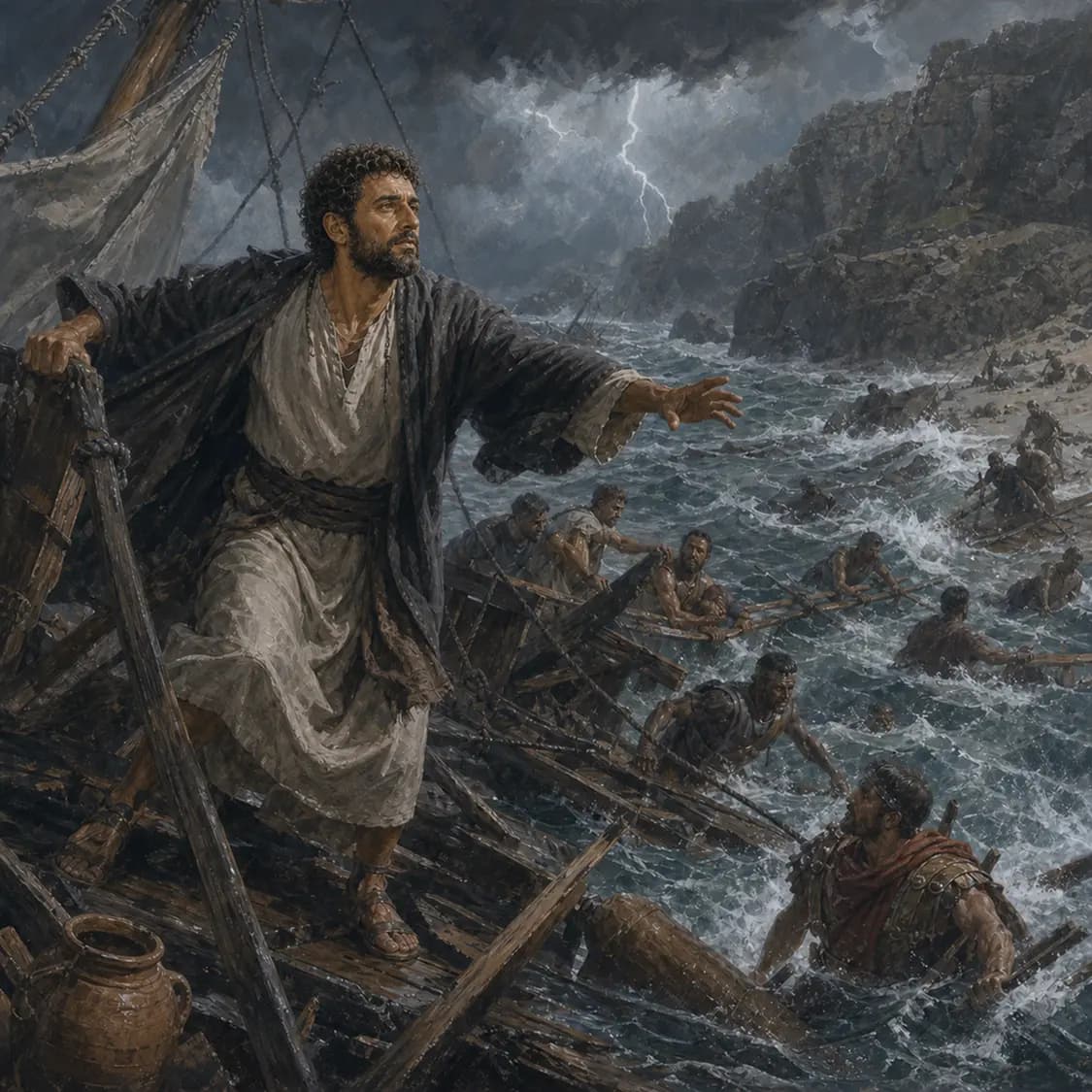
When a gentle south wind began to blow, their plan seemed to be working. They sailed close along the coast. Before long, however, a violent northeaster swept down upon them. The ship could not head into the wind, so they gave way and were driven along by the storm.
Near the small island of Clauda, the crew barely managed to secure the lifeboat. They wrapped supporting cables around the ship and lowered its gear, fearing they might be driven onto dangerous sandbars. The storm battered them so severely that the next day they began throwing cargo overboard. On the third day, they threw the ship’s equipment into the sea with their own hands.
For many days, neither the sun nor the stars appeared, and the storm continued. At last, all hope of being saved faded.
After the men had gone a long time without food, Paul stood among them. He reminded them that the loss could have been avoided if they had listened to his warning. Yet he did not leave them without hope. He urged them to take courage because no one aboard would lose his life, though the ship would be destroyed.
During the night, an angel of the God to whom Paul belonged and whom he served had stood beside him. The angel told Paul not to be afraid. Paul still had to stand before Caesar, and God would preserve everyone sailing with him.
Paul told the men that he trusted God and believed everything would happen as he had been told. Still, the ship would have to run aground on an island.
The storm continued. On the fourteenth night, around midnight, the sailors sensed that land was near. A first sounding measured twenty fathoms; a little later, the depth was only fifteen. Afraid of striking rocks in the darkness, they dropped four anchors from the stern and waited for daylight.
Some of the sailors then tried to escape. Pretending that they were going to lower anchors from the front of the ship, they let the lifeboat down into the sea. Paul warned Julius and the soldiers that unless the sailors remained aboard, the others could not be saved. The soldiers immediately cut the lifeboat’s ropes and let it drift away.
As dawn approached, Paul urged everyone to eat. For fourteen days they had been waiting in suspense and had taken no food. They needed strength, and Paul assured them again that not one of them would perish.
In front of everyone, Paul took bread, thanked God, broke it, and began to eat. The others were encouraged and ate as well. There were 276 people aboard. When they had eaten enough, they lightened the ship further by throwing its remaining wheat into the sea.
At daylight, the sailors did not recognize the land, but they saw a bay with a beach and decided to try to run the ship ashore. They released the anchors, loosened the ropes holding the rudders, raised the sail, and headed for the beach.
The ship struck a sandbar. Its bow stuck fast, while the stern began to break apart under the force of the waves. The soldiers planned to kill the prisoners so that none could swim away and escape. Julius, wanting to save Paul, stopped them.
He ordered everyone who could swim to go overboard first and make for land. The rest followed, holding on to planks and broken pieces of the ship. In this way, every person reached land safely.
What We Learned
- Paul’s trust rested on God’s word, not on changing weather. The storm continued, but the promise gave him courage.
- Trust did not lead to passivity. Paul warned others, gave practical instructions, urged them to eat, and helped them prepare for what lay ahead.
- Paul’s faith served the whole ship. His public gratitude to God encouraged frightened and exhausted people to take strength.
- God’s protection did not preserve the ship, but it preserved every life aboard. His care remained certain even through great loss.
Story background
Paul Is Shipwrecked is read in Acts 27:1-44. Paul, a prisoner being taken to Italy under the centurion Julius, sails through worsening seasonal conditions. The account also draws attention to trust amid danger and practical action. Its named people, setting, and sequence matter, while details not stated in the passage should remain open rather than being supplied from later retellings. Read the scene in its surrounding movement: notice what prompts the action, how the central figures respond, and what the final words leave with the hearer. This background keeps the story close to its explicit claims while making room for careful reflection on trust amid danger, practical action, and the other themes named here. The passage can be revisited slowly, with its questions and tensions intact.
People in the story
- Paul — Prisoner, warning voice, recipient of the angelic assurance, and encourager of everyone aboard
- Julius — Roman centurion responsible for the prisoners who eventually prevents soldiers from killing them
- Sailors and ship's officers — Navigate the voyage, try to manage the storm, and at one point attempt to escape in the lifeboat
- Other prisoners and travelers — Share the danger and ultimately reach land safely
- Angel — Tells Paul not to fear and gives assurance that everyone sailing with him will be spared
Themes to notice
Trust amid danger
The passage brings trust amid danger into focus through its named people, actions, and ending.
Practical action
The passage brings practical action into focus through its named people, actions, and ending.
God's promise
The passage brings God's promise into focus through its named people, actions, and ending.
Care for every life
The passage brings care for every life into focus through its named people, actions, and ending.
Questions for reflection
- What stands out to you about trust amid danger in this passage?
- How do the people in the story respond to practical action?
- Which detail would you want to read again in its wider context?
- What question does this account leave you carrying?
Related stories
Carry the story with you
Save your reflections on paul is shipwrecked and revisit them as you continue through Scripture.