
Read the story
Context
Acts tells how the good news about Jesus moved outward from Jerusalem, crossing geographic and cultural boundaries. Its arrival in Rome, the center of imperial power, marks a remarkable moment. Yet Paul enters the city under Roman custody after appealing his case to Caesar. His movements are restricted, and his legal future remains unsettled.
This final scene brings two important threads together. Paul insists that he has not betrayed his own people, and he continues to testify that Israel’s Scriptures point toward Jesus and the kingdom of God. The question is what can happen when the messenger is confined, but people are still able to come and listen.
Story
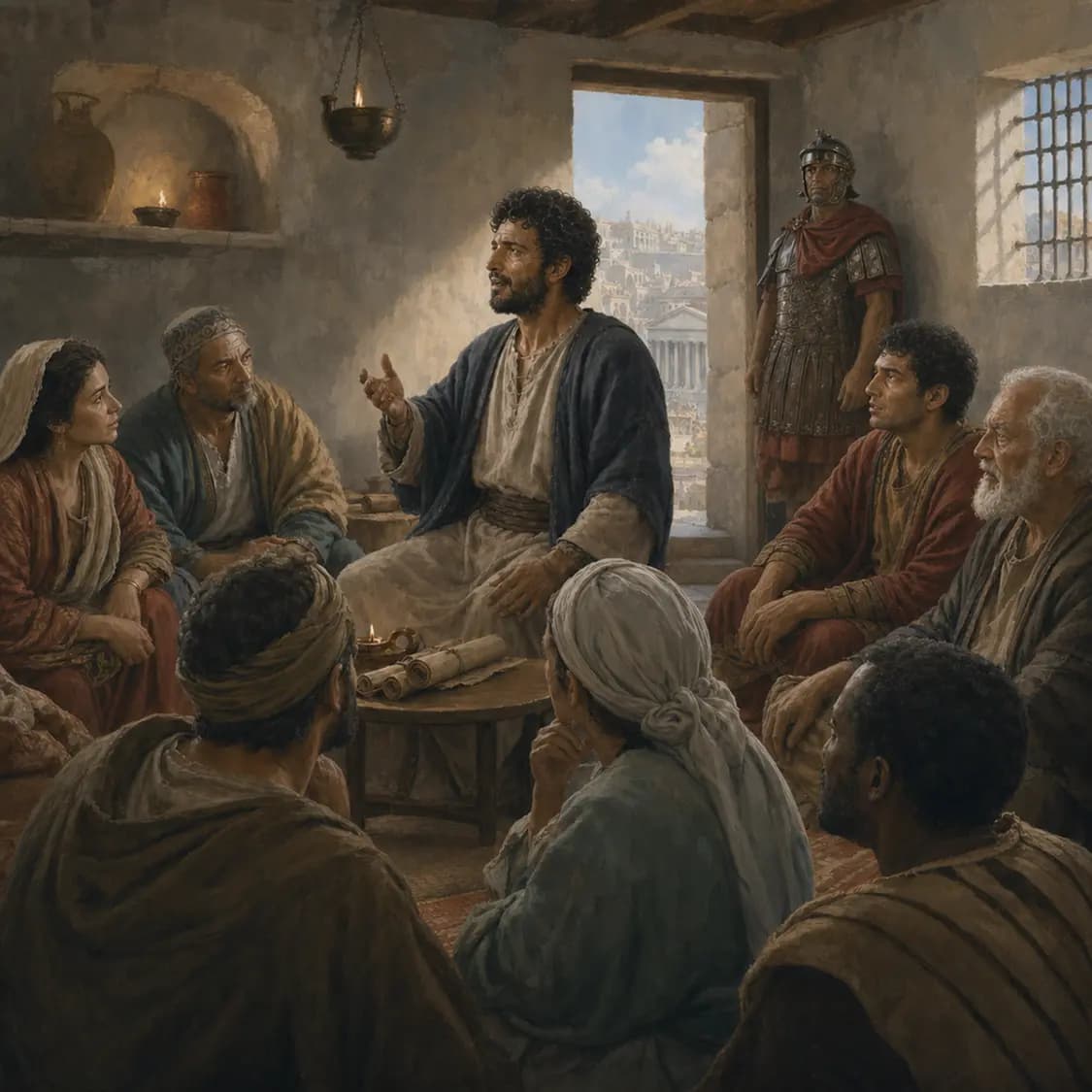
When Paul arrived in Rome, he was allowed to live by himself, though a soldier remained with him as a guard. He had reached the great city, but he had reached it as a prisoner.
After three days, Paul called together the leading members of Rome’s Jewish community. He wanted them to hear directly from him why he was there. He explained that he had done nothing against his people or their ancestral customs, yet he had been handed over in Jerusalem to the Roman authorities.
The Romans had examined his case and found no reason to sentence him to death. They had been ready to release him, but objections were raised, and Paul had been forced to appeal to Caesar. Even so, he made clear that he had not come to accuse his own nation.
His imprisonment, he said, was connected to something much deeper than a legal dispute. It was because of the hope of Israel that he was bound with a chain. The message about Jesus was not, in Paul’s eyes, a rejection of the promises given to Israel. It was bound up with their fulfillment.
The leaders told Paul that they had received no letters from Judea concerning him. Nor had any visitors brought a damaging report about him. Still, they wanted to hear his views because the movement he represented was being spoken against everywhere.
They arranged another day to meet, and an even larger group came to Paul’s lodging. From morning until evening, he explained and testified about the kingdom of God. Drawing from the Law of Moses and the Prophets, he tried to persuade them about Jesus.
The listeners did not all respond in the same way. Some believed what Paul said, while others did not. They disagreed among themselves as the meeting came to an end.
Paul then reminded them of the warning God had spoken through the prophet Isaiah. People could keep hearing without understanding and keep seeing without perceiving. Their hearts could become dull, their ears hard of hearing, and their eyes closed. If they truly saw, heard, and understood, they could turn and receive God’s healing.
Then Paul made a clear declaration: God’s salvation had been sent to the Gentiles, and they would listen.
For two full years, Paul remained in the house he rented. Though guarded as a prisoner, he became a host, welcoming everyone who came to him. He proclaimed the kingdom of God and taught about the Lord Jesus Christ with complete boldness and without hindrance.
What We Learned
- Imprisonment restricted Paul, but it did not silence his witness. He used the opportunity he had to welcome and teach others.
- For Paul, the message about Jesus belonged within the hope of Israel and the witness of its Scriptures.
- The same careful testimony can produce different responses. Some believed, while others remained unconvinced.
- God’s salvation extends to the Gentiles, even as Paul continues to speak respectfully and earnestly to his fellow Jews.
- Acts ends with the kingdom of God still being proclaimed boldly, keeping attention on the continuing advance of the good news rather than on Paul’s legal outcome.
Story background
The Good News Reaches Rome is read in Acts 28:16-31. In Rome, Paul is allowed to live by himself with a soldier guarding him. The account also draws attention to witness despite confinement and Israel's hope and Jesus. Its named people, setting, and sequence matter, while details not stated in the passage should remain open rather than being supplied from later retellings. Read the scene in its surrounding movement: notice what prompts the action, how the central figures respond, and what the final words leave with the hearer. This background keeps the story close to its explicit claims while making room for careful reflection on witness despite confinement, Israel's hope and Jesus, and the other themes named here. The passage can be revisited slowly, with its questions and tensions intact.
People in the story
- Paul — A guarded prisoner who explains his case, testifies about Jesus, and continues teaching in Rome
- Jewish leaders in Rome — Hear Paul explain why he is there and respond with differing degrees of belief
- Roman guard — Guards Paul while he is allowed to live by himself
- People who come to Paul — Are welcomed over two years and hear his teaching about God's kingdom and Jesus
Themes to notice
Witness despite confinement
The passage brings witness despite confinement into focus through its named people, actions, and ending.
Israel's hope and Jesus
The passage brings Israel's hope and Jesus into focus through its named people, actions, and ending.
Divided response
The passage brings divided response into focus through its named people, actions, and ending.
Good news reaching Rome
The passage brings good news reaching Rome into focus through its named people, actions, and ending.
Questions for reflection
- What stands out to you about witness despite confinement in this passage?
- How do the people in the story respond to Israel's hope and Jesus?
- Which detail would you want to read again in its wider context?
- What question does this account leave you carrying?
Related stories



Carry the story with you
Save your reflections on the good news reaches rome and revisit them as you continue through Scripture.