


The pantry shelf holds rice, half a bag of flour, and not much else, and payday is still a week away. In a moment like that, a person does not reach for an abstraction. She reaches for a story in which someone else once stood in front of an empty shelf and watched what happened next. Bible stories about God's provision answer that reach. They include food, water, protection, work, hospitality, and shared resources, and they carry one steady boundary: they do not promise that faithful people avoid scarcity or loss. Most of them begin inside real need, and the need stays visible the whole way through.
This study guide walks through five such stories in their own settings: a wilderness without water, a famine that empties a town, a drought that shrinks a widow's jar, a remote hillside at suppertime, and a young church learning to share. Each one shows provision with a different shape. Read them on their own terms first, and let the framework at the end help you carry them honestly.
What provision means in a Bible story
Provision in a Bible story is concrete before it is anything else. It is bread in the morning, water where there was none, a field a poor woman is allowed to enter, a meal shared between strangers. These stories are honest about the empty shelf. Famine, wilderness, drought, and hunger are not scenery; they are the conditions the characters actually live in, and the text does not hurry past them.
Provision also arrives through means. Sometimes the means is unusual, like bread appearing with the dew. Often it is ordinary: a harvest, a law that leaves grain for the poor, a neighbor's open hand, a community that refuses to let anyone go hungry. God provides, and people gather, glean, carry, cook, welcome, and share. Human work and responsibility belong inside these stories, and reading them well means keeping both in view at once.
Manna and water meet daily wilderness needs
Israel's wilderness journey begins with a song on the far side of the sea and then turns, within three days, into a search for water. The first water they find is bitter. Soon after, the food runs out. The people remember the full tables of the life they left and begin to grumble, and the grumbling is recorded plainly, without embarrassment.
Bread for one day at a time
The answer arrives as a daily rhythm. Each morning, bread appears on the ground with the dew, and each household gathers what that day requires. The lesson is built into the substance itself: what is hoarded overnight spoils, and what is gathered is enough. On the sixth day the people gather a double portion so the seventh can be a day of rest. Provision here is measured in days, and it makes room for rest rather than endless accumulation.
Water from an unlikely place
At Rephidim the water runs out again, and the quarrel grows sharp enough to get its own name. Water comes from a rock struck at God's command, in a dry place, for a people who are testing as much as trusting. The wilderness stories hold both truths together: the need is met, and the meeting does not turn the people into finished believers. Provision is daily because trust is daily.
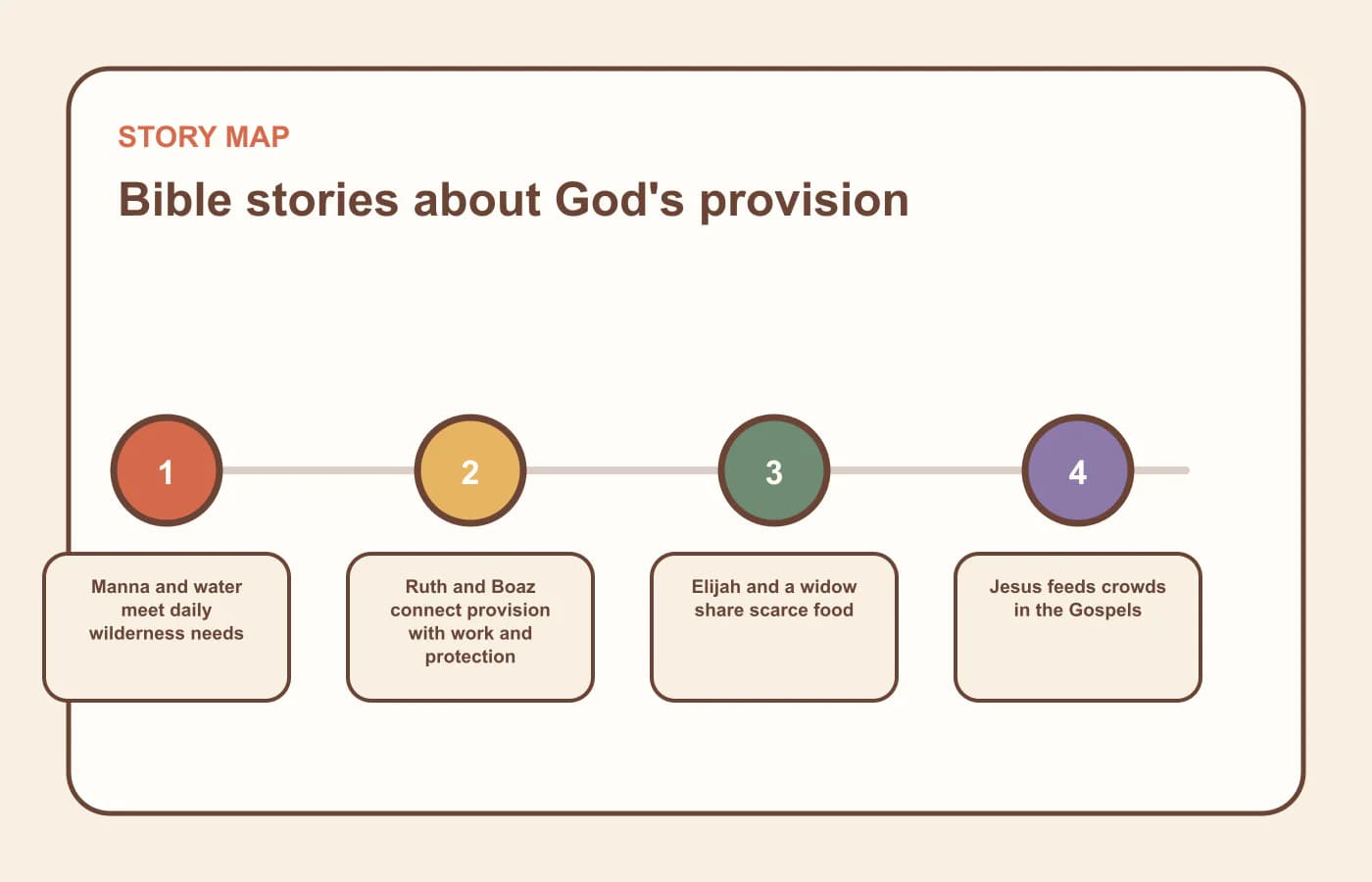
Ruth and Boaz connect provision with work and protection
The book of Ruth opens with a famine in Bethlehem, the town whose name speaks of bread. A family leaves to find food elsewhere, and a decade later two widows return with almost nothing, arriving just as the barley harvest begins. The timing matters. Provision in this story walks in through the harvest gate.
Gleaning is real work inside a real law
Ruth goes out to glean, following the harvesters to gather the stalks they leave behind. Israel's law made room for the poor and the foreigner to do exactly this, which means her provision has an address: a field, an owner, a custom that protects her right to be there. It also has muscles. Ruth works from morning onward in someone else's field, and the story honors her labor as labor. Provision here includes human work and responsibility, and it would be a flattened reading to erase either one.
Protection that costs someone something
Boaz notices Ruth, guards her safety among the young men, and quietly instructs his workers to leave extra grain in her path. Later he takes up the family's cause at the town gate, in public, at real cost to himself. Provision in Ruth moves through land, law, loyalty, and a man willing to spend his standing on two widows. The famine that emptied Bethlehem is answered by a harvest that fills it again, one deliberate act at a time.
Elijah and a widow share scarce food
When Elijah announces a drought, the first provision he receives is a brook and the bread that ravens carry to him. Then the brook dries up, because droughts do that. The story refuses to freeze provision into a single form: what sustained the prophet in one season ends, and the next season's provision looks entirely different.
A handful of flour, shared
God sends Elijah to Zarephath, to a widow gathering sticks to cook what she expects to be a final meal for herself and her son. She has a handful of flour and a little oil, and Elijah asks her to feed him first. Her hospitality inside scarcity becomes the doorway: the jar does not run empty and the jug does not run dry for the length of the drought. Later, when her son falls ill and dies, God restores him through Elijah's prayer. The widow is never blamed for her poverty. The drought is the setting, her generosity is the hinge, and provision keeps pace with a need that keeps changing shape.
Jesus feeds crowds in the Gospels
In Mark's account, the apostles return from their work tired, and Jesus invites them toward rest. The crowd gets there first. He sees their hunger for guidance, has compassion, and teaches them, and the afternoon slips away in a remote place where there is nothing to buy.
You give them something
When the disciples propose sending the crowd away, Jesus hands the task back to them. What they can find is small: five loaves and two fish. He blesses and breaks what is given, the disciples distribute it, and everyone eats and is satisfied. Twelve baskets of fragments are gathered afterward, which is its own quiet detail — provision generous enough for leftovers, and careful enough to collect them.
A meal inside his larger care
Notice the order of the scene. Jesus teaches first and feeds second, and the same crowd receives both. The feeding does not stand alone as a spectacle; it sits inside his steady attention to people who are hungry in more than one way. The disciples participate throughout, carrying what he blesses to the people who need it.
The early church shares resources
After Pentecost, the believers in Jerusalem settle into a shared life: teaching, fellowship, meals, and prayer. Acts describes them holding what they own with open hands, selling possessions when a need appears, and distributing to anyone who lacks. Their table fellowship is marked by gladness and sincerity, and the community grows around it.
No one left in need
A little later the picture sharpens: people who own land or houses sell them and lay the proceeds before the apostles, and there is no needy person among them. Barnabas, a man whose name is tied to encouragement, sells a field and gives it over. This is provision carried by a community on purpose. Nobody's hunger is treated as a verdict on their faith; it is treated as the community's responsibility. Sharing includes human work and responsibility here too — someone has to sell, carry, organize, and distribute — and the story presents that work as the normal way God cares for people through people.
How to read provision stories without a prosperity formula
These stories are easy to love and easy to mishandle. Loved well, they teach daily trust. Mishandled, they become a formula in which faith produces wealth and poverty proves its absence. Every story above resists that reading. Faithful people in these pages are hungry, displaced, widowed, and tired, and the text never blames them for it. Provision meets them inside the need; it does not pretend the need away.
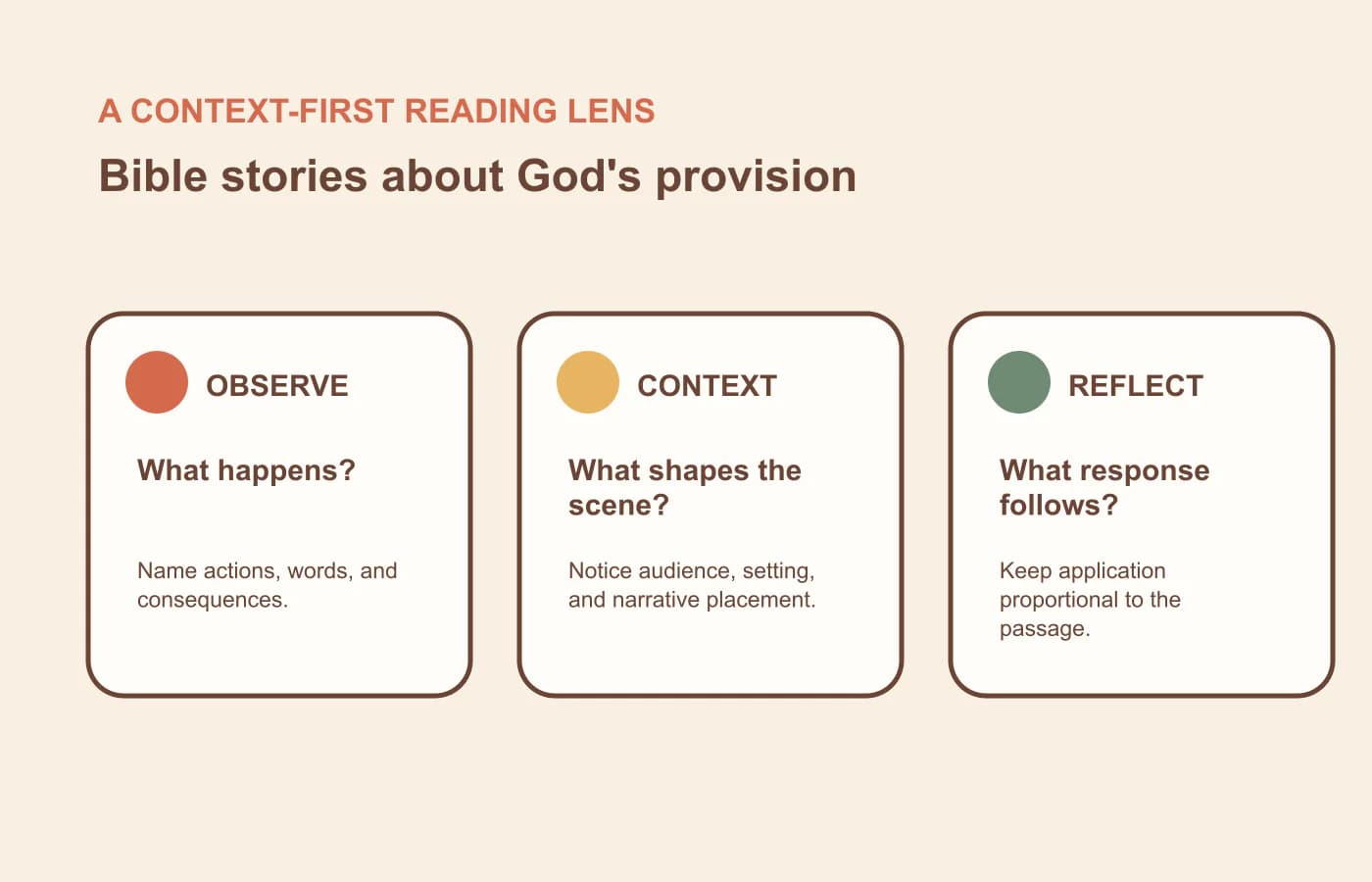
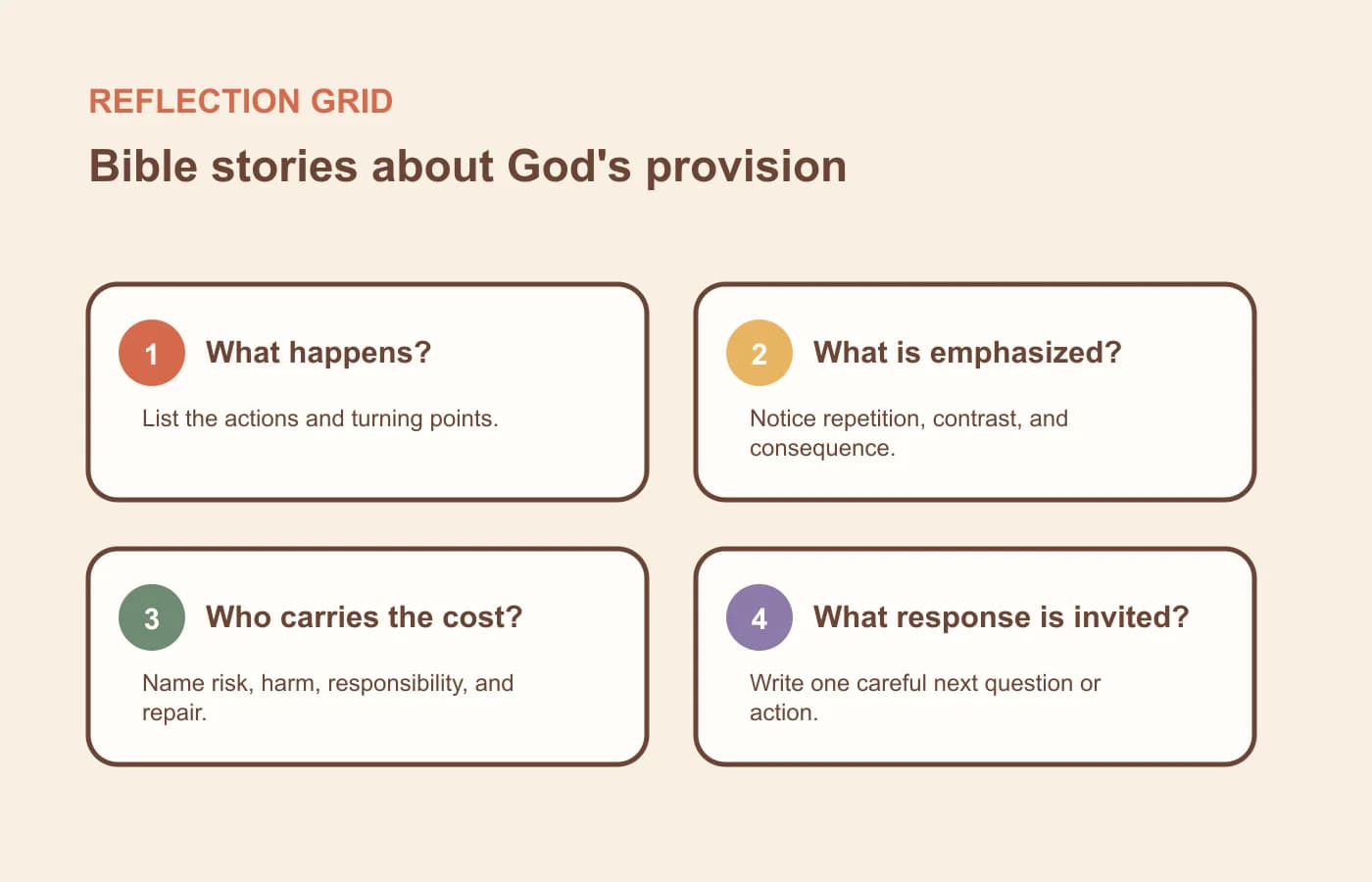
Here is one independent step you can take before any tool enters the picture. Choose a single story, sit down with the whole narrative in your Bible, and read the Bible in context by answering four questions on paper:
What is the actual need, and how honestly does the story name it?
Through what means does provision come, ordinary or unexpected?
What human work and responsibility appear inside the provision?
What does this story ask of the community around the person in need?
Write the answers in your own words. If you want a pattern that keeps those observations, questions, and responses in order, you can take notes while reading the Bible and let the practice grow from there.
If you would like to read complete published story texts and listen to the audio versions, Bible Note's Modern Bible Stories collection is a gentle next step. It offers the full published stories to read or hear at your own pace, and it pairs naturally with the four questions above.
Provision stories end quietly more often than they end spectacularly: a jar that holds out through a drought, a field open to a foreigner, a basket gathered up after everyone has eaten. Let them set your expectations toward daily trust and shared responsibility, and they will keep feeding you for a long time.
Frequently asked questions
Do Bible stories about God's provision promise wealth to faithful people?
No. The stories in this guide show God meeting real needs — food, water, safety, community — inside famine, wilderness, and drought. They teach daily trust and shared responsibility, and they never turn faith into a guarantee of material prosperity.
Why do faithful people still face hunger and scarcity in these stories?
Because scarcity is the setting, not a verdict. Israel grumbles in a real wilderness, Ruth gleans because a real famine emptied her table, and the widow of Zarephath cooks a final meal in a real drought. The text never blames them for being in need.
What is my part when I read a provision story?
Read the whole narrative in its own setting, then ask four questions: What is the need? Through what means does provision come? What human work appears inside it? What does the story ask of the community? Writing your answers down keeps the reading honest.
Where can I read these Bible stories in full?
Each story lives in its biblical book: Exodus, Ruth, 1 Kings, Mark, and Acts. For complete published story text with audio, the Modern Bible Stories collection from Bible Note is an easy place to continue.
Sources
Scripture passages studied in this guide: Exodus 15:22–17:7; Ruth 1:1–4:22; 1 Kings 17:1–24; Mark 6:30–44; Acts 2:42–47; Acts 4:32–37. Internal verification used the World English Bible (WEB).
Editorial status
Written and edited by Hans Keller for Bible Note. Sources, Scripture context, dates, and practical limitations are checked before publication.

About the author
Hans Keller
Editorial & Content Lead
Bible Study & Sermon Learning Content Editor
Hans helps Christians turn sermons and Scripture study into clear notes, thoughtful questions, and faithful next steps.
His work helps listeners and group leaders carry a sermon or study beyond the meeting: back to the passage, into clearer questions, and toward one practical response for the week.
Read with Scripture open
Use this guide alongside the full biblical passage and the practices of your local church. Interpretive details can differ across Christian traditions.
See more Bible Note on Google
Add Bible Note as a preferred source to help find our Bible study guides more easily in Google Search.