
Your Bible is open to Ruth 1, the kitchen is quiet, and you have half an hour before the evening closes in. You want that half hour to add up to something by the end of the month. This six-week Bible study guide for women gives you a simple way to do that: one passage set each week, a page of notes built the same way every time, and questions that keep you inside the text.
Before reading further, do one thing: open your own Bible to Genesis 16, read the whole chapter once without writing anything, and set a blank page beside it. A full passage and a fresh page are the entire machinery of this plan.
A six-week Bible study guide for women
This women's bible study guide is built around six narrative units, each centered on a woman or group of women in Scripture: Hagar, Ruth and Naomi, Deborah and Jael, Hannah, Mary and Elizabeth, and the women at the empty tomb. Each week you read one passage set in full, work through a short set of questions, and write one honest response. Six weeks is long enough to build a habit and short enough to finish.
The plan works alone or in a small group: solo, your page is your companion; together, everyone prepares the same page and the questions become your discussion. Either way, use the translation you already read, and take each passage as a complete unit, from beginning to end.
These six weeks are a starting path. If you want a wider reading journey through the many women of Scripture, see our guide to women in the Bible.
How to prepare one weekly study page
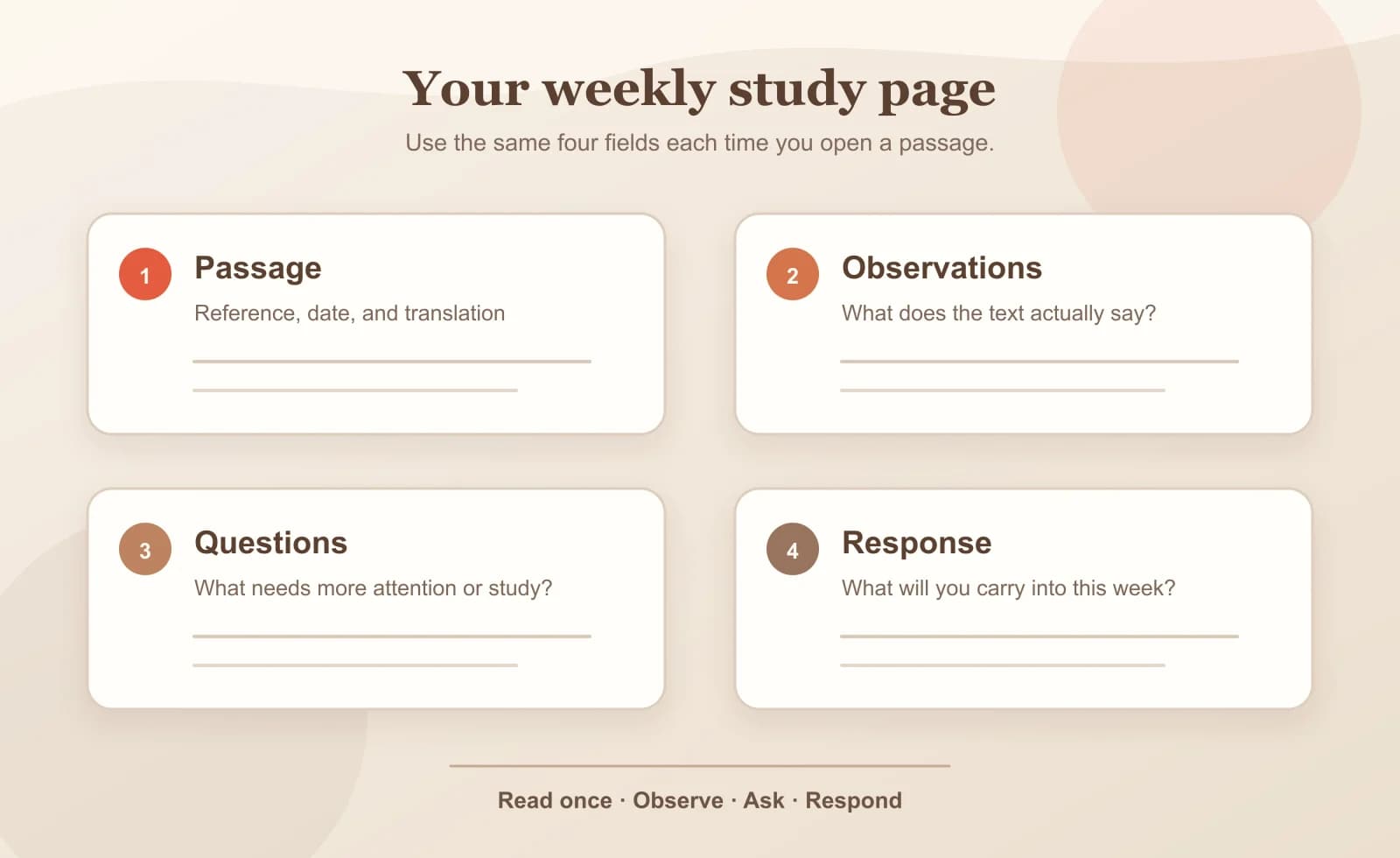
Every week uses the same page, divided into four fields:
Passage: the week's reference, the date, and the translation you are reading.
Observations: what the text actually says, written before you decide what it means.
Questions: two or three things the passage raises that you cannot yet answer.
Response: one concrete way the text meets your life this week.
The order matters: observation comes before conclusions. It is easy to reach for a familiar lesson and miss what the narrative is doing. When you first write only what you see — who speaks, who is silent, what repeats — your conclusions have something solid to rest on.
If you prefer a more structured note format, the SOAP Bible study method fits neatly onto this same page. To compare this rhythm with other ways of organizing study time, see our overview of Bible study methods.
Here is the weekly sequence:
Write the passage reference, date, and translation at the top of a fresh page.
Read the full passage set once, in one sitting if you can, without writing anything.
Read it again and fill in Observations with only what the text says.
Write your two or three best Questions, the ones you would genuinely want answered.
Close with one Response: a trust, a confession, a prayer, or a small act of obedience.
The six-week reading plan
Read each set in your own Bible, in full, before writing. The themes below are starting points; let the text correct or deepen them.
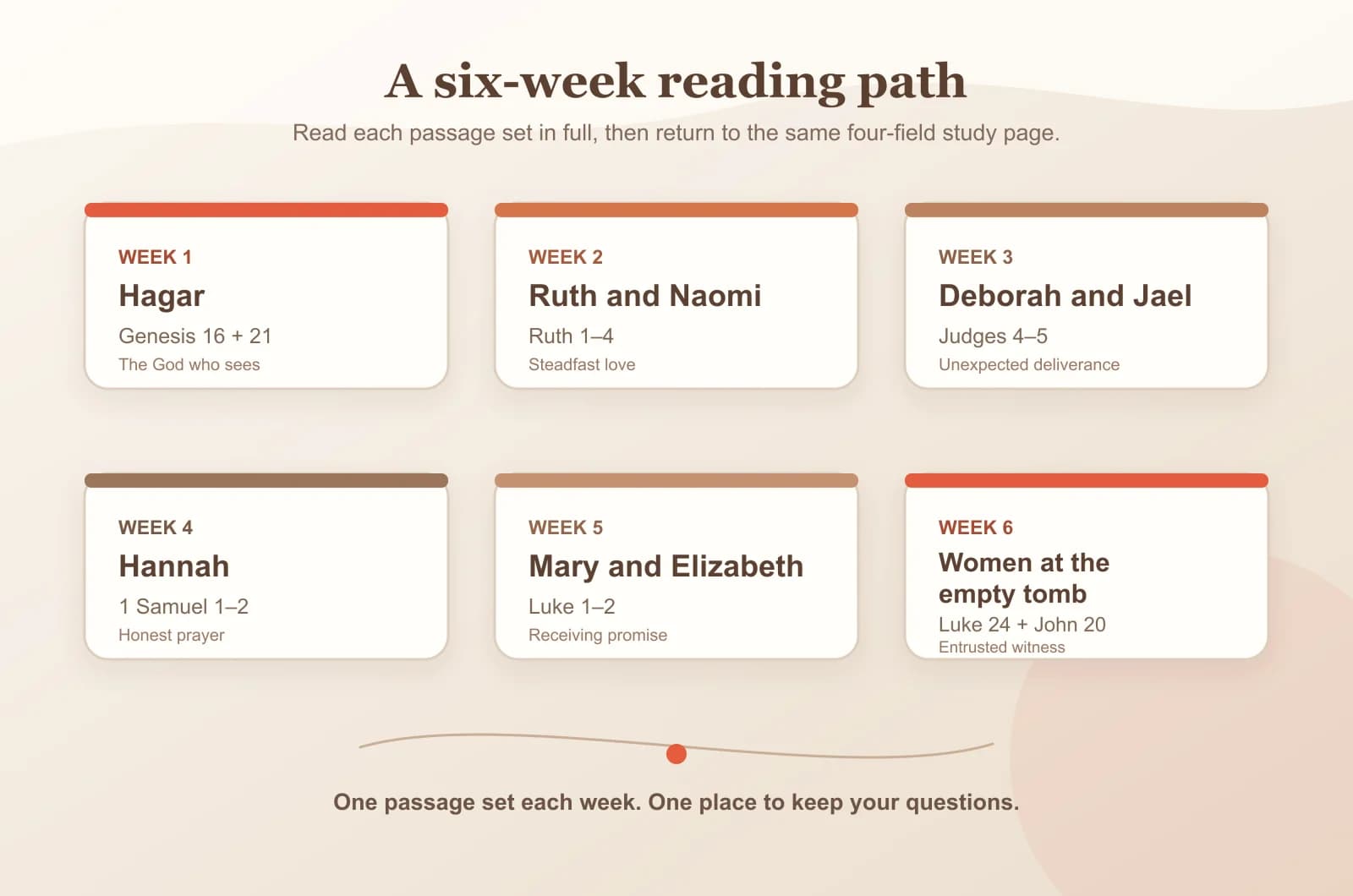
Week 1: Hagar — Genesis 16 and 21
Hagar, an Egyptian servant in Abram and Sarai's household, is drawn into their attempt to hurry God's promise. Mistreated, she flees to the wilderness, where God meets her; years later, sent away with her son, she meets him again. The theme to watch: the God who sees the overlooked.
What do the two wilderness scenes have in common, and what is different between them?
What does God say to Hagar in each chapter, and how does she respond?
How do Sarai and Abram treat Hagar, and what does the text record without comment?
Response: Write about a season when you felt unseen, and what Hagar's story invites you to bring honestly to God.
Week 2: Ruth and Naomi — Ruth 1–4
A famine drives Naomi's family from Bethlehem to Moab; she returns widowed and bereaved, with her daughter-in-law Ruth, who refuses to leave her. Harvest fields, Boaz's kindness, and an unexpected ending follow. The theme to watch: steadfast love expressed through ordinary faithfulness.
What does Ruth's pledge to Naomi in chapter 1 actually commit her to?
Which small, everyday decisions by Ruth and Boaz move the story forward?
Response: Where is faithfulness being asked of you right now in an unglamorous, ordinary form?
Week 3: Deborah and Jael — Judges 4–5
Israel is oppressed under Jabin and his commander Sisera. Deborah, a prophetess and judge, summons Barak with God's command; the battle turns on Jael's courage, and chapter 5 retells everything in song. This is a violent passage; say so on your page. The theme to watch: deliverance through unexpected people.
What roles do Deborah, Barak, and Jael each play, and how does the song retell the events?
Which details does the text celebrate, and which make you uneasy?
Response: Write down the discomfort this passage raises, then turn it into an honest prayer and keep it on the page.
Week 4: Hannah — 1 Samuel 1–2
Hannah bears barrenness and a rival's provocation year after year. At Shiloh she prays so intensely that Eli mistakes her for drunkenness. God gives her Samuel, she keeps her vow, and chapter 2 records her prayer of praise. The theme to watch: honest prayer, and the God who lifts the lowly.
How does Hannah pray, and how do the people around her misunderstand her?
What does her prayer in chapter 2 say about how God rules over the proud and the needy?
Response: Write your own unedited prayer this week, the kind you would pray if no one were watching.
Week 5: Mary and Elizabeth — Luke 1–2
Two announcements, two sons, two generations: Elizabeth, barren for years, carries John; her young relative Mary carries Jesus. Mary's song, the birth in Bethlehem, and the testimony of Simeon and Anna fill these chapters. The theme to watch: God keeping his promises, and faith that receives them.
How do Mary's and Zechariah's responses to the angel differ?
What does Mary's song celebrate about God's character and his way of working?
What do Simeon and Anna add to the story in chapter 2?
Response: Name one promise of God you are still waiting on, and write what waiting faithfully looks like this week.
Week 6: The women at the empty tomb — Luke 24 and John 20
The women who followed Jesus come to the tomb early, find it empty, and become the first witnesses of the resurrection. Luke 24 records their report, which the apostles struggle to believe; John 20 lingers with Mary Magdalene. The theme to watch: entrusted witness, the call to go and tell.
Who are the women named in Luke 24, and how is their report received?
In John 20, trace what Mary Magdalene does from the tomb to her last word in the chapter.
What does Jesus commission Mary to do, and why does that matter as you finish this plan?
Response: Look back over your five previous pages: what has God shown you that you are now called to share with someone else?
Questions that keep the study close to the text
Good questions do more for a study than good answers. Keep a running bank like this one for weeks when your own questions run dry.
Observation prompts:
Who speaks, who acts, and who stays silent in this passage?
What words or details repeat, and where does the scene take place?
What does the text state plainly that you might have been assuming?
Interpretation prompts:
What do the surrounding chapters add to this scene?
What does this passage show about God's character, and about human character?
Where else in Scripture does this theme appear?
Response prompts:
What does this passage ask you to trust, confess, or do?
Who in your life needs what you learned this week?
What will you pray differently because of this text?
Keep six weeks of questions together in Bible Note
Six weeks of pages produce a stack of observations and questions that are easy to lose across notebooks and loose paper. Bible Note Bible Study Chat can begin from an open passage or a sermon note, shows Scripture references with translation labels, and distinguishes Scripture, interpretation, and AI inference in its answers. When an answer is useful, you can save it to a Note beside the questions it belongs to.
If you want one place to hold the questions from all six weeks, open the passage you are studying in Bible Note and ask your question there, then save what helps.
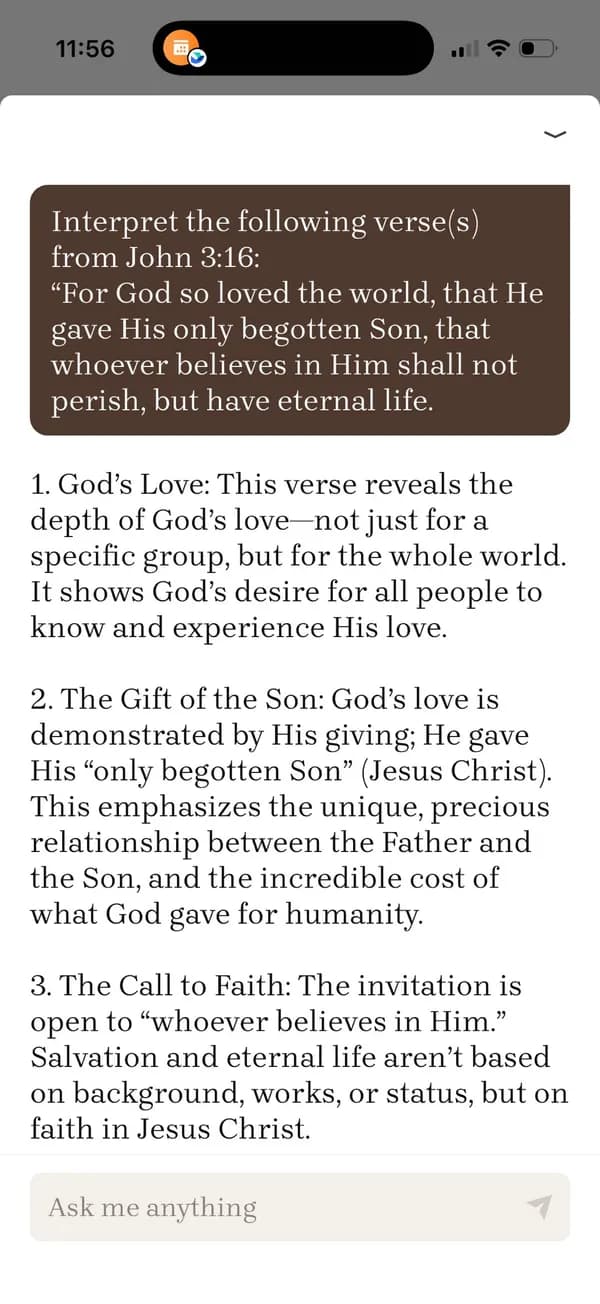
One honest caution: Bible Note's AI can be wrong. It can support your study, while Scripture, your church community, and trusted pastoral care remain the places to take weighty questions. Verify every cited passage in your own Bible before relying on it.
Frequently asked questions
Can I stretch this plan or move through it faster?
Yes. If a passage set deserves two weeks, take two; Ruth and Luke 1–2 both reward slower reading. For a retreat, you can compress the plan into a long weekend. Whatever pace you choose, keep the same four-field page so the habit survives.
How much time does one week take?
Most readers finish a week's reading and one page in 30 to 45 minutes. If you prefer shorter sessions, split reading and note-taking across two days.
Can a small group use this guide together?
Yes. Ask each person to prepare the weekly page at home, then read the passage aloud together and use that week's questions as your discussion. A simple ground rule helps: let the text answer first, and hold interpretations with a light grip.
What should I do with a hard passage like Judges 4–5?
Read the whole unit in context, and write your discomfort down as an observation. Note exactly which details trouble you, then bring them to trusted believers or a pastor. Honest questions are a legitimate response to hard passages.
What if a question is still unanswered after six weeks?
That is normal, and it is no failure. Keep the question in your notes, return to it when a related passage comes up, and bring it to Scripture and trusted believers or a pastor. A written question is easier to carry than a vague one.
Sources
Editorial status
Written and edited by Hans Keller for Bible Note. Sources, Scripture context, dates, and practical limitations are checked before publication.

About the author
Hans Keller
Editorial & Content Lead
Bible Study & Sermon Learning Content Editor
Hans helps Christians turn sermons and Scripture study into clear notes, thoughtful questions, and faithful next steps.
His work helps listeners and group leaders carry a sermon or study beyond the meeting: back to the passage, into clearer questions, and toward one practical response for the week.
Read with Scripture open
Use this guide alongside the full biblical passage and the practices of your local church. Interpretive details can differ across Christian traditions.
See more Bible Note on Google
Add Bible Note as a preferred source to help find our Bible study guides more easily in Google Search.