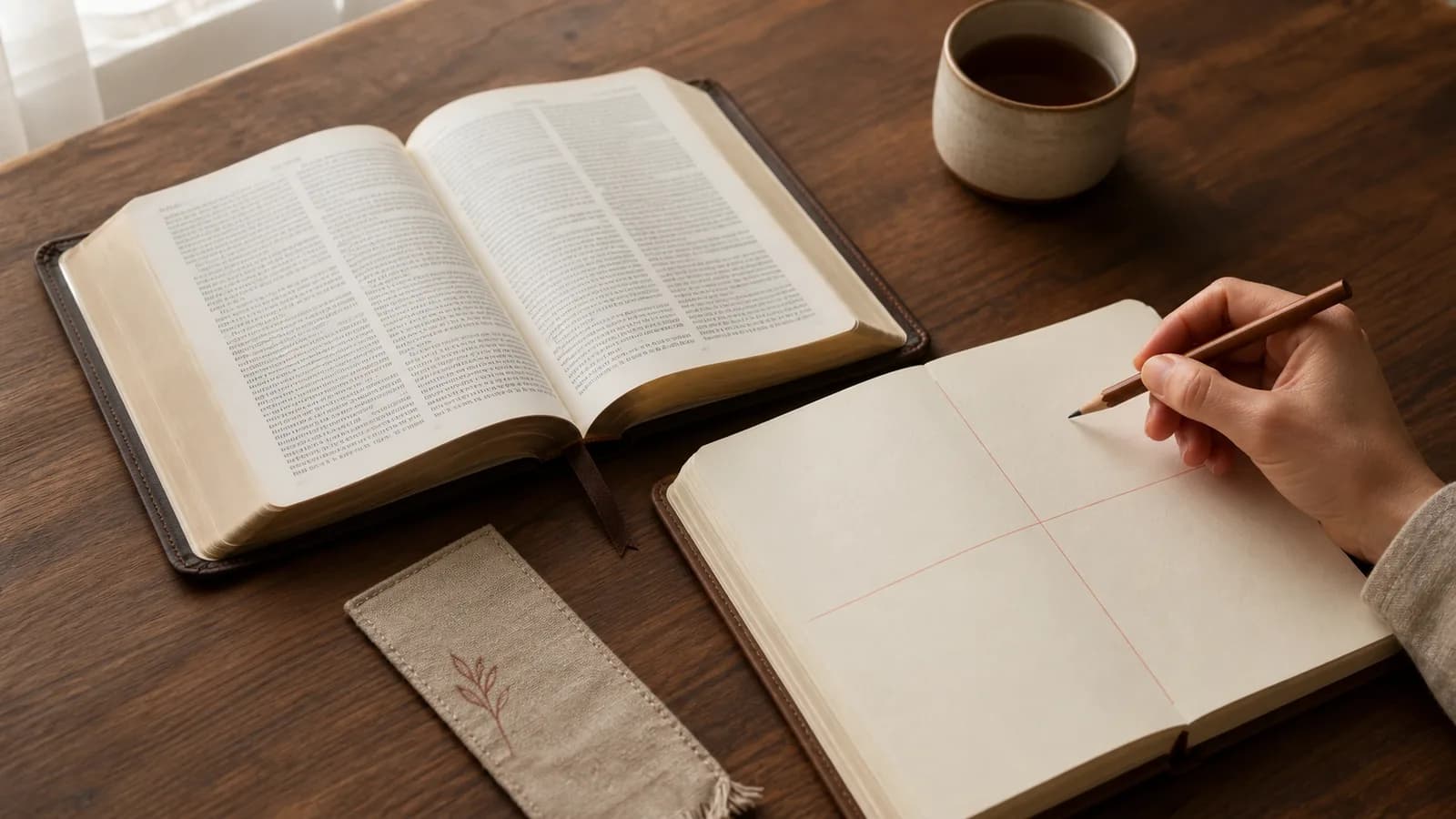
An open Bible and a blank notebook can make a short reading feel more complicated than it needs to be. The SOAP Bible study method gives that page four places to go: choose Scripture, record Observation, name one Application, and end in Prayer.
Use SOAP when you want a simple written trail back to a passage. It works with a wide-margin Bible, a notebook, or a digital note. The goal is a careful return to the text and one response you can revisit during the week.
What the SOAP Bible Study Method Is
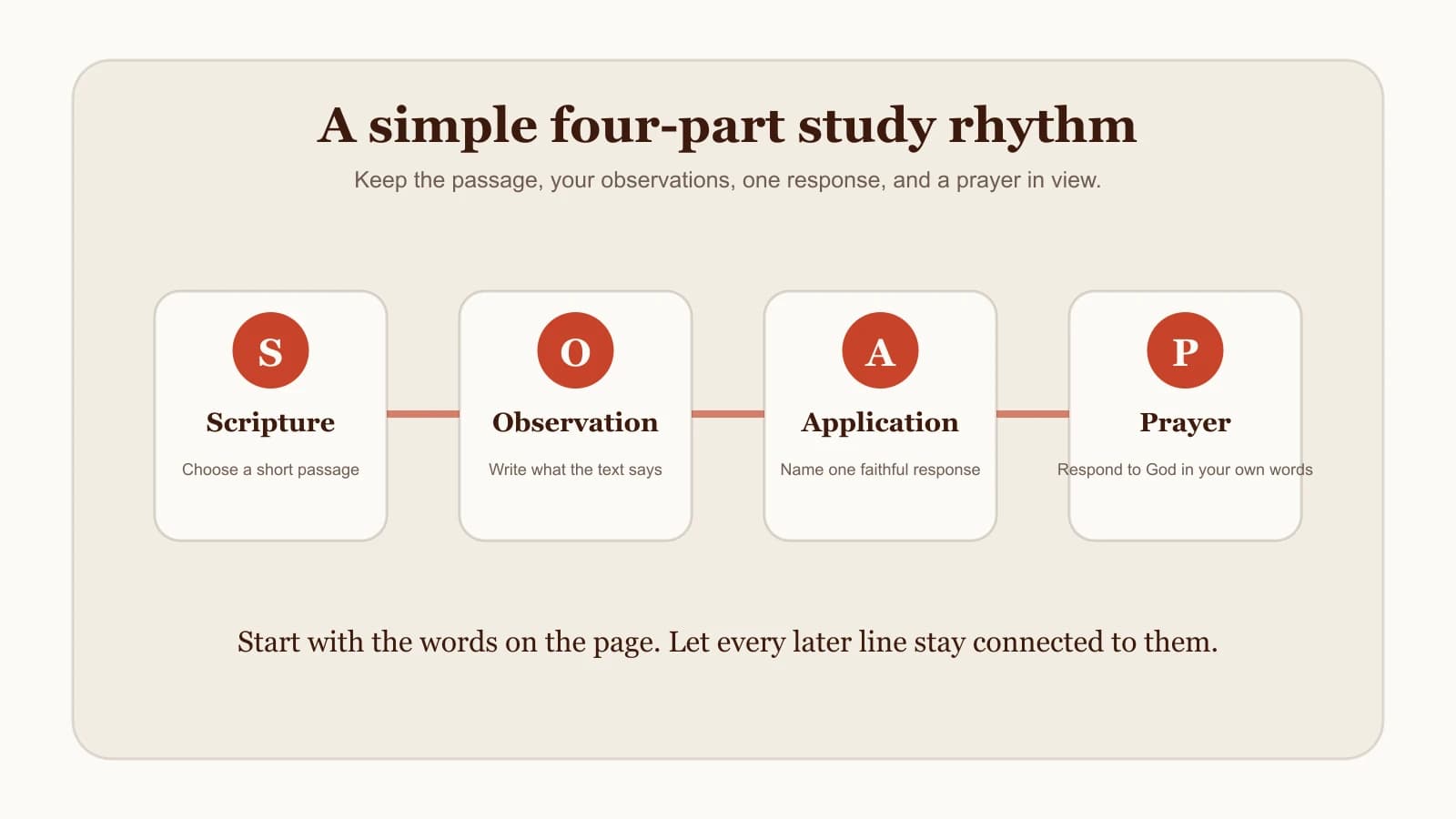
SOAP is a four-part study pattern: Scripture, Observation, Application, and Prayer. The letters give a short Bible reading enough structure to become a useful note. You start with the passage itself, write down what you can point to in the text, choose one response that fits what you have read, and bring that response to God in prayer.
The pattern is intentionally small. A completed SOAP note may contain only a reference, a few observations, one practical response, and a brief prayer. That size makes it easier to return tomorrow without needing a new system each time.
SOAP also gives each kind of note a job. Scripture keeps the reference and translation visible. Observation gathers evidence from the passage. Application names a response for ordinary life. Prayer gives you a way to answer God with the passage still open in front of you.
What You Need Before You Start
Begin with a short, complete unit of thought: a paragraph, a short psalm, or a small scene in a Gospel. A single verse can work, especially when you also read the verses before and after it. The surrounding lines often explain who is speaking, what problem is being addressed, and why a particular phrase matters.
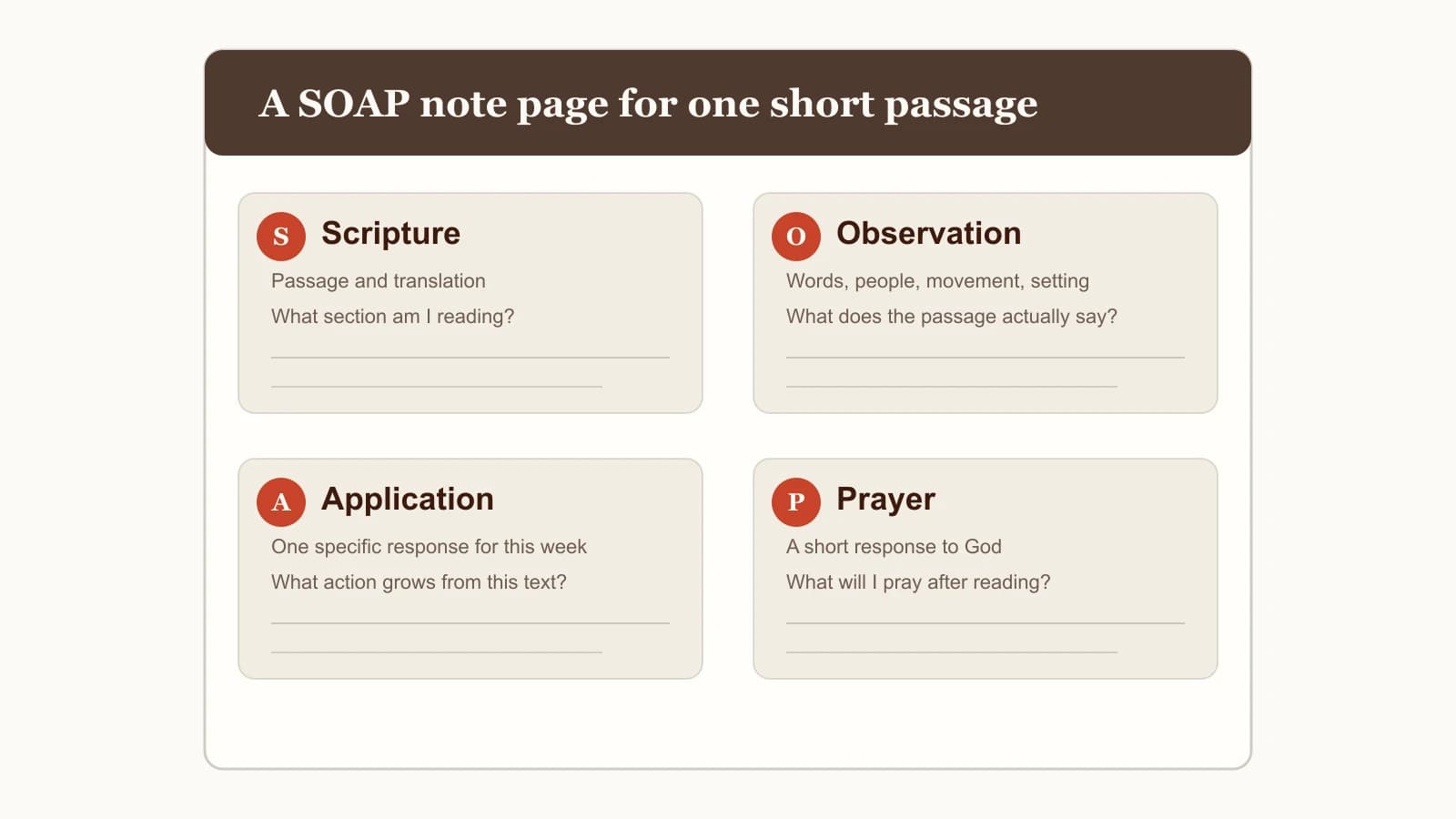
Keep the translation you are reading in the note. That small habit helps when you return later and want to check wording or compare another translation. You also need a page with room for four headings. A simple sermon notes template can give you a starting layout when a blank page feels too open.
Set aside enough time to read the passage twice. On the first read, follow the flow. On the second, keep a pencil or note page ready. Ten quiet minutes can be enough for a short passage when the aim is attention, not volume.
How to Use SOAP in Four Steps
The four steps are easiest to remember when you move through them in order. Keep the Bible open as you write. If a question appears, record it under Observation and return to the surrounding context before settling on a conclusion.
Scripture
Write the book, chapter, verse range, and translation. Choose a short passage that has a beginning and an end. You may copy one central verse into the note, then keep the whole paragraph in view as you study.
Observation
Write details an attentive reader could see in the passage: repeated words, contrasts, commands, people, actions, setting, or a change in the scene. Observation is the place to gather evidence. A question mark belongs here when you need more context.
Application
Name one response that follows from the passage. Make it small enough to recognize during the week: send the apology you have been delaying, set aside time to pray for a neighbor, or reread the same paragraph tomorrow before a difficult conversation. The response should connect to what you observed, not float above the text.
Prayer
Write a short prayer shaped by the passage and your response. You may give thanks, ask for wisdom, confess a needed change, or ask for help carrying out the application. Keep the language honest and specific to the text you just read.
Read the whole short passage once without writing.
Record the reference and translation under Scripture.
Gather two or three details under Observation.
Choose one Application and write a short Prayer that responds to it.
A SOAP Bible Study Example You Can Adapt
Mark 1:35 in the World English Bible reports that Jesus went out to a deserted place to pray while it was still dark. That single verse sits inside a larger scene of teaching, healing, and people searching for him. Read the surrounding passage before writing your note so the verse stays connected to the movement of the chapter.
Here is one modest SOAP entry based on that verse:
Scripture: Mark 1:35 (WEB). I read the surrounding verses and noted that this moment comes after a demanding day of ministry.
Observation: The verse describes Jesus rising early, going out, finding a deserted place, and praying. The action is specific and quiet. The larger scene keeps the verse from becoming a slogan about an ideal morning routine.
Application: Tomorrow, before I begin a busy task, I will spend five minutes reading one short passage and writing one observation before I check messages.
Prayer: God, help me begin this task with attention to your Word. Give me patience to read carefully and faithfulness in the response I write.
This example offers one way to work with the passage. It does not set a universal timetable or turn one verse into a rule for every reader. If you are preparing to bring the same observations into a group, these small-group Bible study questions can help you turn them into open questions that invite others back to the text.
Common SOAP Bible Study Mistakes
A SOAP page becomes more useful when each section remains in its lane. Start with the whole paragraph before isolating a phrase. The verses around a line often carry the speaker, audience, purpose, and sequence that guide an accurate observation.
Give Observation room to breathe. A first thought may become a helpful question, yet it still needs testing against the passage. Write the detail first: a repeated word, a command, a change in speaker, or the order of events. Then use study resources, trusted teachers, or a group discussion when the meaning needs more work.
Keep Application concrete. “Be better this week” rarely tells you what to do on Tuesday afternoon. A specific response has a place, a person, a time, or a small action connected to the passage. You can revise an application after further study; a note is a place to return, not a private authority over Scripture.
Before you close the page, ask:
Did I read the surrounding verses and name the translation?
Can I point to the words or actions behind each observation?
Does my application fit the passage and name one practical response?
Does my prayer answer what I have read with humility?
Use Bible Note to Keep a SOAP Study Together
When a SOAP study begins with a sermon, Bible Note is a useful place to keep that work together. Its sermon-notes workflow captures a sermon and organizes Scripture references, key points, applications, and a prayer, giving you a clear starting point for revisiting one passage during the week.
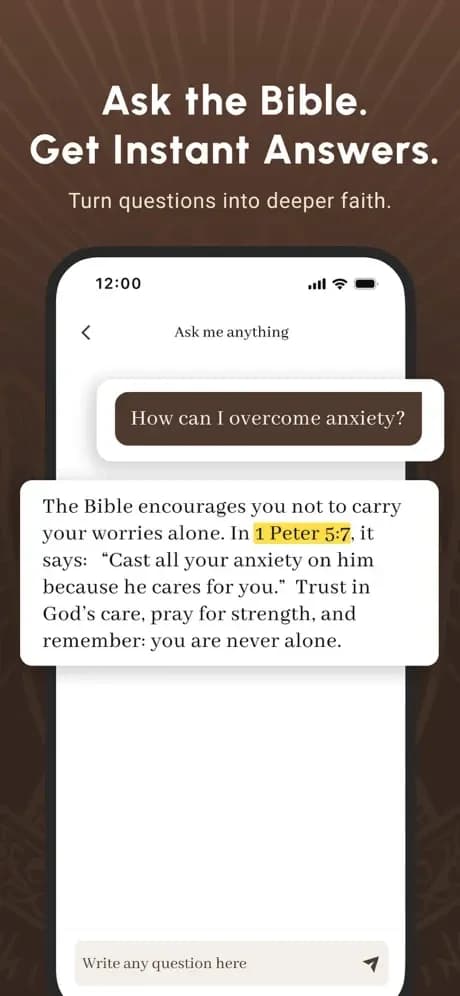
Some questions need another careful pass through the text. Bible Study Chat begins with the passage or note context, shows Scripture references with their translation, and marks interpretation as interpretation. Read the cited verses in context and use the answer as a study aid while you continue testing your observations.
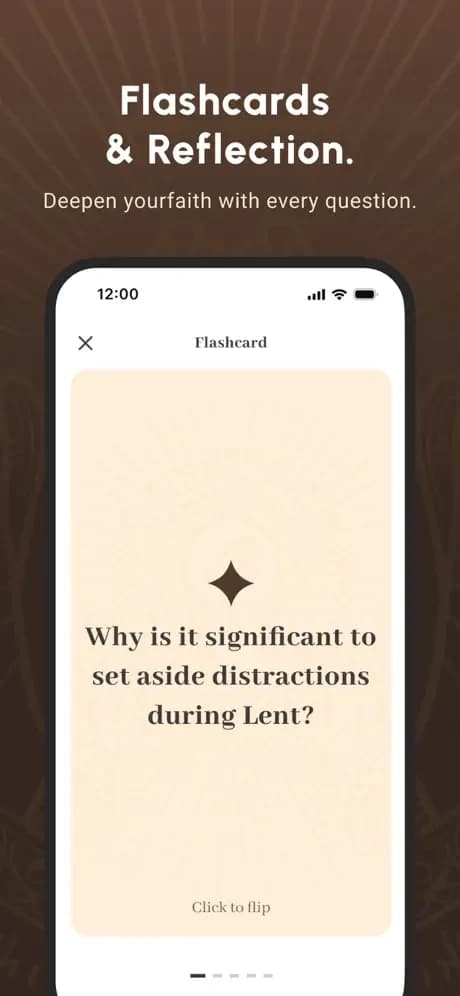
For later review, Bible Note can create flashcards from a sermon note. A card can bring a key question or Scripture reference back into view after the initial study session. Your SOAP entry still stays rooted in the passage you read and the response you wrote.
Frequently Asked Questions
How long does a SOAP Bible study take?
A short passage can fit into ten to fifteen focused minutes. Give yourself longer when the context or a question calls for more careful study.
Can I use SOAP with a whole chapter?
Yes. Read the chapter first, then choose one paragraph or scene for the written SOAP entry. A smaller unit helps you keep the observations specific.
How long should the Observation section be?
Two or three clear details are enough for many studies. Add more when the passage has a clear pattern, repeated language, or a question you want to investigate.
Does SOAP work in a group?
Yes. Each person can make a brief note, then share observations before the group discusses possible interpretations and applications.
Can I keep SOAP notes digitally?
Yes. A digital note works well when it keeps the passage reference, observations, response, and prayer easy to find when you return to the study.
Sources
Editorial status
Written and edited by Hans Keller for Bible Note. Sources, Scripture context, dates, and practical limitations are checked before publication.

About the author
Hans Keller
Editorial & Content Lead
Bible Study & Sermon Learning Content Editor
Hans helps Christians turn sermons and Scripture study into clear notes, thoughtful questions, and faithful next steps.
His work helps listeners and group leaders carry a sermon or study beyond the meeting: back to the passage, into clearer questions, and toward one practical response for the week.
Read with Scripture open
Use this guide alongside the full biblical passage and the practices of your local church. Interpretive details can differ across Christian traditions.
See more Bible Note on Google
Add Bible Note as a preferred source to help find our Bible study guides more easily in Google Search.