Learning how to take sermon notes is simpler than it looks. You need one page with room for the passage, the big idea, the key points, one honest application, and a short prayer. If you can capture those five things while staying engaged with the message, you already have a sermon note worth keeping.
This guide walks through a complete rhythm: a little preparation before the service, a five-part page you can keep up with while you listen, and a short review habit afterward. It works with a paper notebook, a tablet, or a phone, and by the end you will have a repeatable way to take notes during a sermon without missing what is being said.
What to prepare before you start
Good sermon note taking begins before the first song. A few small decisions beforehand remove most of the friction that makes people quit by the second point.
First, find out which passage will be preached if you can; many churches publish the sermon text in a bulletin, a weekly email, or a church app. Reading it once before the service gives you a map of the terrain, so the preacher's movements feel familiar.
Second, choose your tool and set it up in advance. A notebook and a smooth pen are enough. If you prefer a phone or tablet, silence notifications and open your note page before the sermon starts.
Finally, put a small header at the top of the page before anything is said: the date, the preacher's name, the sermon title if you know it, and the passage reference. Arrive a few minutes early and offer a brief prayer for a listening heart.
A five-part sermon notes page
The method at the center of this guide fits on a single page divided into five fields: passage, big idea, key points, application, and prayer.
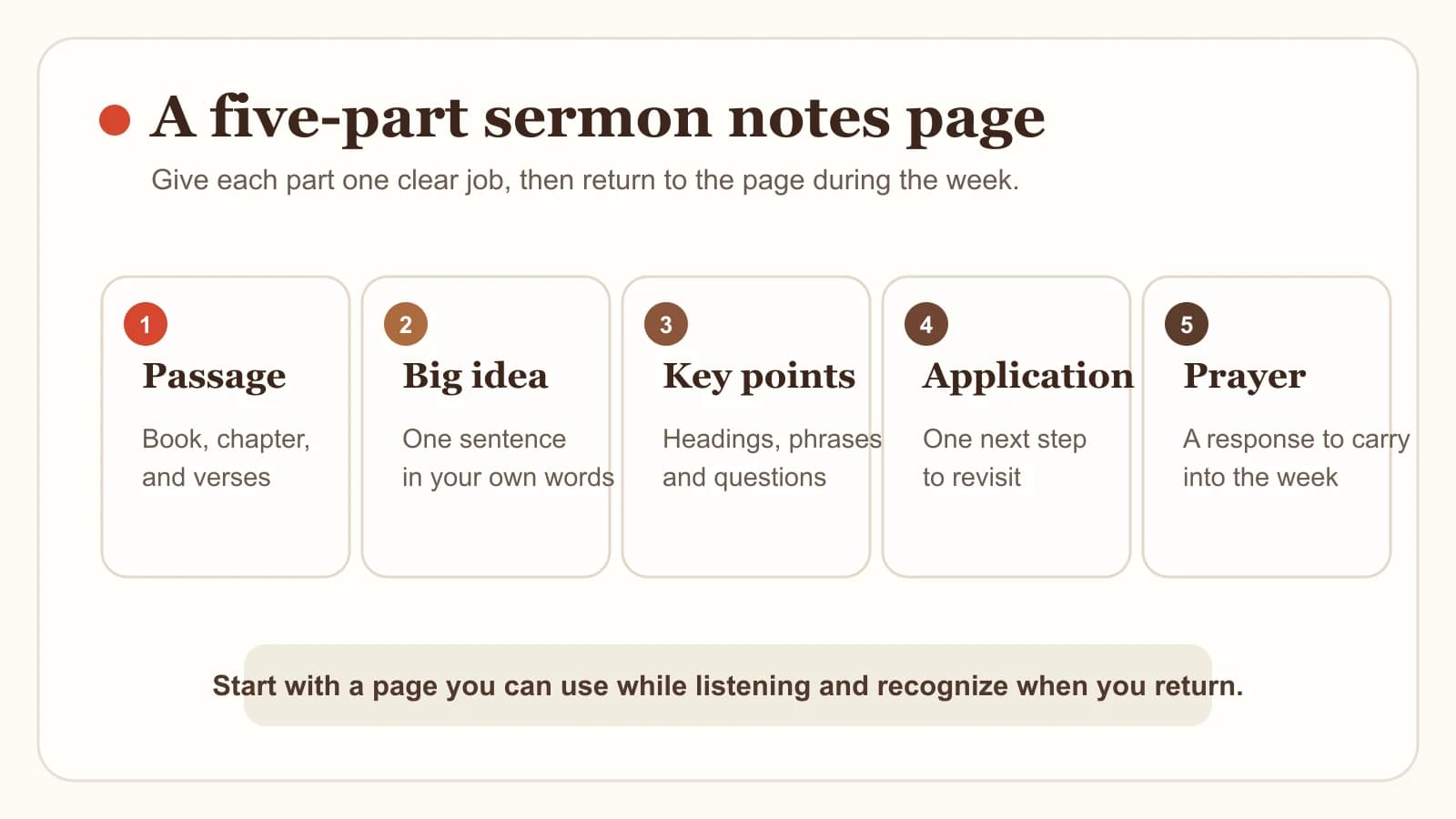
Passage
Write the main Scripture reference at the top before you record any details. When the preacher turns to a supporting passage, jot that reference in the margin. Weeks later, these references are the hooks that let you reopen the text and rebuild the message from the Bible itself.
Big idea
Leave a line or two for the sermon's big idea: one sentence, in your own words, that names what the message is about and what it asks of you. You often will not know it until the middle of the sermon, so leave the space open and come back to it when the preacher lands the plane.
Key points
Under the big idea, record the two to four key points that carry the message. Keep them as short phrases you can scan at a glance, with a reference or a striking image beside each one. The goal is a skeleton you can re-flesh from memory.
Application
Reserve a field for one concrete response: something to do, stop, start, or pray about this week. One honest sentence is enough.
Prayer
Close the page with two or three lines that turn the message into prayer. Thank God for what the passage shows, confess what it confronts, and ask for help with the application you wrote.
If you want a ready-to-use layout, the sermon notes template follows this same five-part shape and can save you the setup work.
During the sermon: listen for the message's shape
The hardest part of sermon note taking is writing while listening. The way through is to listen for the shape of the message and let that shape decide what earns a place on your page.
Write the passage reference first, before any details.
Track the message's main movement and give each key point its own line.
Mark every question in the margin for later, and keep listening.
Write the passage before the details
When the text is read, write the reference before anything else. Anchoring the note in the text keeps every later detail attached to something you can verify and revisit.
Follow the preacher's movements
Preachers signal their structure. Listen for words like first, second, and finally; for a phrase that keeps returning; for the moment the pace slows and the voice drops. Those signals usually mark a key point, so give each one its own line with a little space underneath.
Capture questions without answering them yet
Questions will rise while you listen: a confusing verse, a claim you want to check, an application you are unsure about. Write each one in the margin with a question mark and keep listening. Answering them is Wednesday's work. The question mark protects your attention; the page holds the thought for later.
After the sermon: turn notes into a next step
A sermon note does its best work after the service ends. The rhythm below keeps the page alive through the week: prepare before, capture during, revisit after.
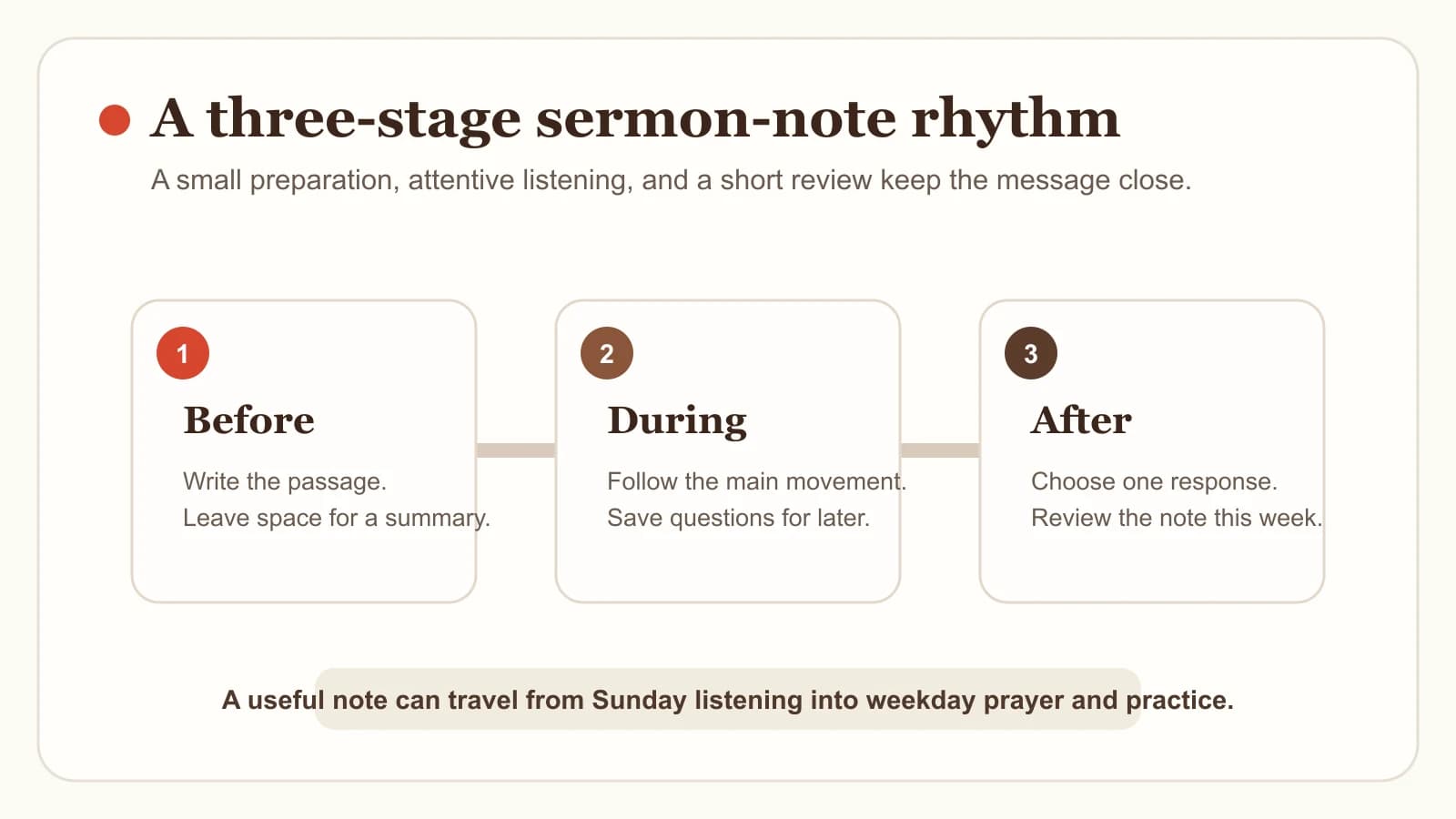
Within a day or so, sit down with the page for ten minutes: fill in the big idea, tidy any cryptic phrases, and mark the one application you will attempt. Then reopen the passage itself and read it with your notes beside it. That pairing of text and note is where the sermon settles into memory.
Later in the week, bring one observation and one question from your notes into conversation. If you meet with a group, a set of small-group Bible study questions is a natural next step for turning a Sunday message into a shared discussion.
Choose a note-taking method that fits the message
The five-part page is one faithful option among several, and different messages reward different layouts.
The outline method
The outline method nests the preacher's points under one another with indentations. It suits expository sermons that move verse by verse through a passage, because the structure of the message mirrors the structure of the text.
The Cornell method
The Cornell method divides the page into a main note area, a narrow cue column on the left, and a summary space at the bottom. Cornell's Learning Strategies Center describes it as a system worth adapting to your situation, and it adapts well to sermons: take running notes on the right, add cues and questions in the margin during your midweek review, and finish with a one-sentence summary at the bottom.
The SOAP method
SOAP stands for Scripture, Observation, Application, and Prayer. It works well as a follow-up layout: copy the key verse or reference, write what you observe in the text, name one application, and close with prayer. Many people take outline-style notes on Sunday and rewrite the heart of the message as a SOAP entry on Monday.
No single layout wins for every listener or every church. Try each for a few weeks, keep the one that helps you return to the passage, and feel free to blend them.
Recording, permission, and accuracy boundaries
Some listeners prefer to record a sermon and work from a transcript afterward. That can be a genuine help, provided you handle two boundaries with care.
The first boundary is permission. Before you record a live sermon or reuse a recording, ask the church, the pastor, or the media team. Many churches record their own services and will gladly share the audio; others have good reasons to limit recording. Treat this as a practical courtesy, and let your church's leadership answer any legal questions for your setting.
The second boundary is accuracy. Automated tools, including sermon transcription workflows, can save hours of typing, and guides to the best sermon transcription apps can help you compare options when you already have a recording. Whatever tool you use, compare the transcript against the original audio and the Scripture references. A transcript is a draft of what was said, and the original message remains the authority.
Use Bible Note to keep the sermon reviewable
Everything in this guide works with plain paper: a notebook, five fields, and a ten-minute midweek review will carry you far, and the habit is yours to build either way.
If you would like help keeping sermon notes organized and easy to revisit, Bible Note is built for this workflow. It can record a live sermon or import supported sermon links; organize recognized Scripture references, key points, applications, and prayer into a structured note; and create flashcards, a devotional plan, and discussion questions from that note.
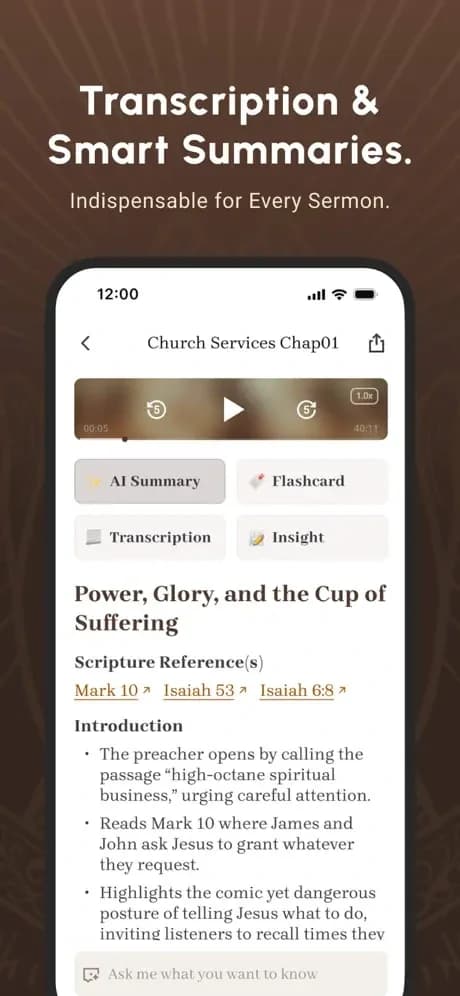
Your structured note keeps the passage and the big idea beside the key points, so a Wednesday review takes only a few quiet minutes.

The flashcards and devotional plan give the review a gentle shape: a question from the sermon, a reference to reopen, a prayer to continue. The sermon stays a sermon, preached by your pastor and anchored in Scripture; the tool simply keeps it within reach while the week does its work.
Frequently asked questions
How much should I write down during a sermon?
Aim for one page. Capture the passage, the big idea, two to four key points, one application, and a short prayer. A brief note you will reread beats a long one you will not.
Is paper or digital better for sermon notes?
Both work well. Paper keeps distractions low; a phone or tablet makes searching and reviewing easier. Choose the tool that helps you stay attentive and return to the note later.
What should I do if I miss a key point?
Leave a gap, mark it with a dash or question mark, and keep listening. You can fill the gap afterward from the passage, from a recording your church provides, or by asking a friend who heard the same sermon.
Do I need permission to record a sermon?
Yes, ask first. Check with your church, pastor, or media team before recording a live sermon or reusing a recording, and follow their guidance for your setting.
How do I review sermon notes during the week?
Take ten minutes within a day to tidy the note and finish the big idea, then reopen the passage midweek with the note beside it. Turning one point into a conversation, a prayer, or a small action completes the loop.
Sources
Editorial status
Written and edited by Hans Keller for Bible Note. Sources, Scripture context, dates, and practical limitations are checked before publication.

About the author
Hans Keller
Editorial & Content Lead
Bible Study & Sermon Learning Content Editor
Hans helps Christians turn sermons and Scripture study into clear notes, thoughtful questions, and faithful next steps.
His work helps listeners and group leaders carry a sermon or study beyond the meeting: back to the passage, into clearer questions, and toward one practical response for the week.
Read with Scripture open
Use this guide alongside the full biblical passage and the practices of your local church. Interpretive details can differ across Christian traditions.
See more Bible Note on Google
Add Bible Note as a preferred source to help find our Bible study guides more easily in Google Search.