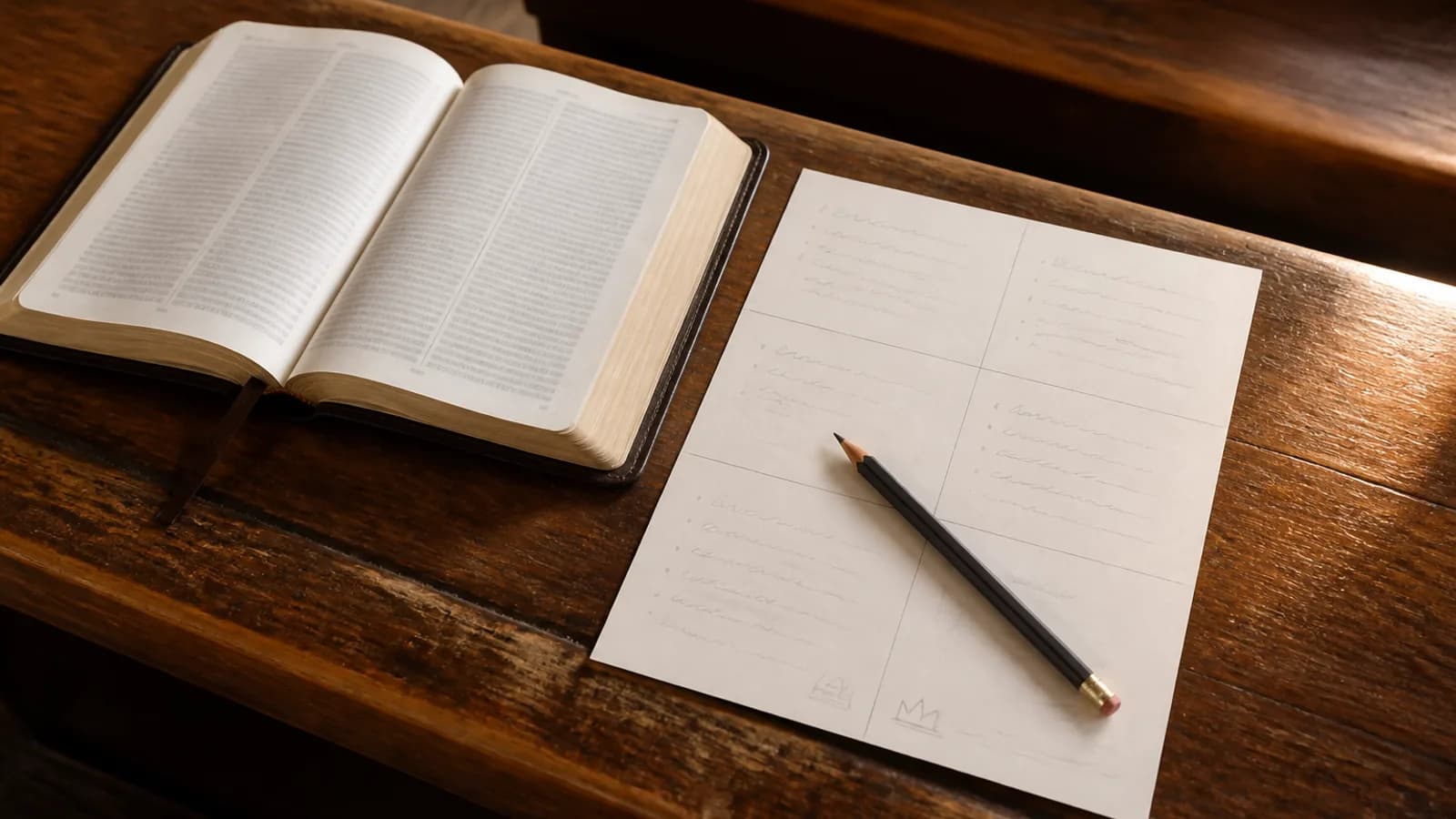
Here is how to turn a sermon into small group discussion questions without making the sermon’s outline the final authority. You listened to the sermon on Sunday, and now your small group meets on Wednesday. The pastor did the preaching; your job is different. You need a handful of questions that send people back into the biblical passage, let them draw out its meaning together, and leave room for an honest response.
This guide gives you a repeatable workflow for exactly that. You will start with the passage the sermon preached, state the sermon’s big idea in one sentence, write observation, interpretation, and application questions in that order, and arrange everything into a 60-minute discussion guide. No sermon is invented here and no verse is quoted for you; the stems below are templates you fill from your own passage and your own notes.
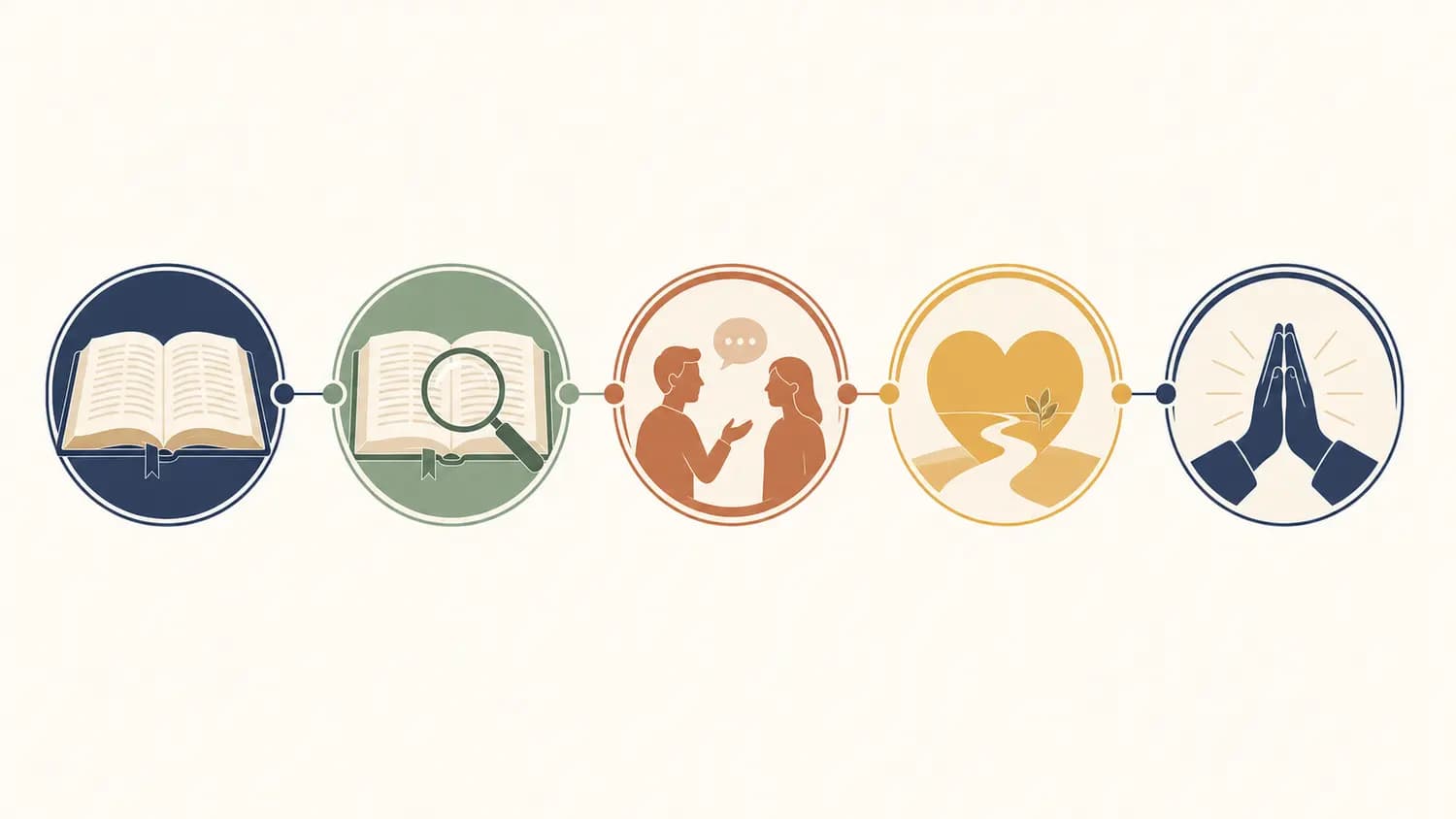
The workflow in one minute
Here is the whole method before we slow down into each step:
Reopen the passage the sermon preached and read it fresh before rereading your notes.
Write the sermon’s big idea in one sentence, plus the two or three movements that carried it.
Draft two or three observation questions that can be answered by looking at the text.
Draft one or two interpretation questions that ask what the passage means, with a clear line between the text and opinion.
Draft one or two application questions the group can answer honestly without forced disclosure.
Arrange the questions into a timed 60-minute guide with an opening, a middle, and a next step.
Six questions are usually enough. A short list that people actually discuss beats a long list that only gets read aloud.
Start with the passage, not the transcript alone
A sermon is a guide to a biblical text; it is not the text itself. If your discussion questions only ask people to recall what the preacher said, the group ends up reviewing a talk instead of studying Scripture together. The fix is simple: make the passage the shared point of return.
Before you write a single question, open the passage and read it slowly, once on its own and once with your sermon notes beside it. Mark anything the sermon passed over quickly: a repeated word, a surprising command, or a verse that raised questions the message never answered. Those marks often become your best discussion material, because they belong to the text, not to the preacher’s outline.
This also protects your group when you disagree with a sermon point. You do not have to litigate the pastor’s choices. You can simply ask what the passage itself says.
Find the sermon’s big idea and movement
A forty-minute sermon cannot become forty questions. Your next task is to compress the message without flattening it.
Start with the big idea: one sentence, in your own words, naming what the sermon said about the passage and what it asked of hearers. If you took notes on Sunday, the big idea may already be on your page. If you want to sharpen that habit, our guide on how to take sermon notes walks through a simple page layout that captures the passage, big idea, key points, and application while you listen.
Then name the sermon’s movement. Most sermons travel: from a problem in the text, to what the text says about it, to what that means now. Write each movement as a short phrase. These movements become the spine of your discussion, because each one usually deserves a question of its own.
Keep the big idea at the top of your guide. When the conversation wanders, that one sentence is what you return to.
Write observation questions first
Observation questions teach the group to look closely at the passage before anyone explains it. They are the easiest questions to write and the easiest to skip, which is why they come first.
What good observation questions look like
A good observation question can be answered by pointing at the text. It asks what is there, not what it means: who is speaking, what actually happens, which words repeat, and what contrasts or connections sit in the paragraph. Good stems include:
“What does the passage actually say about [the topic the sermon addressed]?”
“Which words or phrases repeat in this section, and where do they appear?”
“What surprises you in verses [your passage range] when you read them slowly?”
None of these require the sermon at all. A group member who missed Sunday can still answer every one, which keeps the evening open to everyone in the room.

How many to write and how to choose
Draft four or five observation questions, then keep the two or three that best serve the sermon’s big idea. If the sermon lingered on one verse, choose questions that make the group stare at that verse. If you want a broader framework for question writing beyond this sermon workflow, our collection of small-group Bible study questions covers the general craft in more depth.
Add interpretation questions with a clear boundary
Interpretation questions ask what the passage means. They are where a discussion either deepens or dissolves into pooling opinions, so they need a boundary the group can feel.
The boundary that keeps interpretation honest
The boundary is this: the passage says something, and we say things about the passage, and those are not the same authority. A good interpretation question pushes the group to support its answers from the text and its context. Stems that hold this line include:
“What did this mean for the people who first heard or read it?”
“How does this verse connect to the paragraph before and after it?”
“Where in the text do you see that? Help us find it.”
That last question is the facilitator’s best friend. It welcomes every voice while quietly refusing to treat a hunch as the meaning of Scripture.
How the sermon helps without taking over
The sermon can be a conversation partner here. You can ask, “The preacher said this verse means X. Where do you see that in the text?” This uses the sermon as a prompt to investigate rather than a verdict. Write one or two interpretation questions; more than that and the evening becomes a lecture review.
End with application questions the group can answer honestly
Application questions invite a response to the text. They fail in two predictable ways: forcing people to disclose more than they want to share, or prescribing one correct response everyone is expected to copy.
Invitations instead of interrogations
Phrase application as an invitation with room to answer at different depths. Stems that work well:
“Where does this passage confront or comfort you in the week ahead?”
“What would change in [an ordinary area of life] if we took this seriously?”
“What is one small, concrete step this text suggests for you?”
Each question can be answered personally or generally, and “I am still thinking about that” is a complete answer. Silence is allowed. The passage makes the claim; you do not have to extract a confession.
One shared next step
Close the application stage by moving from individual response to one shared step: something the group will pray about, practice, or revisit together next week. This keeps application from evaporating into good intentions, and it gives your next meeting a natural opening question.
Build a 60-minute discussion guide
Now arrange your questions into a plan for the actual evening. A simple 60-minute shape:
Opening (5 minutes): welcome, read the passage aloud, and state the sermon’s big idea in your one sentence.
Observation (15 minutes): two or three questions, with people pointing at verses as they answer.
Interpretation (20 minutes): one or two questions, slowing down wherever the group disagrees about the text.
Application (15 minutes): one or two questions, answered at whatever depth each person chooses.
Next step and prayer (5 minutes): the shared step, then pray through what the passage said.
Write the timings in the margin and hold them loosely. If observation is crackling with energy, steal five minutes from interpretation rather than cutting people off mid-sentence. The schedule serves the discussion, not the reverse.
Where Bible Note fits
Everything above works with a Bible and a pen. But the preparation hours are real: relistening to a sermon, finding the moment a point was made, and reconstructing a half-remembered illustration.
Bible Note’s Sermon Notes experience can help you collect structured sermon notes, recognize Scripture references, and create a draft of small-group questions. Treat that draft as preparation material, not a finished guide to read aloud. You still reopen the passage, check every question against the text, and cut anything that does not serve your group.
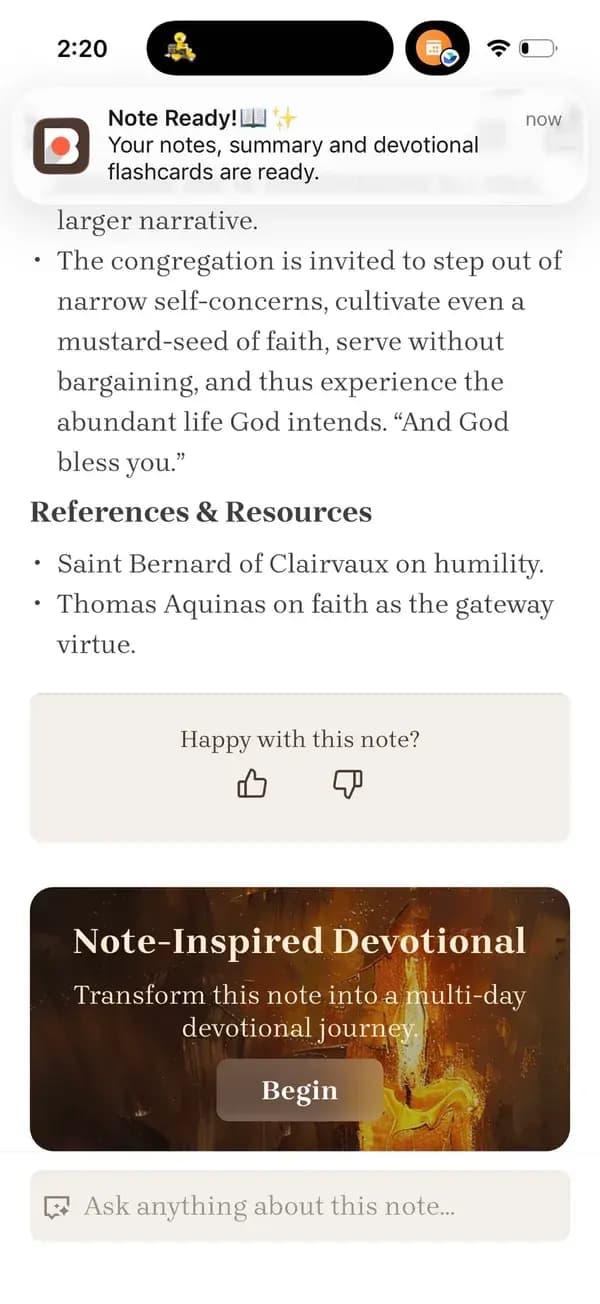
The boundary stays where this article put it. A tool can help organize notes and produce a draft question set; it cannot decide what the passage means for your group, and it does not replace reading the text together on the night.
Frequently asked questions
How many discussion questions should I prepare from one sermon?
Four to six is usually right for a 60-minute meeting: two or three observation questions, one or two interpretation questions, and one or two application questions. Prepare one extra in case the evening moves quickly.
What if group members did not hear the sermon?
Build your questions on the passage rather than the outline. Observation questions about the text work for everyone, and you can summarize the sermon’s big idea in one sentence at the start so nobody is left behind.
What should I do if I disagreed with part of the sermon?
Let the passage arbitrate. Ask the group what the text itself says about the point in question, and where they see it. You can note the disagreement honestly without turning the evening into a critique of the pastor.
How do I keep one person from dominating the discussion?
Aim specific observation questions at the quieter members by inviting anyone to point to a verse, and thank long answers before redirecting: “Let us hear how someone else sees that in the text.” Directing attention to the passage can help rebalance the room.
Can I reuse the same sermon for a second week of discussion?
Yes, if the passage is rich enough to sustain it. Revisit the text with fresh observation questions and spend the second week mostly on interpretation and application rather than repeating the first guide.
Sources
Editorial status
Written and edited by Hans Keller for Bible Note. Sources, Scripture context, dates, and practical limitations are checked before publication.

About the author
Hans Keller
Editorial & Content Lead
Bible Study & Sermon Learning Content Editor
Hans helps Christians turn sermons and Scripture study into clear notes, thoughtful questions, and faithful next steps.
His work helps listeners and group leaders carry a sermon or study beyond the meeting: back to the passage, into clearer questions, and toward one practical response for the week.
Read with Scripture open
Use this guide alongside the full biblical passage and the practices of your local church. Interpretive details can differ across Christian traditions.
See more Bible Note on Google
Add Bible Note as a preferred source to help find our Bible study guides more easily in Google Search.